
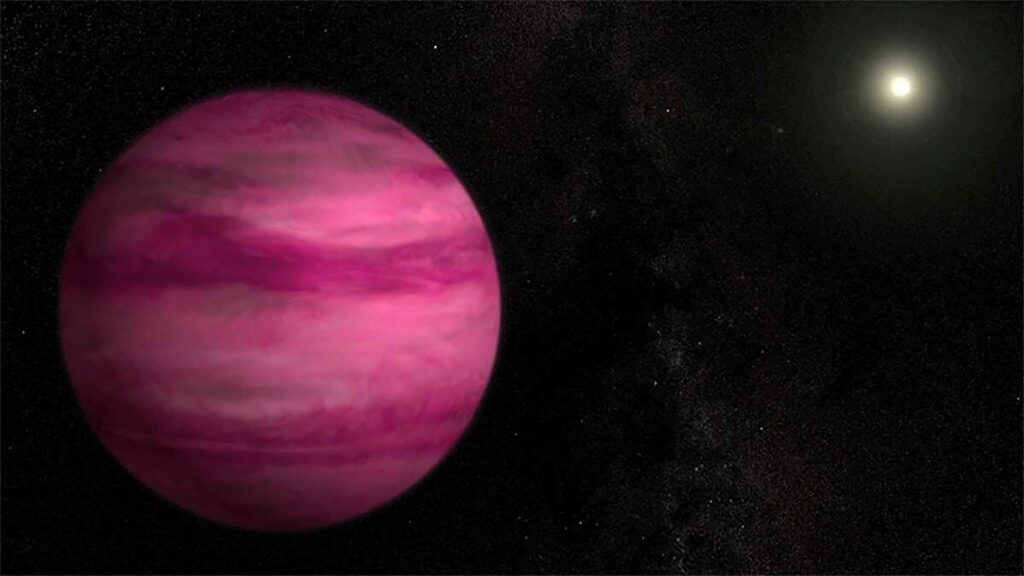

Astronomers have finally cracked one of the mysteries of the famous GJ504b Pink Planet, discovering that its signature rosy haze is shrouded in bizarre, swirling clouds of salt.
Located 57 light-years from Earth, GJ504b has captivated scientists since its discovery in 2013. Despite its enchanting appearance, ground-based telescopes have so far failed to see through its faint, distant light, leaving experts guessing about its true nature. However, NASA’s James Webb Space Telescope (JWST) has unlocked the planet’s environment rich in exotic chemistry and surrounded by salty skies.
The investigation, led by a team at Northwestern University, marked the first time astronomers have obtained direct spectroscopy of the planet’s atmosphere. At roughly 25 times the mass of Jupiter, GJ504b straddles the grey area between a massive gas giant and a dim brown dwarf, leading astronomers to classify it broadly as a planetary-mass companion. Unlike most directly imaged exoplanets, which sizzle at blistering temperatures between 1,000 and 2,000° Fahrenheit, this pink world is remarkably cold. It registers a comparatively chilly 550° F, or roughly the temperature of a standard bread-baking oven.
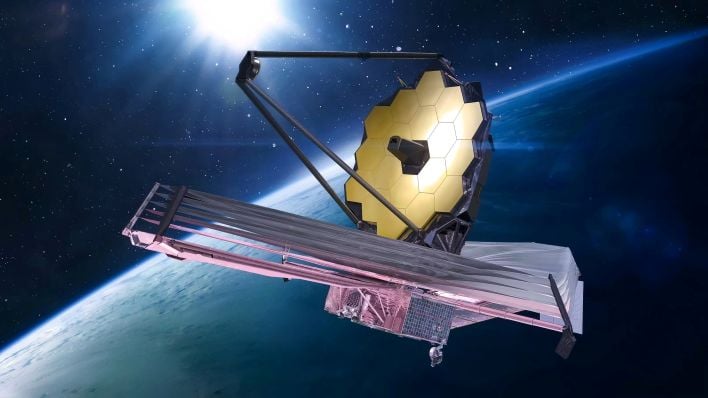
This low temperature, caused by the planet aging and cooling over 2.5 to 4 billion years (according to estimates), made it nearly impossible to capture from Earth. Where ground-based telescopes failed after countless nights of observation, it only took Webb two hours to obtain its first images. By filtering out the glare of the planet’s sun-like host star, the telescope isolated GJ504b’s faint light, breaking it down into a spectrum that we could begin deciphering.
The resulting data initially presented a puzzle, showing a heavy mix of water vapor, methane, carbon dioxide, and ammonia. When researchers fed these elements into advanced astrophysical simulation models, the equations yielded physically impossible atmospheric behaviors. The breakthrough came when the team added clouds to their simulations to see how they might block or scatter the light. After testing various configurations, they discovered that clouds composed of vaporized salt particles perfectly matched the telescope’s readings, smoothing out the signatures of deeper chemical layers.
Even as the salt cloud riddle is solved, scientists still want to figure out whether GJ504b originally formed like a standard planet from a disk of cosmic dust or collapsed directly from a gas cloud like a miniature star.
Main image: “Pink Planet,” or GJ504b (Credit: NASA/Goddard Space Flight Center)