
Science & Exploration
19/06/2026
1 views
0 likes
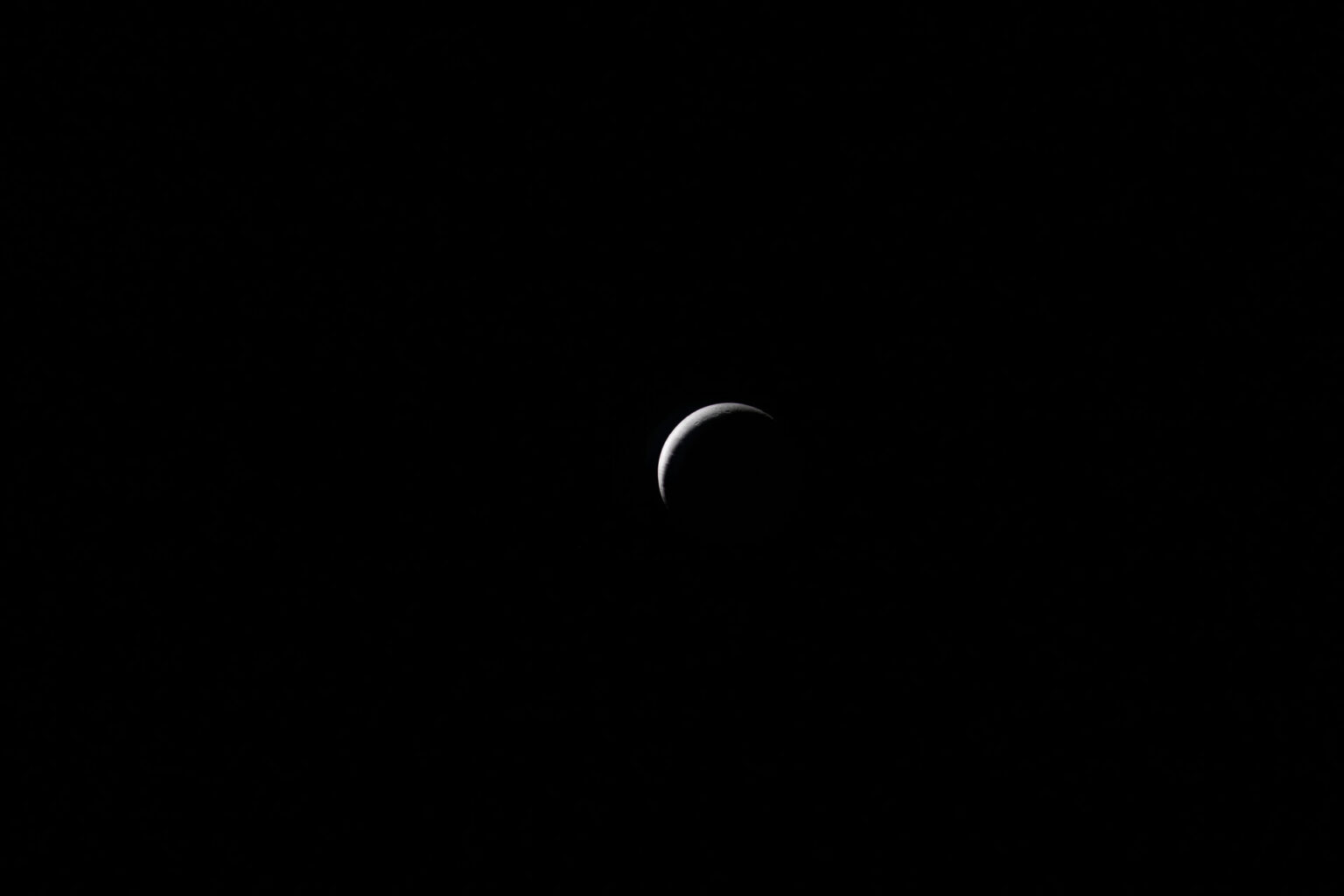
This image is part of a series captured by ESA astronaut Sophie Adenot for the European Earthshine experiment, which investigates whether we can measure how much sunlight Earth reflects by using the Moon as a natural projection screen.
In climate research, scientists seek to better understand Earth’s reflectivity, known as its albedo. This parameter is key to improving climate models and to estimating Earth’s energy balance – the delicate equilibrium between the energy our planet receives from the Sun and the energy it sends back to space. This reflected energy depends on clouds, ice and surface properties, and even small changes in this balance can have significant effects on our climate.
The principle of Earthshine is that sunlight backscattered by Earth softly illuminates the dark side of the Moon shortly after the new Moon. By observing this faint glow, scientists can estimate how much light our planet reflects.
This approach was pioneered during the first half of the 20th century by French astronomers André-Louis Danjon and Jean Dubois, who used ingenious optical methods to measure Earth’s global light signature. They observed that our planet reflects about 30% of the sunlight it receives, and that this reflectivity varies from day to day, largely due to cloud cover.
Since the beginning of her mission, Sophie has collected data over three lunar cycles, contributing to a dataset built up by astronauts since 2023.
“The observation window is very short, either at moonrise or moonset, and the Moon has to be visible above the thin atmospheric layer. Getting the exposure right with the camera is also quite tricky: the bright crescent illuminated by the Sun must not be overexposed, while the rest of the lunar disc, softly lit by earthshine, needs to remain visible.…” explains Sophie.
But the experiment is evolving: in the coming months, astronauts will also image stars, which will serve as a calibration standard for Earthshine observations. Because stars have well-known colours, combining star images with Moon observations will allow scientists to retrieve calibrated colour information, and better estimate the true colour of Earth, our pale blue dot.
“Danjon and Dubois lacked modern technology – and especially access to a space station – so their data remain limited. But imagine if it weren’t: we could compare Earth’s colour over a century as a climate signal. It’s a sobering though, but given today’s rapid climate change, we may not need to wait that long to see differences in what Sophie and other astronauts are now measuring,” says Peter Thejll, senior scientist at the Danish Meteorological Institute (DMI).
Earthshine is led by scientists from the Danish Meteorological Institute (DMI), the Department of Space at the Technical University of Denmark (DTU Space), and the Institute of Space Systems (IRS) at the University of Stuttgart, Germany.
Images are taken using a Nikon Z 9 camera with a 400 mm fixed lens.
Like