
When NASA sent the Artemis II space launch system into orbit in early April, a 25-year-old software package underpinned many of its systems.
But this isn’t some legacy application that the space agency hadn’t updated over the last two-plus decades. Rather, Artemis II relied on the core Flight System to run everything from telescopes and avionics to command and control instruments because software engineers have been continuously updating cFS since the early 2000s.
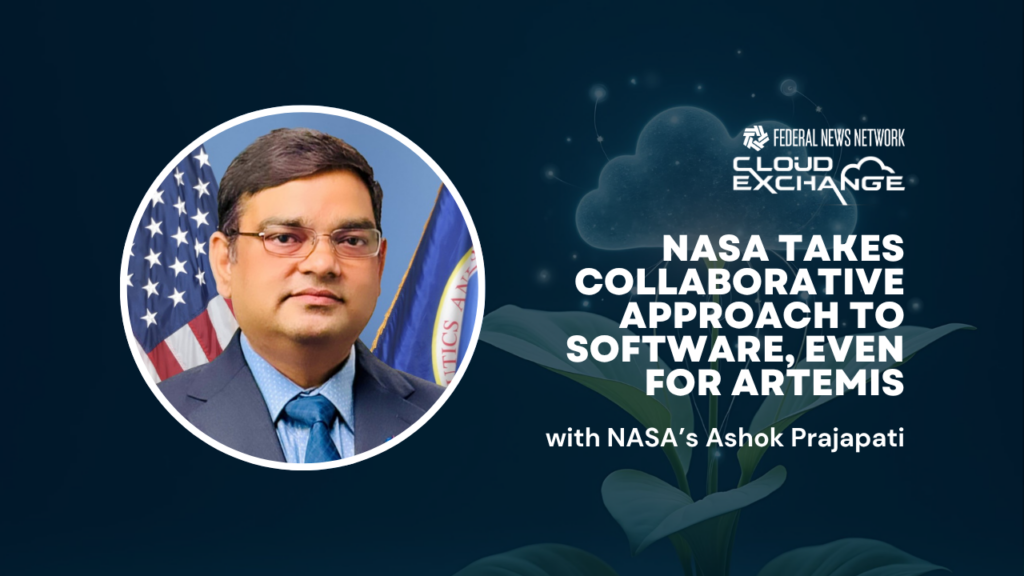
NASA built and maintains cFS through an open source platform and relies on the broader space community to keep the architecture, tools and core components modernized, said Ashok Prajapati, core Flight Systems program manager and chairman of the NASA cFS Steering Committee.
“This is a very versatile package. It basically grew into a layered modular architecture where there’s a common piece, there’s a different common interfaces, and there’s a mission specific piece,” he explained during Federal News Network’s Cloud Exchange 2026.
“Everything below the mission-specific piece became very common, and cFS became basically one of the highly used flight software frameworks. It went on many, many missions. This is NASA’s go-to framework whether it’s Artemis or it’s Mars Sample Return missions. And many sciences, like telescopes such as the Roman Space Telescope, are powered by cFS.”
To infinity and beyond NASA
And it’s not just the space agency that relies on cFS. Private sector companies also take advantage of the open source framework as a starting point when building components for their rockets and spaceships.
Prajapati said cFS’ interoperability across different platforms and proven value has led NASA to use the software framework on more than 100 missions over the last two decades.
“This is fully reusable, very modular and — since this is community-based — open source. A lot of the community folks are contributing back to us. So, if they find anything they want to contribute to some new feature, they contribute it and that becomes mainstream cFS and reusable for anybody else,” he said.
“Certain pieces, like the main core engine are open source. Certain applications are open source, for example, the Platform Support Package. If anybody wants to add a new operating system or new avionics, they can. The whole idea was to share the minimum portion that is not very specific or proprietary, so that [collaborative development] can get started in the community more easily.”
Cloud eases NASA updates
The idea behind cFS is that NASA, other government agencies and private sector organizations can all start from the same baseline when developing applications. Then, Prajapati said, community members can add “their secret sauce” to their pieces to meet their specific mission requirements. cFS isn’t flight ready, he added.
“This is very much reusable for various segments. It can be used for instruments. It can be used to control the hardware. It’s a basically the brain behind all the operations. We call it the Command and Telemetry Framework, so you can command the spacecraft using cFS,” he said. “The two pieces to it, ground and flight. So cFS goes on flight, and there’s a counterpart on the ground side — various software packages that allow you to command and receive telemetry and do whatever you want to do with that.”
Over the last several years, modernizing applications built on cFS has become easier because of cloud services.
Prajapati said when NASA, or one of its partners, writes new code, it gets put into the development pipeline, tested and added to the baseline.
“We use our on-premise cloud for our continuous integration, continuous delivery pipeline. We use the cloud for software development to collaborate across the agency and with partners, other customers beyond the agency. It’s the same way we use distributed teams and some of our team members working with others to make submission happen, and we utilize cloud to exchange the data,” he said.
“If you are working on certain features or a certain mission-specific piece of it, then [typically] you have to set up a full infrastructure locally. That is going to take a long time, and time is money. Through cloud services, we basically have all the test infrastructure already laid out for people. Your job is to write your piece and push it forward. It’s going to run through all the steps, even if it takes overnight, but next morning you have all the results, and you go look at it, scan it and fix it. This is a manifold time savings, and obviously that impacts mission cost.”
At the same time, the versatility of cFS means NASA also can use the framework for hardware, like avionics. He said that’s done in a lab and tested in real-world exercises.
To continue to keep cFS valuable for NASA and its partners and to maximize collaboration, Prajapati led an effort to create the cFS Steering Committee, which he leads. The committee includes public and private sector experts who act as the decision-making body for cFS, he said.
New NASA cybersecurity tool coming
As part of that ongoing effort, the steering committee expanded community outreach and launched the first NASA cFS Symposium in 2024.
“This year was the second iteration of it, and this year was an overwhelming success. We got people from at least 120 different organizations, including government, commercial, international and academia. Our focus was very much including the entire community, which means tapping into all the government agencies who are working on space using cFS and all the industry partners who are working on cFS. There also was a lot of interest in this from academia,” he said.
“There was great interest from the community to join hands, and that was very surprising to me. Why this did not happen before? There are lots of conferences out there where people are talking about flight software or about space or hardware. There’s no focus on [the underlying] software, while this is one of the top five reasons to delay the mission or to fail the mission.”
NASA also offers training and certifications around cFS as well as provides access to 15 different applications and a series of tools and interfaces.
The latest product developed by the space community is Airlock Security Manager, which will help users take care of security encryption, decryption and application-to-application communications.
“You can say it’s one good step towards a zero trust architecture. We also rolled out security manager, which basically helps configuration policies and security policies. That way, any standard cyber person who’s familiar with all the security policies, can configure the security the way they want for a spacecraft or our telescope,” Prajapati said.
“The next big piece is high-performance space computing, which has great horsepower on avionics and will be jointly developed with Microchip Technology and NASA. So far we have been using various hardware pieces. My team is working on porting over the cFS to the hardware HPSC platform that will enable all the technologies with lots of built-in features.”
HPSC includes hardware-based security support, post-quantum cryptography, artificial intelligence support and a lot of vector processing, he said.
“You can run AI models on board and make those kinds of decisions to capture the events, which you were never able to capture before. That’s going to be a game changer.”
Discover more articles and videos now on the Cloud Exchange event page.
Copyright
© 2026 Federal News Network. All rights reserved. This website is not intended for users located within the European Economic Area.