
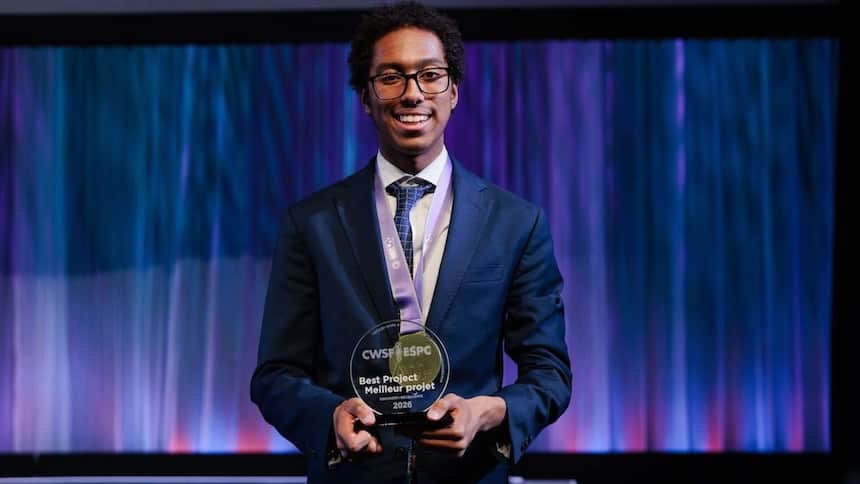
Liam Desre, 14, taught himself astrophysics
How does a kid come up with an explanation of the universe that’s never been thought of before?
For Liam Desre, it came from not letting his age or lack of experience get in the way.
“Most of the time, I forgot I was 14 and tried to treat myself like a real astrophysicist,” the Grade 9 student from Kingston, Ontario, told CBC Kids News.
For years, Liam spent countless hours in his bedroom teaching himself about the cosmos, math, and computer programming to try to answer a question that has long puzzled scientists.
Last month, he presented his findings at the 2026 Canada-Wide Science Fair in Edmonton, Alberta, earning him the top prize — the Best Project Discovery award.
He said he hopes his project will help astrophysicists better understand our ever-expanding universe.
Fuelled by sibling rivalry
Making credible theories in astrophysics takes a pretty advanced understanding of math and science — knowledge that typically requires a university degree.
So how did Liam do it?
When he was in Grade 6, his older sister was already in university studying computer science and math.
He started reading her textbooks to see if he could grasp course material before she could.
“It started with rivalry, but then I just dug so much deeper into it because I wanted to learn more about the universe, something that is amazing,” he said.
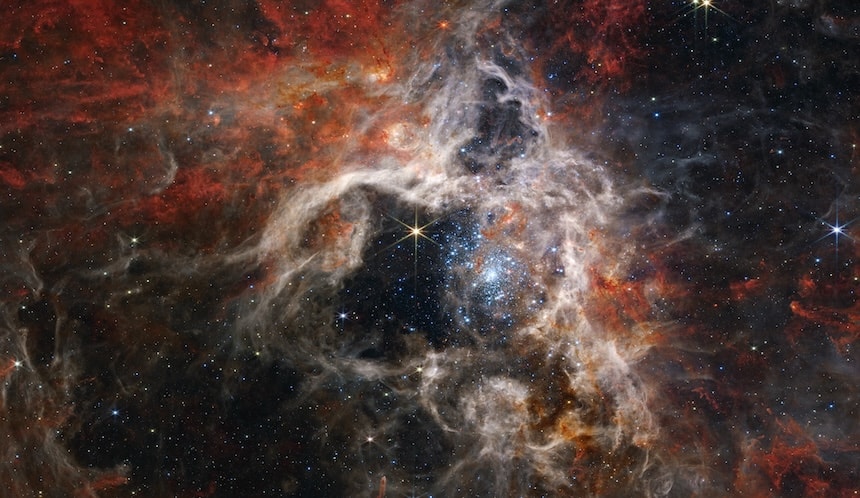
It typically takes many years for a person to learn the advanced mathematics and physics that make up the foundation of the universe. (Image credit: NASA, ESA, CSA, STScI, Webb ERO Production Team)
Two years later, his Grade 8 biology teacher noticed Liam had a deep interest in math and physics and encouraged him to enter the science fair.
That’s when he started exploring his award-winning concept.
Cosmic expansion
For years now, scientists have observed that the universe is expanding, and that that expansion is getting faster and faster over time.
Many scientists think something called dark energy is the force driving that acceleration.
“They believe there’s a uniform energy throughout the universe that doesn’t interact with light and can’t be observed, and that’s why they named it dark,” said Liam.
The problem is, that inability to observe dark energy means scientists still don’t know what it is, leading some to wonder if something else could be behind the expansion.
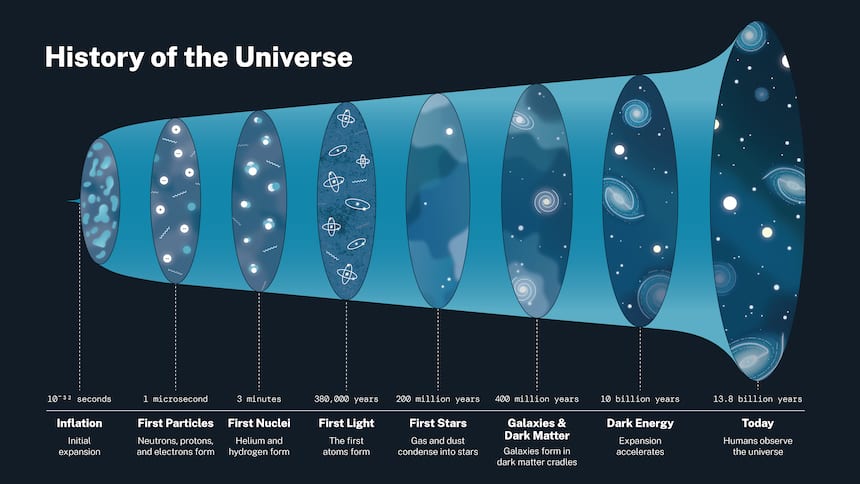
This NASA illustration shows the expansion of the universe from the Big Bang to present day, including when expansion started to accelerate roughly 10 billion years in. (Image credit: NASA)
Using black holes instead
Liam’s big idea was to try to see if black holes — rather than dark energy — could provide clues to what’s behind the acceleration.
“I read a book called the Black Hole War by Leonard Susskind, and it talked about how we could use our knowledge of black holes to understand other realms of physics,” he said.
During his spare time in Grade 8, Liam looked at the math behind black holes and tried to find parallels with the structure of the larger universe.
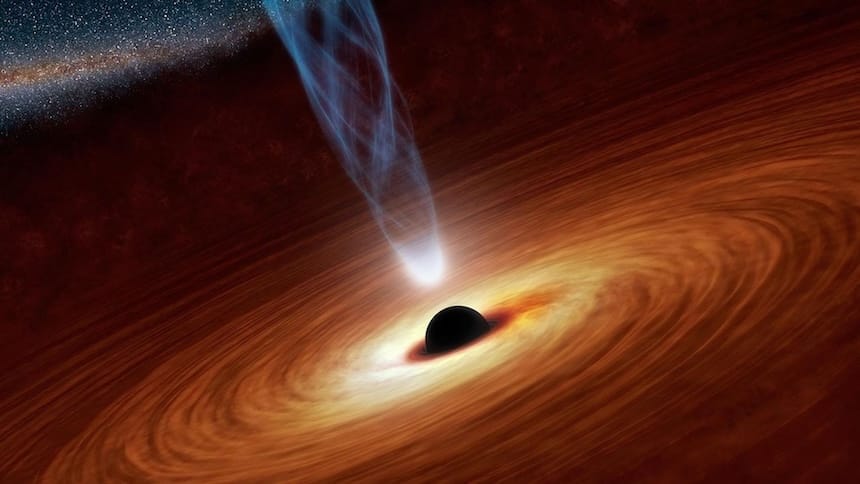
Black holes are created under specific conditions when stars, like our sun, explode. They’re points in spacetime where gravity is so strong that even light can’t escape.(Image credit; NASA)
He did it all alone, determined to explore his theory without any outside mentoring.
“I could see my math making more and more sense over time,” he said.
But once the math was done, Liam then had to spend many more months teaching himself computer programming in order to even test his mathematical model.
“When I finally ran the computer simulation, I found it agreed to what we observe in the universe to around 93 per cent,” he said. “I was like, ‘Wow, this is insane.’”
Sharing his findings
Liam’s findings are a complicated thing to explain.
But put simply, he found that certain properties of black holes did map onto the larger universe.
His model suggests a physics principle called entropy could be the driver of cosmic expansion, rather than dark energy.
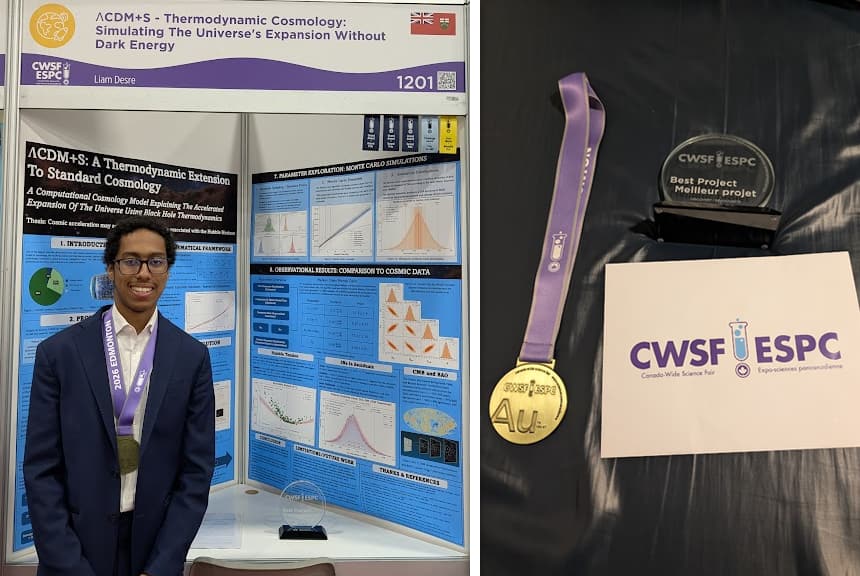
After years of teaching himself astrophysics, Liam shared his findings at Canada’s biggest and most prestigious science fair this year. (Image submitted by Liam Desre)
After showing his findings at a regional science fair, Liam qualified for the national, Canada-wide science fair.
He was one of 390 finalists from across Canada.
But with so much impressive competition, he didn’t think a top prize was in the cards.
“I thought highly of my project, but never thought I’d win best of fair. It just seemed impossible. When I saw the other projects, I was like, ‘Yeah, no way I’m winning that,’” he said.
Needless to say, when his name was called as the winner of the main prize, it was a shock.
“It was just insane,” he said.
Reni Barlow, the executive director of Youth Science Canada, told CBC Kids News that it was well-deserved.
“He set out to answer one of the hardest questions that exists,” Barlow told CBC Kids News.
“To not only wrap your head around the theoretical basis of things like black holes, but to also manage the advanced math in a credible way, it was remarkable,” he said.
For his win, Liam was offered several university scholarships and a prize of around $700, which he plans to use to buy more advanced textbooks.
He said his next steps are preparing for an even bigger science fair — the European Union Contest for Young Scientists (EUCYS), which takes place in Germany in September.
Have more questions? Want to tell us how we’re doing? Use the “send us feedback” link below. ⬇️⬇️⬇️