
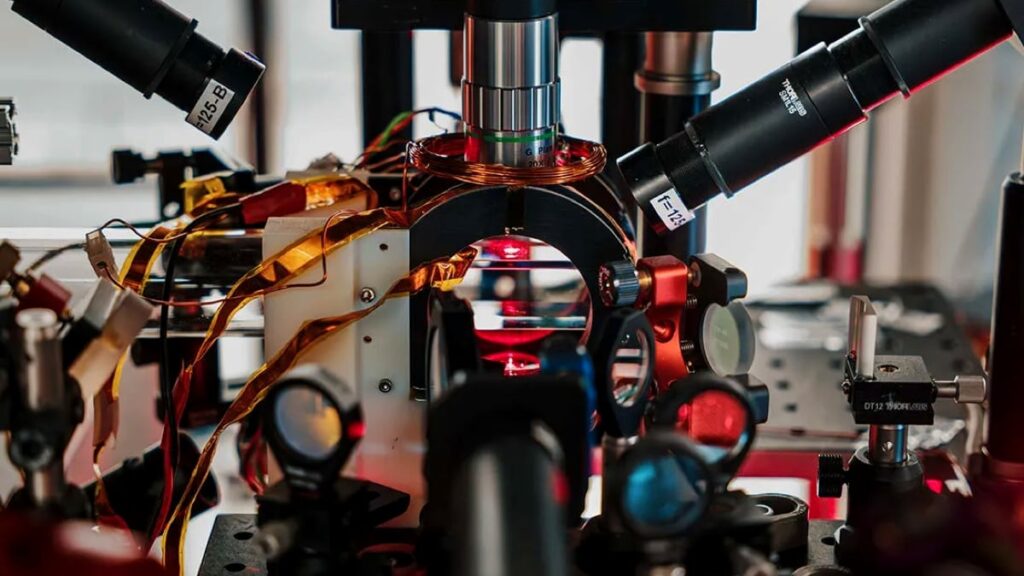
The quantum world is mind-bogglingly counterintuitive: at the smallest scales, basic physical qualities like position and speed are murky, and time as we know it doesn’t seem to exist.
These quantum quirks hinder our attempt to understand the Universe, the nature of existence, and even the quality of consciousness.
Fundamental mathematical rationale from Newtonian physics, quantum mechanics, relativity, and, more specifically, the Wheeler-DeWitt equation, suggests that time has no built-in direction, and may even disappear at the deepest level.
In contrast, the second law of thermodynamics offers an ‘arrow’ of time: the Universe began in an ordered state, perhaps as an infinitely dense point, and is becoming increasingly more disordered.
So, to probe the nature of time, and whether it represents a foundational property of our cosmos, Giovanni Barontini, a physicist at the University of Birmingham, created a ‘mini-universe’ from scratch, as one does.
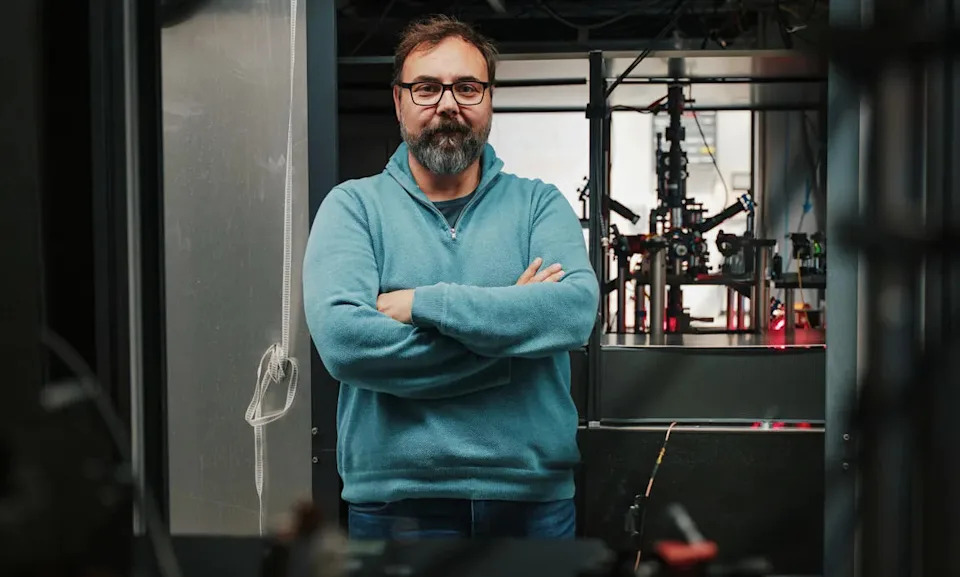 Giovanni Barontini standing in front of the ‘mini-universe’, or apparatus used to cool and trap rubidium atoms. (University of Birmingham)
“This study provides the first controlled experimental evidence that ‘time’ can be defined by changes within a system rather than as the external ‘ticking clock’ we think of as time,” Barontini explains.
In an attempt to make time emerge on its own, Barontini built his mini-universe from approximately 24,000 rubidium atoms cooled to billionths of a degree above absolute zero, forming an exotic atom ‘slushy’ called a Bose-Einstein condensate.
Also known as the fifth state of matter, this occurs when particles are chilled to near absolute zero; they lose their individuality and begin behaving like a unified, singular ‘super-particle.’
Barontini confined this alien substance in a dipole optical trap, which split it into two sectors using a barrier formed by the crossing of two laser beams of different frequencies.
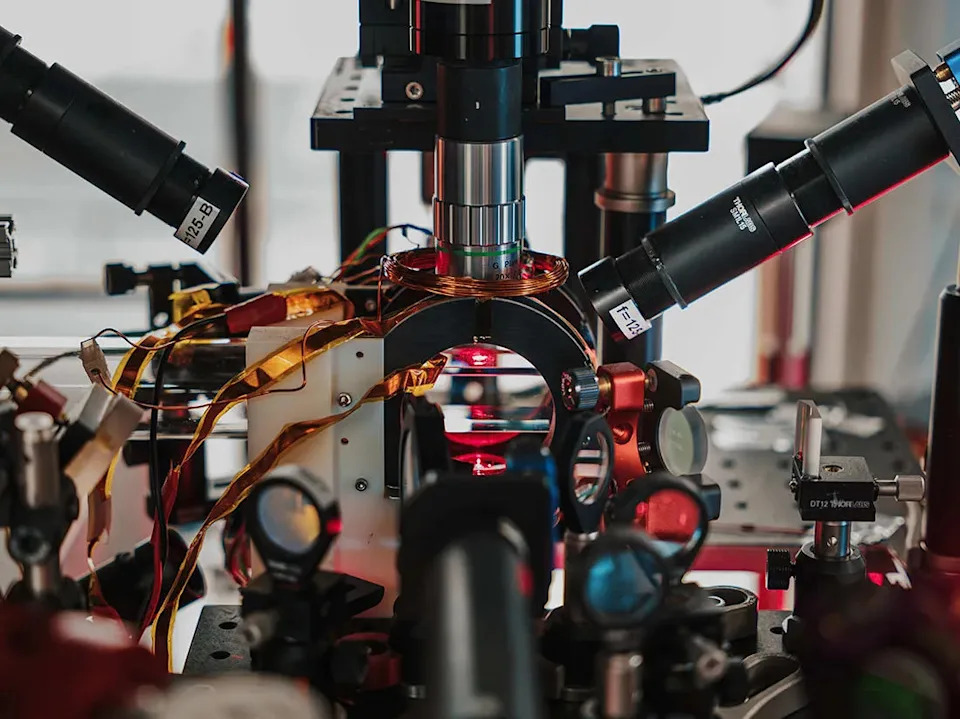 Behold, the mini-universe, represented by the ‘cloud’ of 24,000 ultra-cold rubidium atoms contained in a magneto-optical trap. (University of Birmingham)
This arrangement yielded a ‘bright’ sector that was observed and a ‘dark’ sector that remained unobserved, allowing a sense of time to emerge as the atoms moved back and forth between the two sectors.
Barontini compares these sectors to the unobserved parts of our real Universe: dark matter and dark energy.
In other words, the movement of atoms became the clock, providing a sense of time based on the action of entropy, rather than the ticking hands of a conventional timepiece.
“In the experiment, the observed part of the system exchanges atoms and entropy with the unobserved part. From this entropy exchange, we define an internal, ‘entropic’ time,” Barontini told ScienceAlert.
“This time increases when entropy is exchanged, and it stops when the entropy exchange stops.”
The oscillation of atoms across the barrier occurred rhythmically, like repeating cycles of a universe-expanding Big Bang followed by a cosmos-crashing Big Crunch – similar to an existing hypothesis that proposes that we live in an endlessly cycling Universe.
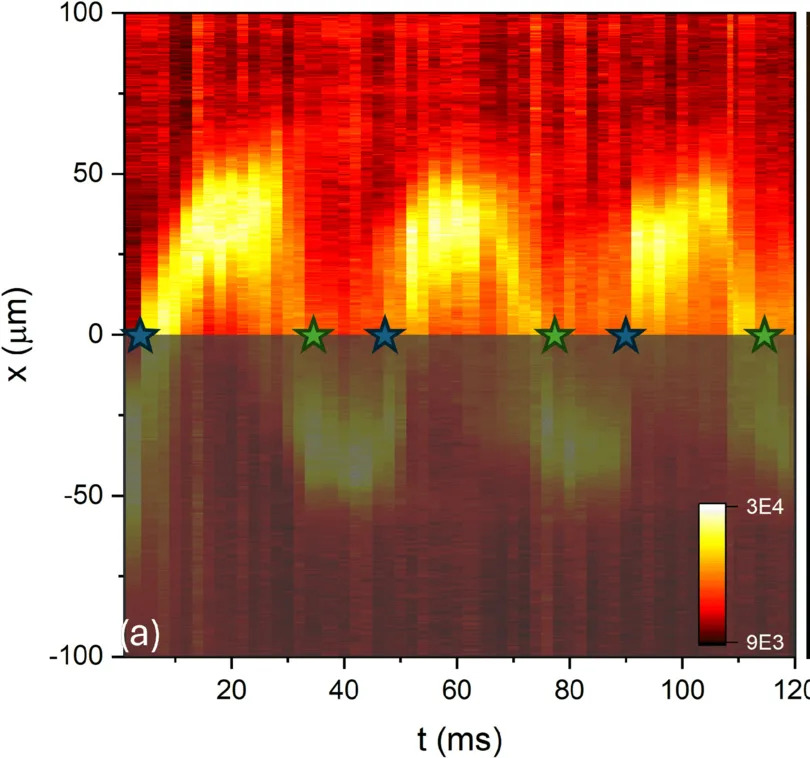 The movement of atoms from the bright, observed region and the dark, unobserved region. The migration of atoms into the bright sector represents the Big Bang (blue stars), while the migration into the dark sector represents a Big Crunch (green stars). (Giovanni Barontini, Phys. Rev. Res., 2026)
As a result, a sense of time naturally emerged from this sequence of events because the flow of entropy has a direction, and this entropy-based ordering does not run backward.
“A simplified way to say it is: the mini-universe does not need an external parameter to order the events; its own entropy flow tells which event comes next,” Barontini said.
Such mini-universes are an invaluable testing ground for physics, as cold-atom systems can be precisely engineered to explore some of the Universe’s most mysterious mechanics.

Subscribe to ScienceAlert’s free fact-checked newsletter
To examine questions about the Big Bang or potential Big Crunch, “We can change the trap shape, the barrier height, the interactions between atoms, the density profile, and the coupling between different regions of the system,” Barontini told ScienceAlert.
“For example, one could ask whether an apparent collapse behaves like a singularity or instead turns into a bounce.”
Similarly, one can approximate the boundaries of black holes by trapping atoms on one side of the mini-universe.
Related: Success! Physicists Build The World’s First Clocks Powered by Atomic Nuclei
The Big Bang and black holes were themselves surprising discoveries. So who can guess what enlightenment will follow from poking at miniature universes with a quantum stick?
By creating a controlled quantum system to test some of these mathematical and physical questions quantitatively, physicists can also prod the befuddling aspects of quantum gravity in hopes of attaining the ‘impossible’ dream of uniting general relativity and quantum mechanics.
Therefore, this work “offers new insight into the nature of time in quantum gravity that could be used to describe dynamics just as effectively as conventional time,” Barontini concludes.
This research was published in Physical Review Research.
Related News