
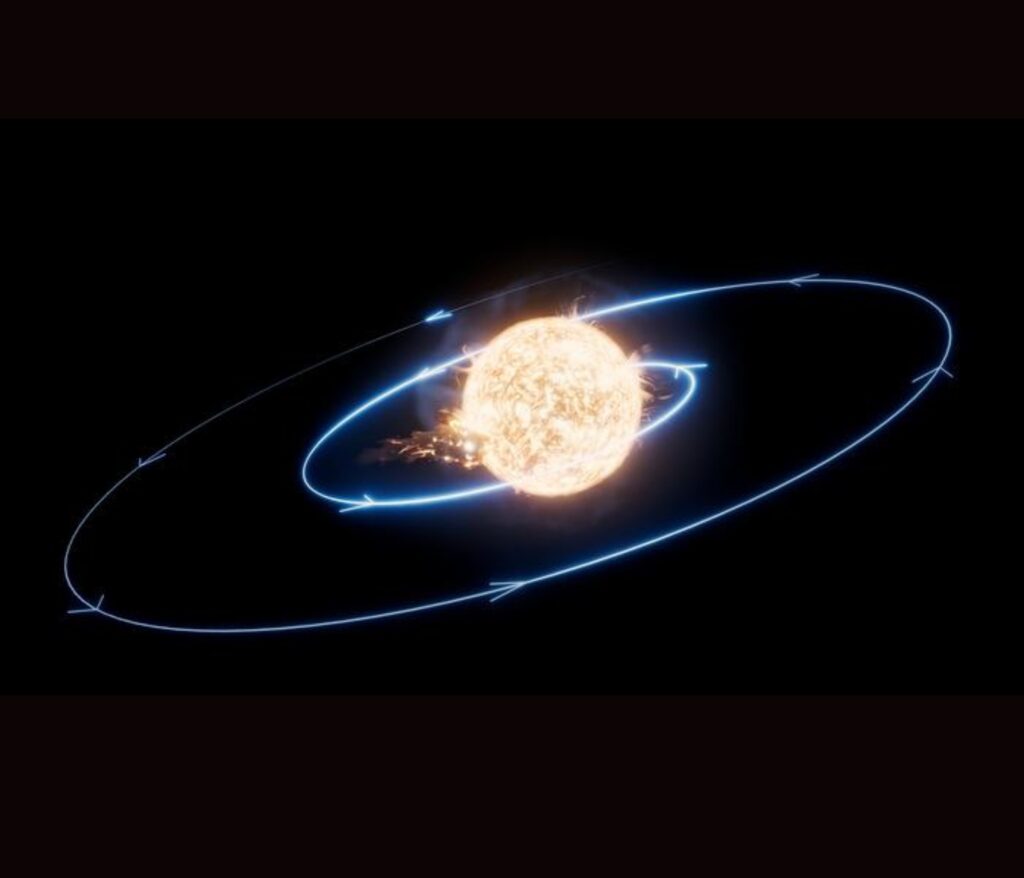
Stars are some of the most prominent beings in the universe, creating planets and lighting up galaxies. However, they sometimes manage to destroy those planets that orbit them.
Scientists are confident that they have discovered solid proof of one star eating its planet and leaving behind chemical signatures as evidence of the occurrence.

The star, called TOI-5882, is situated at a distance of 1,300 light-years from Earth and looks much like our own sun.
At first glance, the star appears ordinary. Yet hidden in its light is evidence that something unusual happened in its past.
Planetary destruction on a cosmic scale
When a planet falls into its host star, astronomers call the event an engulfment. The process happens surprisingly quickly on astronomical timescales, often lasting only days or weeks.
Because these events are so brief, scientists almost never witness them directly. Instead, they search for the traces left behind.
A team of researchers studying TOI-5882 found one of those traces in the form of lithium, a chemical element that plays a key role in understanding what happened.
While stars naturally contain some lithium, planets typically hold much higher amounts.
“You are what you eat, right?” said Brooke Kotten, a graduate student researcher in the University of Michigan Department of Astronomy and lead author of the new report.
“We know that there’s much more lithium in planetary material than there is in stars. So if a star eats a planet, it’s going to take on a bunch of lithium.”
Following the clues
Finding unusually high lithium in a star is not enough on its own. Scientists must determine whether the amount is truly abnormal compared with similar stars.
To answer that question, the research team used spectroscopy, a technique that breaks starlight into its component wavelengths.
This allows astronomers to identify the chemical elements present in a star’s atmosphere.
The researchers assembled a comparison group of 62 stars with similar ages, masses, and temperatures. They then measured how TOI-5882 stacked up against them.
Study senior author Melinda Soares-Furtado is an assistant professor at the University of Wisconsin.
“The fact that we can look at a star 1,300 light-years away and say with confidence, ‘This star has more lithium than you would expect,’ is a testament to both the precision of modern instrumentation and the hard interpretive work that goes into making sense of that signal,” said Soares-Furtado.
“And it’s not like you have to cherry-pick the data to make it stand out. It’s robust. No matter how you slice it, TOI-5882 is so enriched in lithium it shows up as being at least in the 97th percentile.”
The role of lithium
Lithium is relatively fragile inside stars. Over time, stellar processes tend to destroy much of it. That makes an unusually high concentration stand out.
“Lithium atoms delivered by planetary engulfment to a star are like sports fans arriving at a stadium,” said Seth Jacobson, a senior author of the study and assistant professor at Michigan State University.
“There may already be a few early arriving fans present, representing the initial amount of lithium in the stellar atmosphere, but they are quickly outnumbered.”
Based on the lithium levels observed, the team estimates that the swallowed world may have been somewhere between a few times Earth’s mass and the size of Neptune.
Why this star is different
The mystery becomes even more interesting because TOI-5882 is not old enough or large enough to explain the engulfment through normal stellar expansion.
Many stars eventually enter a red giant phase near the end of their lives. During this stage, they swell dramatically and can consume nearby planets.
Scientists expect our own sun to do exactly that roughly 5 billion years from now, likely engulfing Mercury and Venus and possibly Earth. TOI-5882, however, has not reached that stage.
The star does have a massive companion orbiting it: a brown dwarf more than 20 times the mass of Jupiter.
Brown dwarfs are often described as objects that are too large to be planets but not massive enough to become true stars.
Researchers suspect this companion may have disturbed the orbit of a smaller planet, eventually sending it spiraling into TOI-5882. The idea remains under investigation and could become the focus of future research.
New clues about planetary engulfment
Beyond solving the mystery of a single star, the work helps astronomers understand how often planetary engulfment occurs throughout the galaxy.
The findings may also point toward new questions. A handful of other stars in the comparison group showed elevated lithium levels as well, hinting that additional processes could enrich stars with lithium.
That means astronomers may have uncovered only part of the story.
“That’s what makes this field so exciting. You really are solving a mystery,” said Kotten.
“We can’t just watch the crime happen, so we have to work with all the clues we’re given to figure out whodunit.”
The detective theme is one that resonates with her personally.
“When I was growing up, I dreamed about becoming a private investigator,” she said. “I think that explains a lot about where I ended up. I do feel like a detective.”
The full study was published in the journal The Astrophysical Journal.
Image Credit: NASA, ESA, CSA, Ralf Crawford (STScI)
—–
Like what you read? Subscribe to our newsletter for engaging articles, exclusive content, and the latest updates.
Check us out on EarthSnap, a free app brought to you by Eric Ralls and Earth.com.
—–