
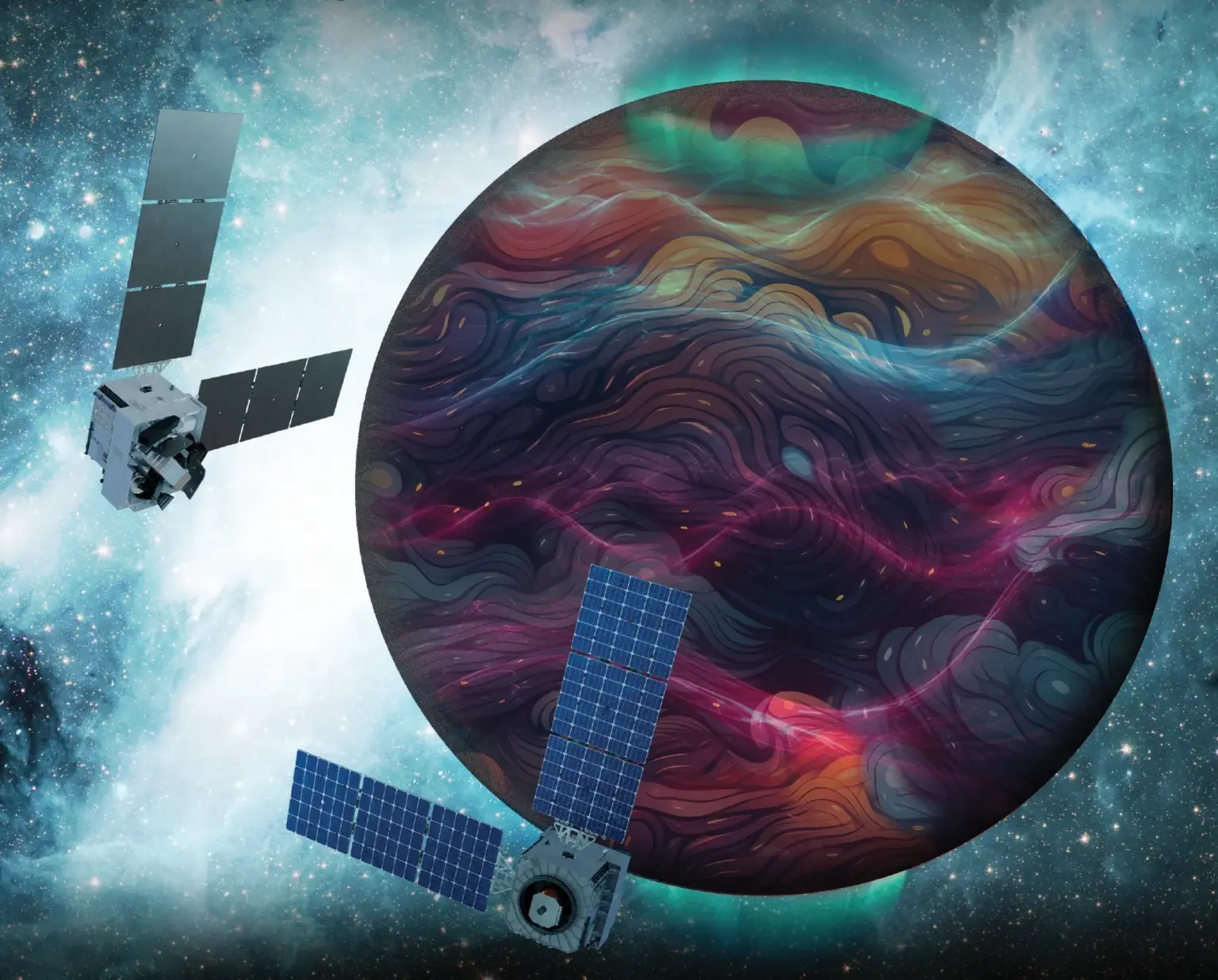
NASA has selected the DAPHNE mission for the next stage of development, marking a significant step toward improving understanding of how Earth’s atmosphere interacts with the space environment.
The mission aims to uncover how processes occurring deep within the atmosphere affect conditions in near-Earth space, with the goal of enhancing space weather forecasting capabilities.
The Dynamic Atmosphere-Ionosphere Explorer (DAPHNE) mission will enter Phase B, where detailed planning and mission design activities will take place.
Using two identical satellites flying in tandem, the mission will investigate the complex connections between Earth’s lower atmosphere and the upper atmospheric regions where space weather phenomena occur.
By providing new insights into atmospheric dynamics, the DAPHNE mission is expected to strengthen prediction models used to assess risks to critical technologies, including GPS systems, low Earth orbit satellites, and human spaceflight operations.
Improved forecasting could help operators better prepare for disruptions caused by changing space conditions.
Nicky Fox, associate administrator, Science Mission Directorate, NASA Headquarters in Washington, explained: “NASA is advancing the United States’ leadership as a space weather-ready nation, and by providing new insights into Earth’s atmosphere we can better predict and prepare for impacts in our daily lives on Earth and in space.
“As NASA sends astronauts beyond Earth’s magnetic protection to the Moon, Mars, and beyond, DAPHNE will join the NASA science fleet strategically located across the solar system to provide data that will help mission planners predict and mitigate the effects of space weather for the benefit of all.”
Investigating the link between Earth’s atmosphere and space weather
The DAPHNE mission is designed to study the ionosphere and thermosphere, a region where Earth’s neutral atmosphere gradually transitions into the ionised plasma environment of space.
This dynamic layer is constantly influenced by a combination of solar activity, atmospheric motion, and interactions with near-Earth space.
Despite decades of research, scientists still have limited understanding of how energy and momentum from Earth’s lower atmosphere affect conditions in the upper atmosphere.
These interactions can alter the behaviour of charged particles and influence the severity and timing of space weather events.
To address this challenge, DAPHNE’s twin spacecraft will collect simultaneous measurements from multiple locations. The satellites will monitor key atmospheric characteristics, including neutral winds, temperature variations, and atmospheric composition.
This coordinated approach will provide a more comprehensive picture of how atmospheric processes evolve and spread through the upper atmosphere.
Improving space weather prediction
One of the mission’s primary objectives is to improve predictive models of space weather.
Current forecasting systems rely heavily on observations of solar activity, but researchers increasingly recognise that conditions within Earth’s atmosphere also play a critical role in shaping the near-space environment.
The DAPHNE mission will incorporate data related to energy transfer from the lower atmosphere, helping scientists build more accurate models of how atmospheric disturbances influence the ionosphere and thermosphere.
These improvements could lead to better forecasts of events that affect satellite communications, navigation systems, and spacecraft operations.
As society becomes increasingly dependent on space-based infrastructure, the ability to anticipate space weather impacts is becoming more important. Enhanced forecasting could reduce operational risks for satellite operators while helping to protect astronauts working in orbit.
Mission timeline and leadership
The DAPHNE mission is led by Aimee Merkel at the Laboratory for Atmospheric and Space Physics.
Before receiving final approval, the mission will undergo a confirmation review in 2027 to evaluate technical progress and funding availability. If approved, NASA expects the mission’s development cost, excluding launch services, to remain below $250m in fiscal year 2023 dollars.
Launch is currently planned for no earlier than 2029. The DAPHNE mission originated from NASA’s DYNAMIC mission opportunity and is funded and overseen by the Solar Terrestrial Probes Program at NASA Goddard Space Flight Center.
With its focus on atmospheric coupling and space weather forecasting, the DAPHNE mission could provide critical data needed to better understand the forces shaping Earth’s space environment and improve the resilience of technologies that modern society depends upon.