
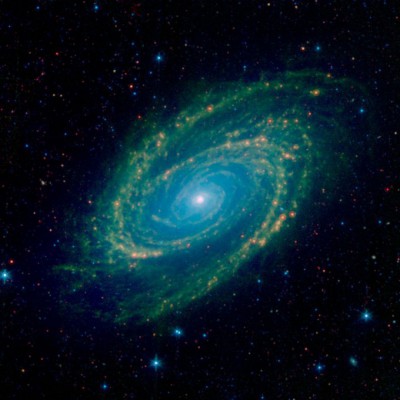
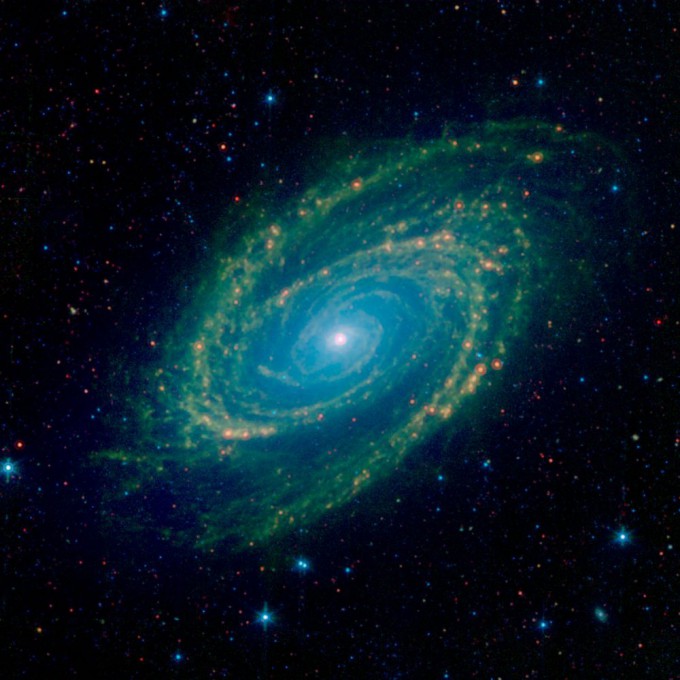
Most galaxies in the universe are known to be filled with dark matter. Image unrelated to the study. Provided by NASA/JPL-Caltech
The third galaxy believed to contain almost no dark matter—considered a key component of the universe yet still not fully understood—has been discovered. The finding is expected to provide important clues for revealing the nature of dark matter and for understanding how galaxies form.
According to a report by the U.S. science outlet ‘Scientific American’ on the 17th (local time), a Yale University research team has discovered the dwarf galaxy ‘DF9’, which their analysis shows contains almost no dark matter, and published the results in the ‘Astrophysical Journal’ on the 16th. DF9 is the third known case of a galaxy classified as having little to no dark matter, following DF2 and DF4.
According to the standard model describing the universe, it is composed of 68.3% dark energy, 26.8% dark matter, and 4.9% ordinary matter. Dark energy is the driving force behind the expansion of the universe since the Big Bang, while dark matter is a concept introduced to explain the motion of celestial objects by providing additional mass. Because it does not interact with light, it cannot be directly observed.
In general, when astronomers analyze the velocities of stars within a galaxy, they find a mass that cannot be explained by visible matter alone, and interpret this discrepancy as evidence for the presence of dark matter.
The research team measured the motions of stars within DF9 using the ‘Keck Cosmic Web Imager (KCWI)’ at the W. M. Keck Observatory in Hawaii. Based on these measurements, they calculated the total mass of the galaxy and found that it can be fully accounted for by the visible stars and gas alone. The team interpreted this as evidence that DF9 contains almost no dark matter or possibly none at all.
DF9 belongs to the same galaxy group as DF2 and DF4. The fact that all three galaxies have been found in the same environment is said to increase the likelihood that they share a common origin.
The researchers proposed a new galaxy formation scenario. They suggest that during a past collision between two massive galaxies, ordinary matter and dark matter became separated, and as a result, galaxies deficient in dark matter may have formed.
Michael Keim, a researcher at Yale University who led the study, said, “Almost all galaxies in the universe are known to have dark matter accounting for most of their mass,” adding, “DF2, DF4, and DF9 are extremely exceptional galaxies.”
The team expects that the discovery of DF9 will provide important clues toward identifying the true nature of dark matter. Pieter van Dokkum, a professor at Yale University, described it as “strong evidence that dark matter is a real substance with physical properties.”
doi.org/10.3847/1538-4357/ae6b8d
Copyright ⓒ DongA Science. All rights reserved.