
Standing before Keith Tyson‘s works, it becomes difficult to separate the handmade from the elemental. Paint blooms through chemical reactions, sculptures respond to their surroundings, algorithms generate unexpected beginnings, and familiar genres like the still life become places where mathematics, philosophy, and memory seamlessly converge. Across decades of making, Tyson has cultivated a practice that resists easy categorization, one where engineering and intuition, scientific inquiry and poetic wonder are allowed to occupy the same space.
His latest exhibition, “The Generative Universe,” at Hauser & Wirth Downtown Los Angeles, gathers works spanning more than three decades into a meditation on interconnectedness. Tyson imagines the universe as a continuous field of relationships—an ever-shifting network in which every action, material, and living thing participates. That perspective has shaped everything from his pioneering Artmachine, developed in the early 1990s, to his ongoing explorations of painting, natural processes, electronics, and responsive sculpture.
Although conversations around artificial intelligence have brought renewed attention to Tyson’s early experiments with systems and computation, his work has never been driven by technology for its own sake. Instead, it returns again and again to distinctly human questions: How do we make sense of uncertainty? Where does creativity begin? Can a set of rules reveal something deeply emotional? Throughout the exhibition, rigorous conceptual structures remain inseparable from curiosity, vulnerability, and the pleasures of making.
With Whitewall, Tyson generously reflects on the evolution of his thinking—from his early years as an artist searching for a language of his own to his enduring fascination with chance, authorship, and the hidden forces that shape everyday life. Ideas moves easily between philosophy and painting, artificial intelligence and gardening, revealing an artist who is just as interested in asking expansive questions as he is in embracing the beauty of not always arriving at definitive answers.
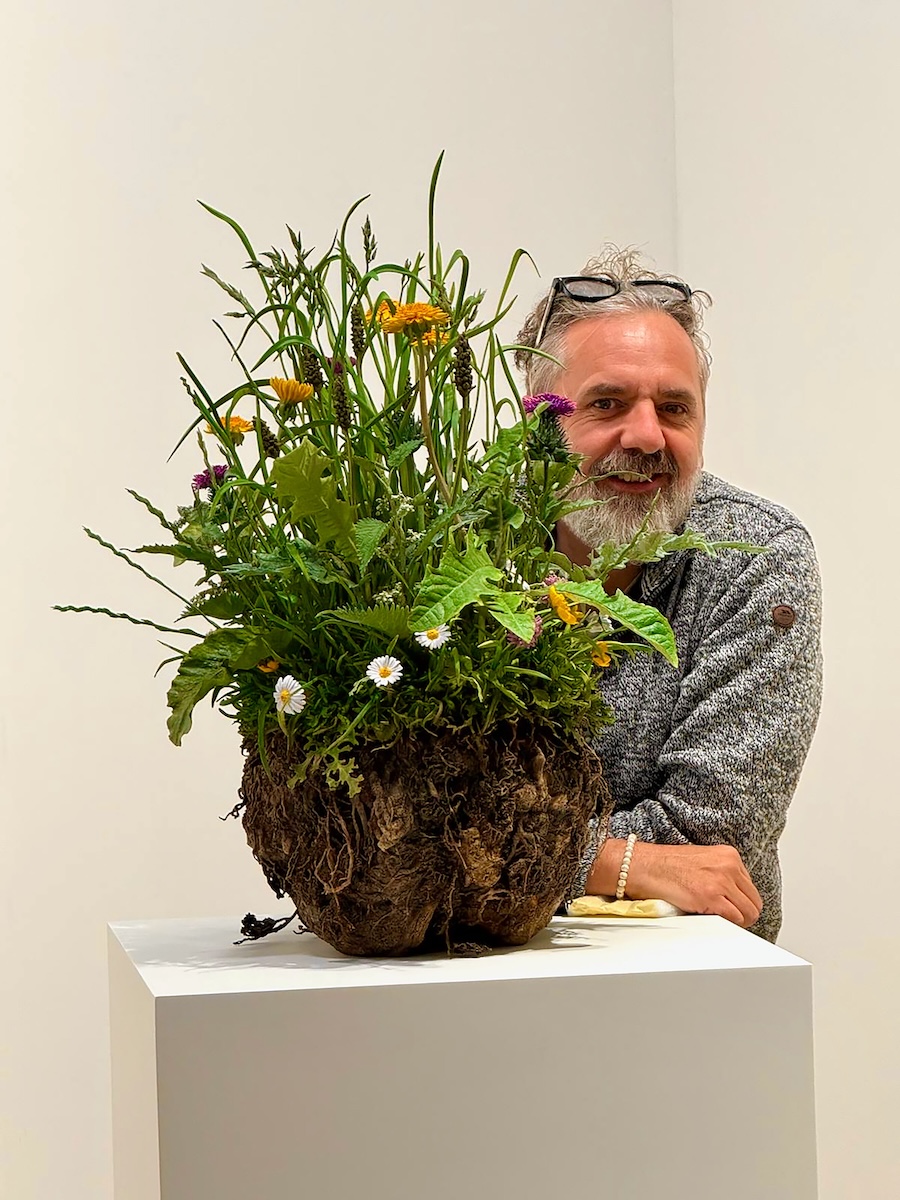
Keith Tyson with “Pixel,” 2025, © Keith Tyson. Photo: KT Projects, courtesy the artist and Hauser & Wirth.
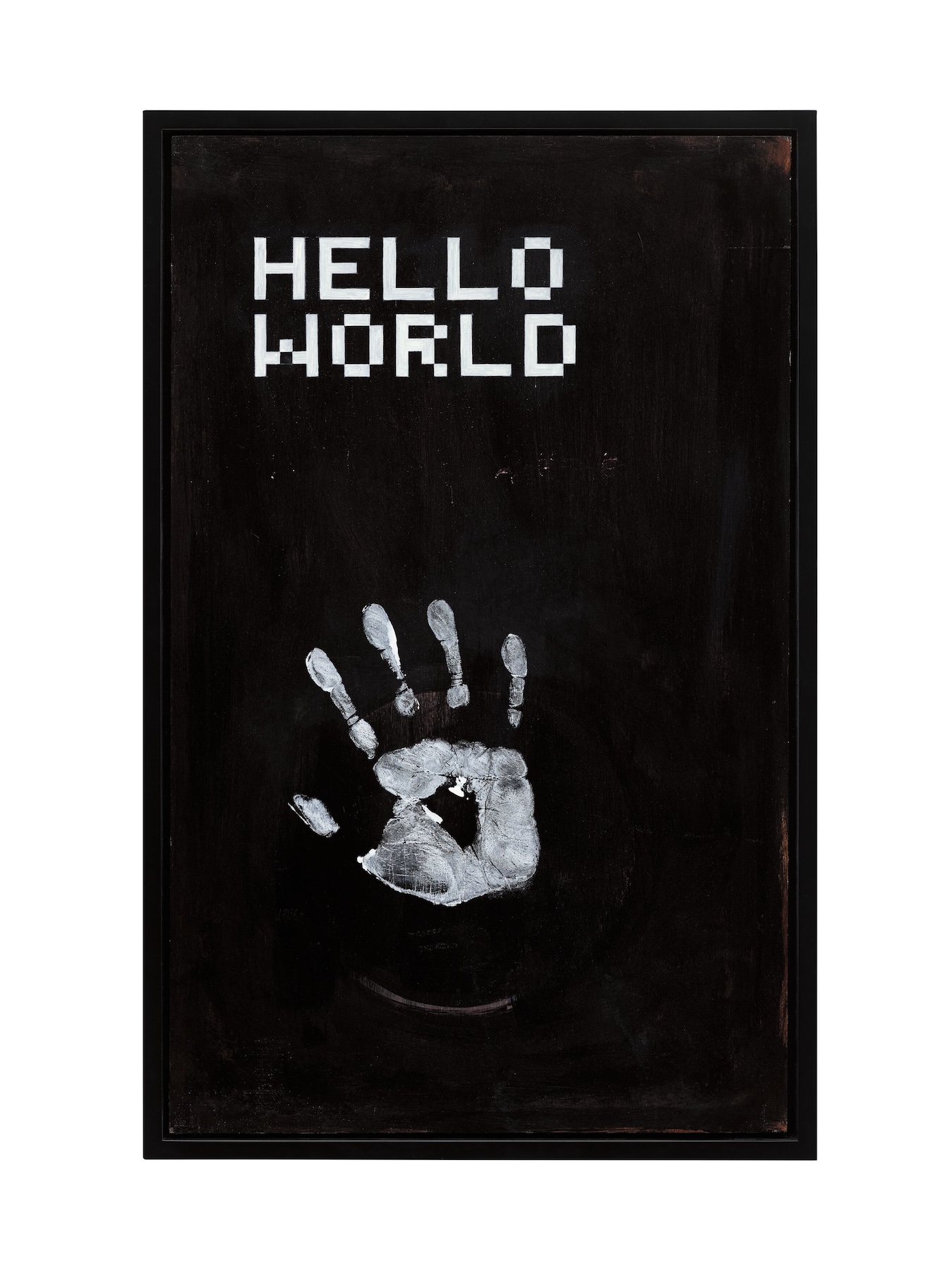
Keith Tyson, “Artmachine Iteration no. 1.1: Hello World,”
1991,
Acrylic handprint and text randomly positioned on metal plate,
61 x 38 x 3.5 cm / 24 x 15 x 1 3/8 in,
64.1 x 41.2 x 3.1 cm / 25 1/4 x 16 1/4 x 1 1/4 in (framed),
Photo: Peter Mallet, © Keith Tyson
Courtesy the artist and Hauser & Wirth.
WHITEWALL: Your exhibition frames the universe as a single generative system where forms continuously arise and dissolve. How has working this way over decades changed how you understand authorship, both in art and in life?
KEITH TYSON: I didn’t always think this way. When I started out, I saw myself as a fairly traditional artist who wanted to make work about the world around me. Over time, my worldview evolved. Philosophy, Eastern mysticism, science, mathematics, and quantum mechanics all contributed to that shift.
I gradually came to see art making, and really any human activity, as contingent on countless other systems. Even this conversation depends on biological evolution, technology, language, and generations of people meeting before us. It’s not a position I arrived at in art school. It’s something that slowly emerged.
At college, there were many discussions around the death of the author and thinkers like Derrida and Foucault. I wanted to make things that still related to life, craftsmanship, and the human experience. Artists like Sol LeWitt, Donald Judd, and On Kawara offered a way forward. Their systems-based approaches still carried a sense of pathos.
When I began working with coding, I wasn’t trying to erase authorship. I was trying to build something larger than myself. I didn’t feel I fully knew who I was yet. What interested me was whether a work could capture something of the strangeness of being alive.
WW: You’ve spoken about seeing paint as a programmable material early on. Did that mindset come from engineering, or from a desire to expand beyond traditional painting?
KT: Painting itself is already full of systems. You could spend a lifetime studying different techniques, from historical glazing methods to contemporary approaches. In that sense, painting is programmable. You apply a process and a result emerges.
After the financial crisis, I found myself returning more directly to painting. I’d been working with assistants on large systematic projects, and I wanted to reconnect with my own hand. What fascinates me about paint is that it captures something of the attitude behind its application.
Photography records light. Painting records something more elusive. It seems to pick up traces of intention, emotion, and presence. When I say paint is programmable, I mean that you can apply systems to it and reveal different emotional, political, or social dimensions.
Revisiting the Artmachine in the Age of AI
WW: The Artmachine feels particularly resonant today amid conversations about AI and algorithmic creativity. When you revisit those early works, do they feel newly relevant?
KT: The individual objects the Artmachine produced were always less interesting to me than the process itself. What fascinated me was the idea of encountering an object that didn’t have a practical function and wasn’t expressing a particular personality. It simply existed.
“What interested me was whether a work could capture something of the strangeness of being alive.”
Keith Tyson
Interestingly, there was an AI research center at my art school. I spent time there learning a programming language called Prolog and built a very simple conversational system. I fed information from the Encyclopaedia Britannica into it by hand and used it to generate prompts.
I wasn’t really trying to make AI art. I was trying to interrupt my own habits and assumptions. I wanted systems that could push me somewhere unexpected.
At the same time, I was interested in the idea of finding the universal through the particular. One work in the exhibition includes a fictional university map. I threw a dart at it, and whatever it landed on became the subject of a painting. The hope was that by selecting a single point, you might somehow glimpse the whole.
Unpredictability and the Human Condition
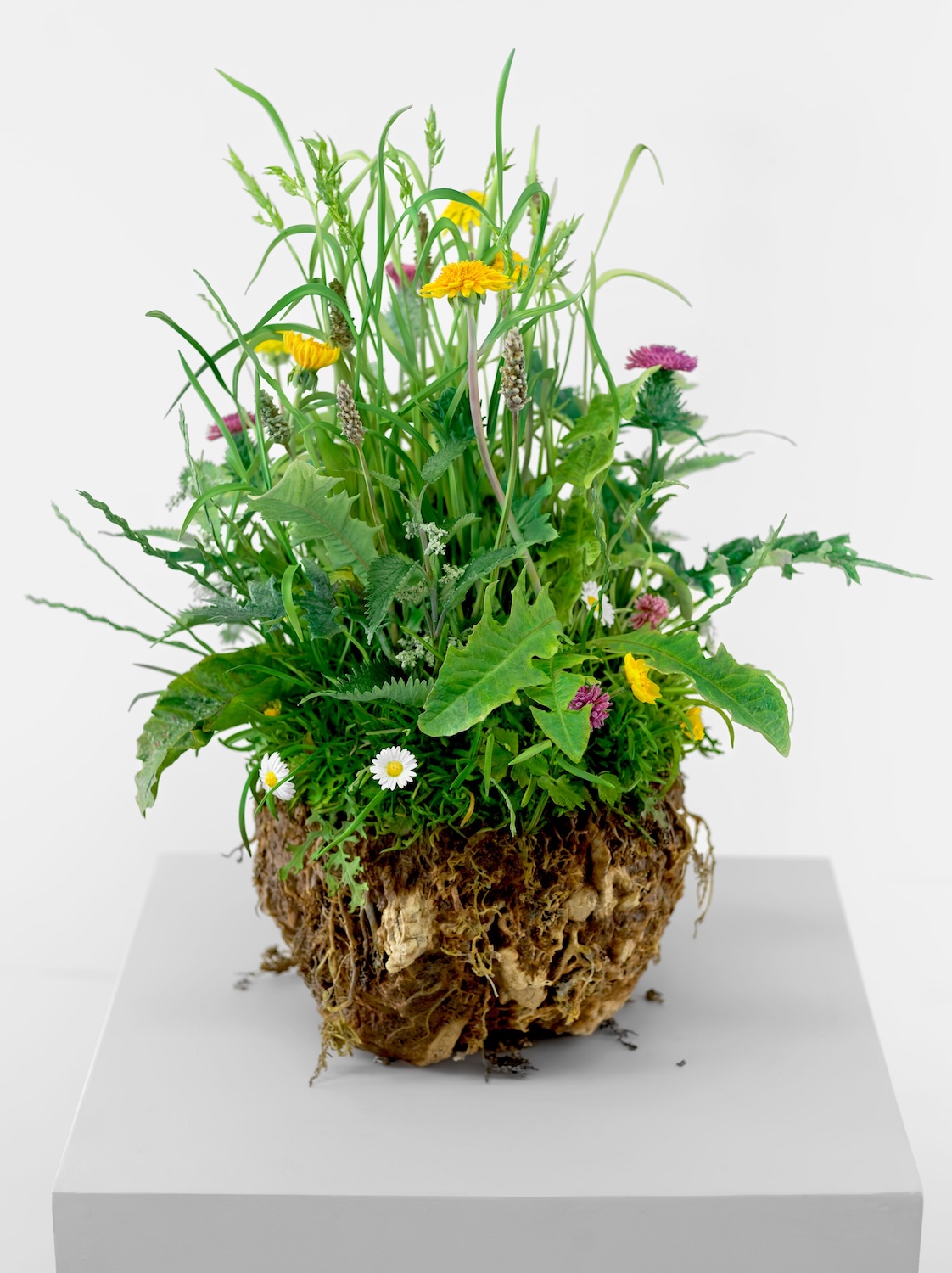
Keith Tyson, “Pixel,”
2024,
Painted bronze sculpture of a sod of earth with various grasses and plants,
Sculpture: 60 x 45 x 45 cm / 23 5/8 x 17 3/4 x 17 3/4 in,
Including plinth: 170 x 60 x 60 cm / 66 7/8 x 23 5/8 x 23 5/8 in,
Photo: Steve Russell, © Keith Tyson,
Courtesy the artist and Hauser & Wirth.
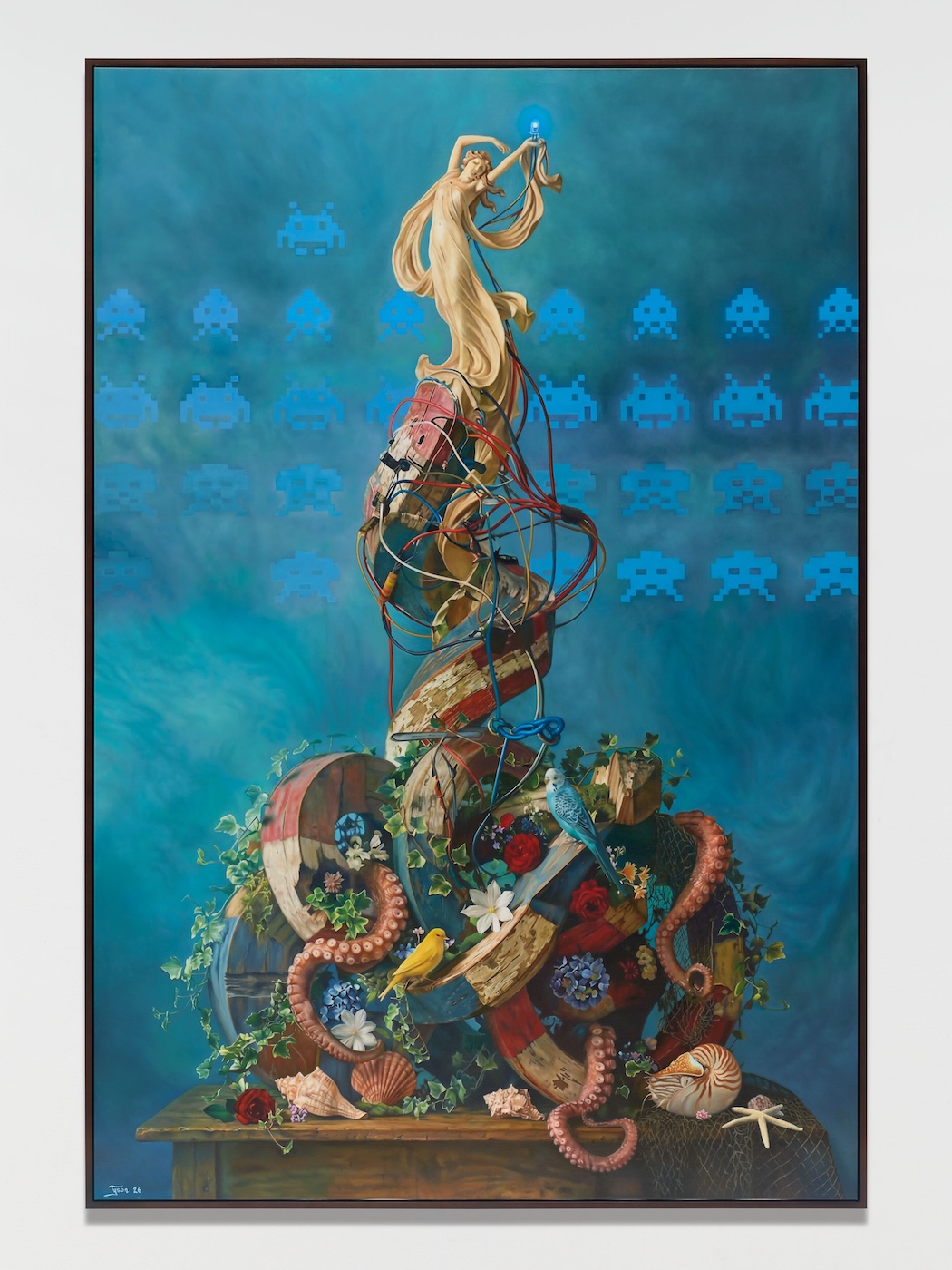
Keith Tyson, “North Atlantic Still Life with Taito Overlords,”
2026,
Oil on canvas,
185 x 125 cm / 72 7/8 x 49 1/4 in,
188.2 x 128.2 x 5 cm / 74 1/8 x 50 1/2 x 2 in ,(framed)
Photo: Dawkins Colour, © Keith Tyson,
Courtesy the artist and Hauser & Wirth.
WW: Alongside the conceptual rigor in your work, there’s often something emotional and vulnerable. Do you see unpredictability as a way of accessing feeling?
KT: Unpredictability is deeply connected to our sense of self. Computers can’t truly generate randomness. They create pseudo-randomness. Real unpredictability always comes from the physical world. Choice depends on that unpredictability. The ability to surprise, to choose differently, is fundamental.
I want my work to remain deeply human. In terms of vulnerability and emotion, I try to make works that anthropomorphize a little bit…they say something about what it is to be, to exist, to suddenly find yourself on this planet with no instruction manual, with a very complicated world around you, with all these power structures, trying to do your best, led by emotion. Some conceptual artists tried to remove the human presence from art. That was never my intention.
I don’t want to fetishize technology, either. Art should still tell human stories. It should express something poignant or moving about existence. Otherwise, it becomes another kind of activity altogether.
WW: In works like the Nature Paintings, chemical reactions and fluid dynamics become collaborators. What continues to surprise you about giving materials that freedom?
KT: Nature is extraordinary. If you let it do its thing, it often produces remarkable beauty.
The real question is why we perceive certain patterns as beautiful. Is it because they’re familiar to us? Are we somehow predisposed to respond to particular forms of complexity? I don’t know.
What interests me is the space between total control and total chaos. I often compare it to gardening. A perfectly controlled formal garden can feel rigid. Pure neglect becomes chaos. Beauty tends to exist somewhere in between.
WW: Your still-life paintings combine mathematics, cosmology, and scientific frameworks with one of painting’s oldest genres. What keeps bringing you back to still life?
KT: I remember standing in front of a still-life painting in the National Gallery and realizing that many of the flowers came from entirely different parts of the world. They would never naturally exist together.
I started thinking about bringing together different painting languages in the same way: photorealism alongside expressionism, charcoal beside mathematics, cave painting beside scientific diagrams.
The still life became a place where different systems could collide. It also gave me a way to relearn painting on my own terms, and I liked its limitations. Every painting begins with some kind of vessel and some kind of bloom, yet the possibilities are endless.
“I want my work to remain deeply human.”
Keith Tyson
There’s something humble about still life, too. Historically, it’s been considered a minor genre. I just started getting into the iterative quality of it.
Making the Invisible Visible
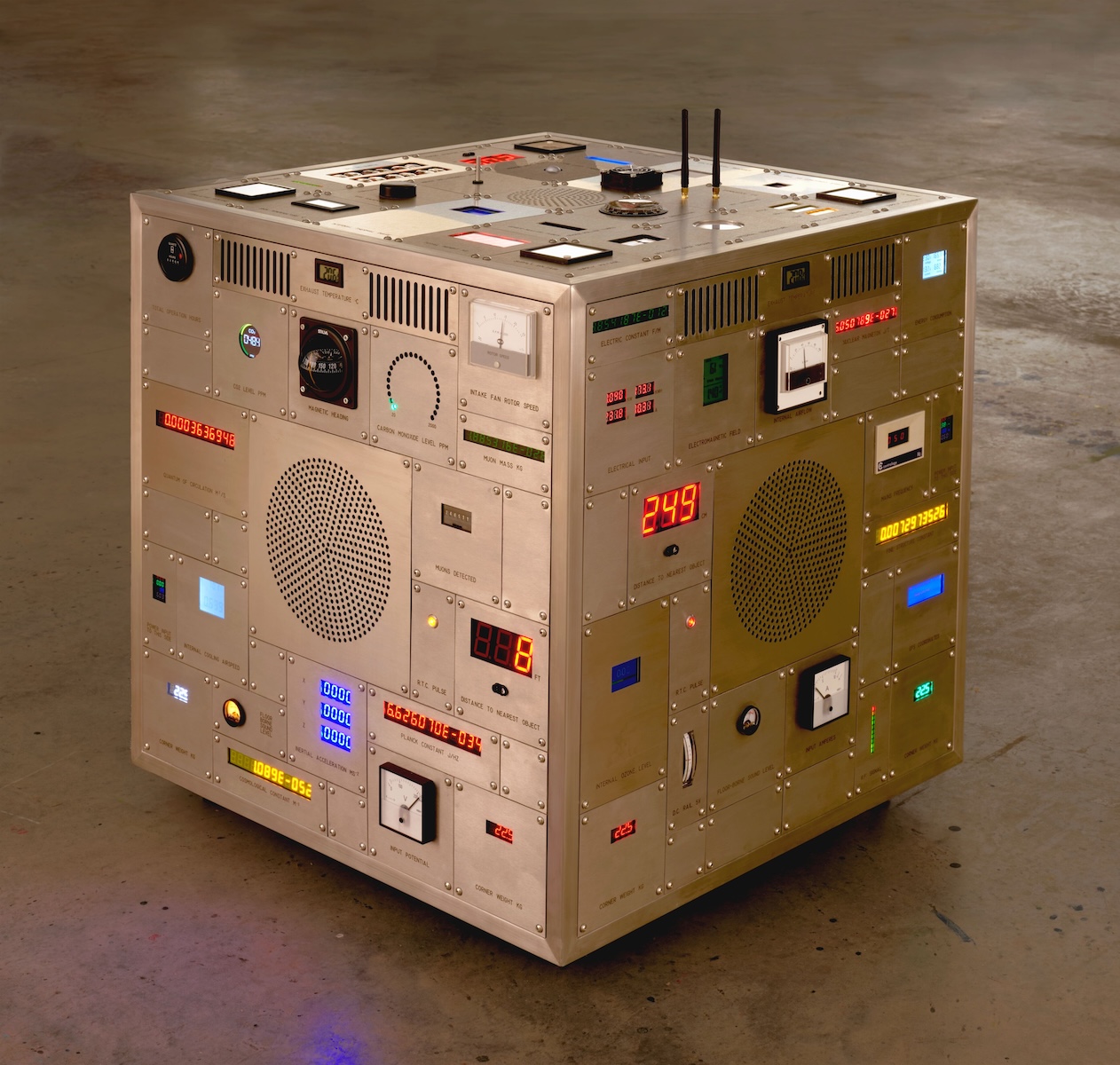
Keith Tyson, “Everything,”
2024,
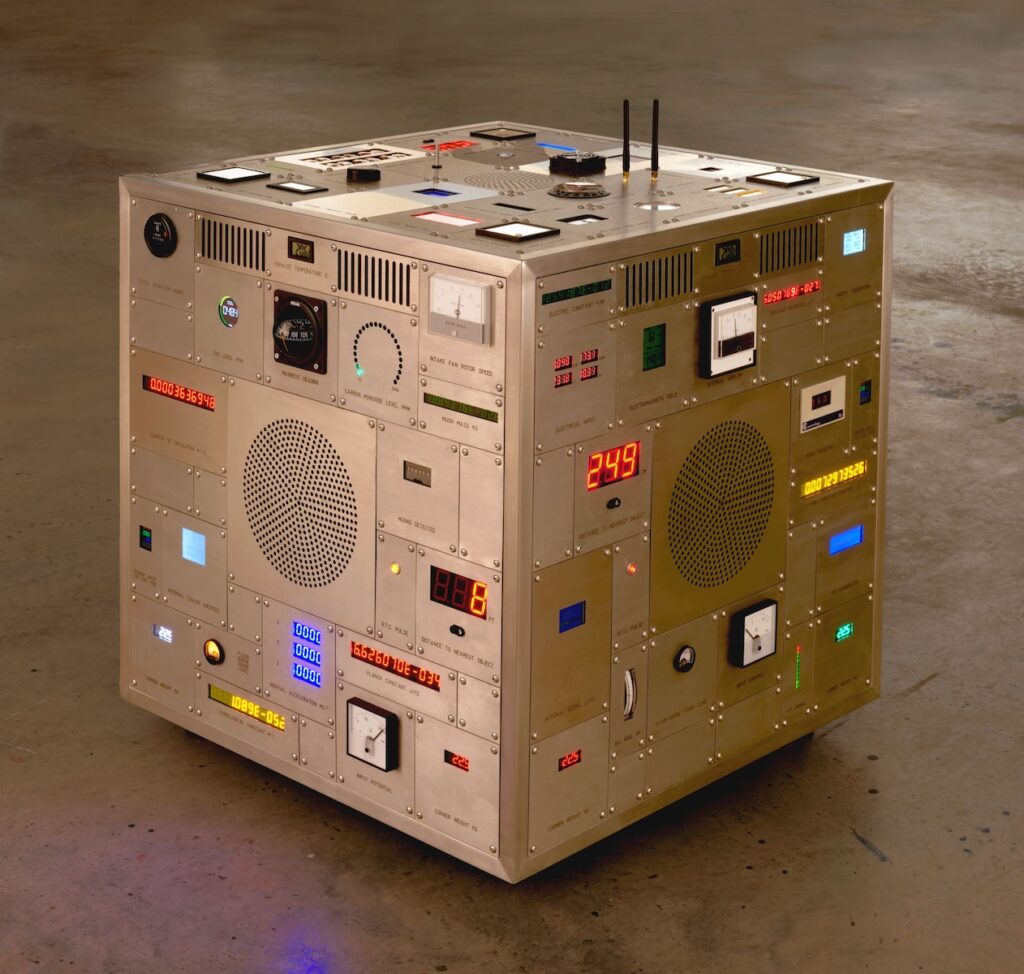
Stainless steel, electronic and analogue displays, environmental sensors, electricity,
75 x 75 x 75 cm / 29 1/2 x 29 1/2 x 29 1/2 in,
Photo: Dawkins Colour, © Keith Tyson,
Courtesy the artist and Hauser & Wirth.
WW: In Everything, the sculpture responds continuously to its environment through sensors and electronic systems. Do viewers relate differently to works that appear to behave rather than simply exist?
KT: Probably. Part of what I wanted to express was that we’re surrounded by invisible forces all the time. Radio waves, electromagnetic fields, cosmic radiation—there’s so much happening around us that we can’t perceive directly.
The sculpture emerged from that idea. It also reflects our desire to extend our senses, to measure everything from the smallest particles to the farthest reaches of the universe. Yet despite all that knowledge, we’re still individuals trying to navigate existence.
One thing I discovered while making the work is that all our senses are forms of touch. Photons touch the retina. Sound waves touch the eardrum. Molecules touch receptors in the nose. Once you realize that, the world becomes strangely intimate.
I’ve seen children become completely captivated by the piece. Adults often react the same way.
The Cosmic and the Personal
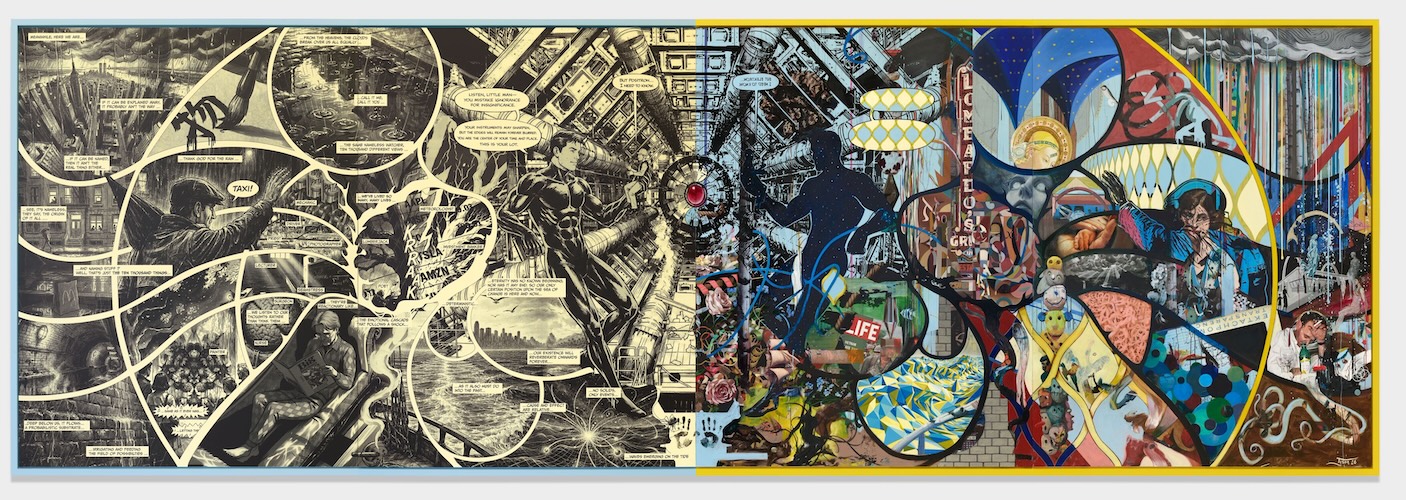
Keith Tyson, “10,000 Things,”
2026,
Ink and oil on canvas in artist’s frame,
260 x 800 x 2.5 cm / 103 7/8 x 321 1/4 x 2 in ,
269.7 x 809.4 x 5.4 cm / 106 1/8 x 318 5/8 x 2 1/8 in (framed),
Photo: Dawkins Colour, © Keith Tyson,
Courtesy the artist and Hauser & Wirth.
WW: Across the exhibition there’s a tension between vast cosmic systems and intimate human gestures. How do you continue to preserve that balance?
KT: I don’t think I have to preserve it because that’s simply the reality we live in.
We’re constantly moving between enormous systems and deeply personal experiences. We fall in love, lose people, raise families, and at the same time we’re connected to global networks and confronted with questions that span entire civilizations. That’s contemporary life.
If my work reflects that tension, it’s because there’s so much material to draw from. I don’t have to manufacture it.
WW: Are there any upcoming projects you’d like to share?
KT: I’m exploring a few ideas. One possibility is a project in Paris focused on my “Hello World” works. Across many bodies of work, I’ve made a first version that establishes the basic rules. Looking at all of those beginnings together could be interesting.
Right now, though, I’d actually like some time to absorb things. After a major exhibition, I find it important to spend time reading, researching, and taking ideas in. Someone once asked how I come up with so many ideas. I told them I’m willing to let go of the first one.
Reinvention is important. Every project begins with an empty studio, an uncertain idea, and a series of attempts. After a big show, the best thing I can do is stop for a moment and listen.
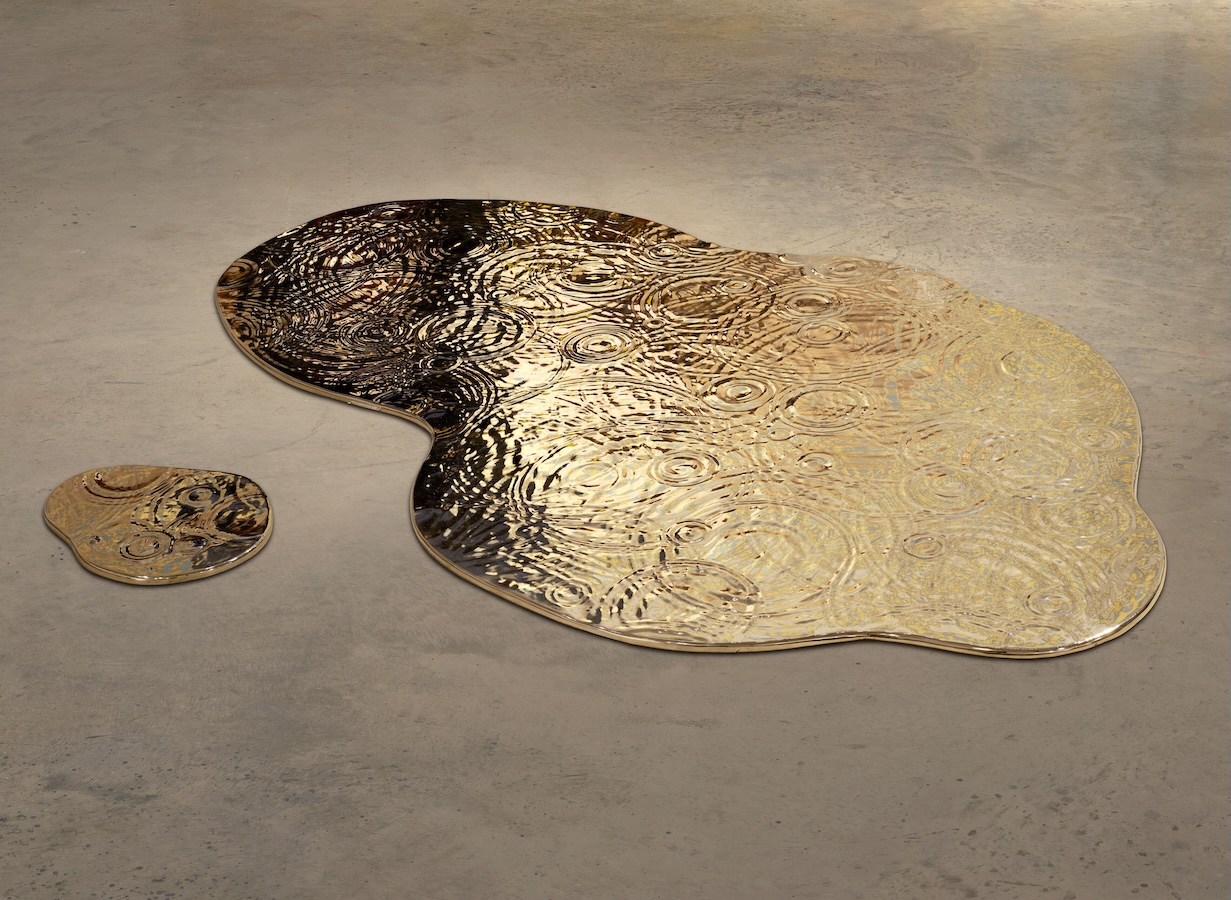
Keith Tyson, “Puddle in a Summer Shower,”
2025,
Polished cast bronze of the surface of a puddle during a summer shower, 2 parts,
overall: 1 x 158 x 95 cm / 3/8 x 62 1/4 x 37 3/8 in,
Photo: Dawkins Colour, © Keith Tyson,
Courtesy the artist and Hauser & Wirth.