
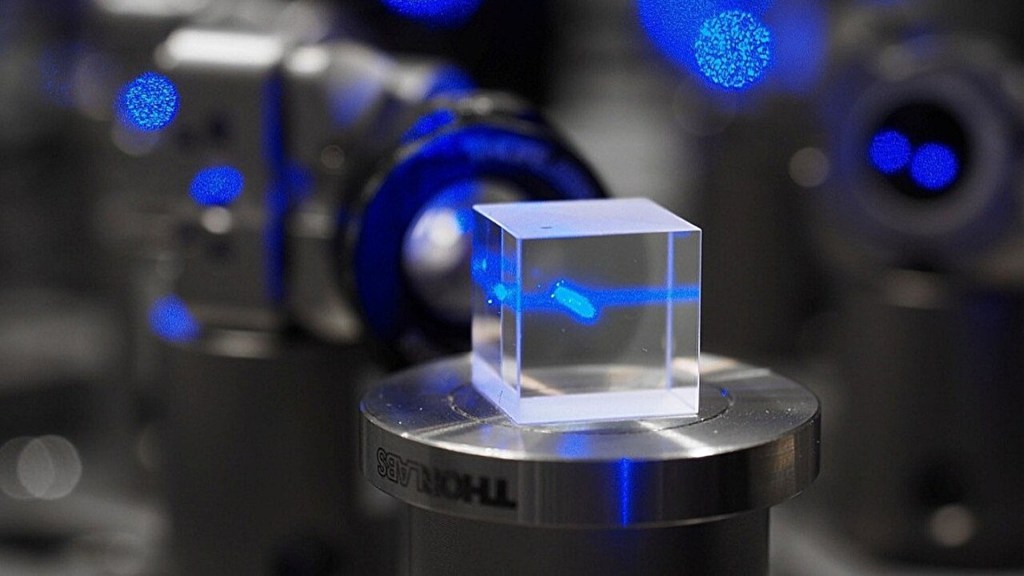
Finding out what the universe is actually made of remains one of the ultimate frontiers in modern physics. While scientists know that dark matter and gravitational waves are out there, detecting their incredibly faint signals requires instruments of unimaginable precision—tools that can easily be overwhelmed by the background noise of their own components.
Addressing this persistent bottleneck, an international collaboration led by Imperial College London has unveiled a prototype quantum sensor that successfully isolates cosmic phenomena by neutralizing disruptive experimental interference under realistic operating conditions.
The experimental milestone, marks a foundational step toward deploying long-baseline atom interferometers. These advanced systems work by using specialized lasers to split clouds of atoms and then bring them back together, allowing researchers to measure microscopic changes in atomic motion with exquisite detail.
By comparing two separate atom clouds exposed to the same laser light, any minute discrepancy in their behavior could reveal a passing gravitational wave or a ripple in an exotic dark matter field.
Taming the chaos of laser phase noise
While the underlying math of atom interferometry is sound, practical execution has long been plagued by a severe engineering challenge. The very lasers used to manipulate and interrogate the atom clouds produce inherent “phase noise“.
This systemic fluctuation is orders of magnitude larger than the faint cosmic signals researchers are actively trying to hunt down. Left uncorrected, this internal laser noise completely blinds the data, making it fundamentally impossible to identify any outside cosmic influences.
To bypass this barrier, physicists proposed a differential approach. By arranging two distinct interferometers in a specific configuration, any shared noise from the primary control laser should cancel when the two datasets are cross-referenced. Until this study, however, validating that this cancellation could actually hold up under real-world experimental settings remained unproven.
The tabletop prototype and stress testing
To test the resilience of this technique, researchers inside Imperial’s Ultracold Strontium Laboratory constructed a specialized tabletop testing apparatus. The hardware layout features two macroscopically separated clouds of strontium-87 atoms.
These atoms are cooled to near absolute zero and securely levitated using blue laser light, while being monitored by a single, highly stable clock laser system.
To push their noise-cancellation methodology to its absolute limit, the team deliberately injected massive amounts of artificial phase noise into the matrix—far exceeding the natural fluctuations of standard laboratory equipment. Initially, the introduced chaos completely erased the delicate interference patterns, rendering each individual interferometer completely unusable.
However, when the data from the two separated clouds were mathematically compared, the shared laser noise vanished. The underlying signal emerged cleanly, operating right at the fundamental limit dictated by quantum mechanics.
Unlocking a new window into the universe
To confirm the sensor’s practical utility, the scientists introduced an additional oscillating frequency designed to mimic the exact signature of an elusive dark matter field or a passing spacetime distortion. Despite being buried beneath overwhelming background noise, the differential pair identified the target signal with remarkable fidelity.
The success of this pilot test directly clears the path for scaling up the technology for international installations. The technique is central to the development of next-generation atom interferometer projects currently underway worldwide, including the MAGIS facility at Fermilab and the proposed AICE infrastructure at CERN.
By moving the discussion from theoretical math to a proven hardware reality, this quantum breakthrough ensures that future large-scale observatories will possess the clarity needed to map the invisible architecture of our universe.
The research was first published in the journal Nature.