
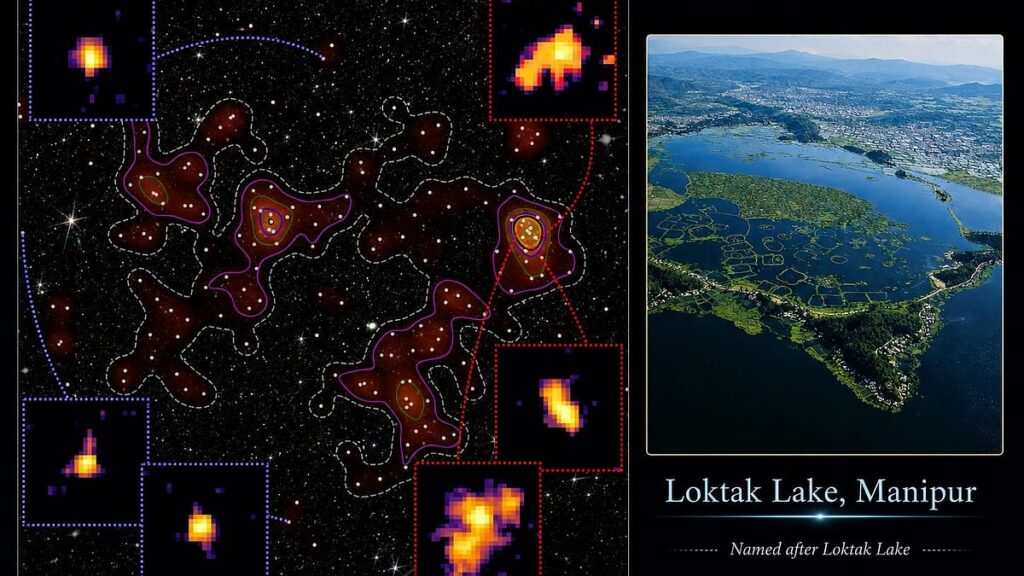
When Ronaldo Laishram was growing up in Manipur, he often came across scientific discoveries named after places far from home. Years later, the astrophysicist has helped place a piece of Manipur on the cosmic map.
Leading an international team of researchers using the James Webb Space Telescope (JWST) and the Subaru Telescope, Laishram studied the Loktak Protocluster, a giant assembly of galaxies that existed when the universe was only 1.2 billion years old. The observations offer evidence that a galaxy’s environment was already influencing its evolution at this early stage of cosmic history.
Named after Loktak Lake, Manipur’s iconic freshwater lake, the protocluster provides astronomers with a rare glimpse into how some of the universe’s largest structures were taking shape in their infancy. Because its light has taken about 12.6 billion years to reach Earth, astronomers see the system as it appeared when the universe was less than a tenth of its present age.
Galaxies in a crowded neighbourhood
Galaxy clusters are among the largest structures in the universe. Their earliest stages are known as protoclusters, vast concentrations of galaxies that later grow into the giant clusters seen today.
Using the Subaru Telescope’s Hyper Suprime-Cam, Laishram and his colleagues identified a massive protocluster dating back about 12.6 billion years. Follow-up observations with JWST allowed the team to examine its galaxies in unprecedented detail.
The findings, published in The Astrophysical Journal Letters, address an important question in astronomy: when did a galaxy’s surroundings begin shaping how it evolved?
In the present-day universe, astronomers know that galaxies located in dense environments often evolve differently from those in more isolated regions. Large galaxy clusters can affect how quickly galaxies form stars, how they grow and even their overall shape.
What has remained less clear is when these environmental influences first began operating. Observing galaxies in a protocluster provides a rare opportunity to examine these processes at a much earlier stage of cosmic history, when the universe itself was still relatively young.
“Our findings show that even at this early stage, the environment mattered,” Laishram says. “The galaxies within the protocluster were about 1.4 times larger than similar galaxies located in less dense regions. This pushes the timeline of environmental influence further back than previously confirmed and will help scientists better understand the earliest stages of galaxy formation and evolution.”
The team identified the structure by mapping young, star-forming galaxies clustered in a region far denser than the cosmic average.
Comparisons between galaxies inside and outside the protocluster revealed a striking difference.
Observations showed that galaxies within the dense protocluster had already built up larger, more extended stellar structures than comparable galaxies elsewhere, suggesting their surroundings were influencing how they grew.
The findings suggest that environmental effects were already influencing galaxy growth at a remarkably early stage in cosmic history.