
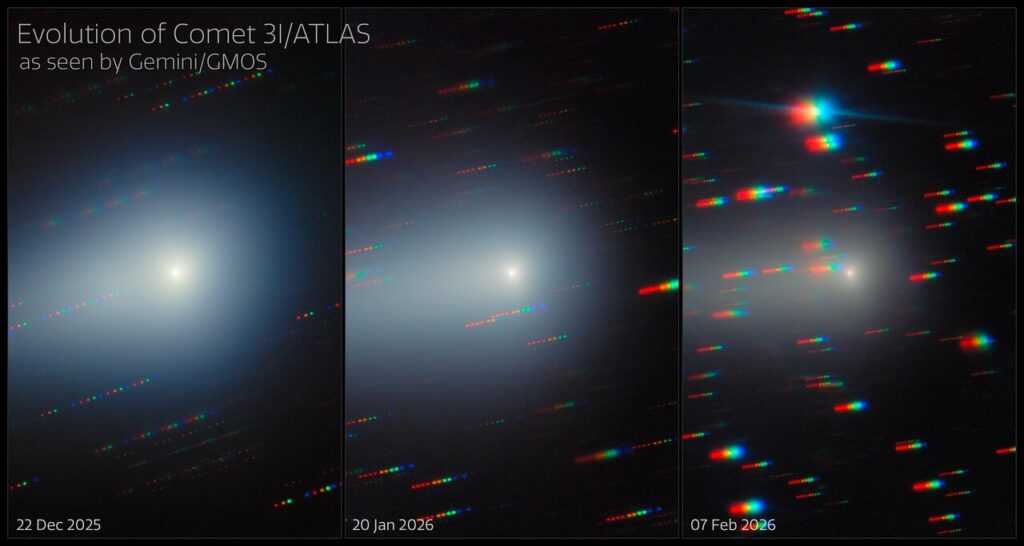
As the third known interstellar interloper to visit our Solar System, the comet 3I/ATLAS was captured here by Gemini North over a month and a half as it traveled away from Earth, never to return. 3I/ATLAS has been imaged countless times since its discovery in July 2025. Gemini North is one half of the International Gemini Observatory, funded in part by the U.S. National Science Foundation (NSF) and operated by NSF NOIRLab.
In these images, 3I/ATLAS appears to change color from greenish to light reddish (you can also compare with the Gemini image from 26 November 2025). The comet’s dust tail consists of large, micron-scale dust particles and carbon-chain gases (sequences of carbon atoms linked together by strong bonds). Compared to the previous observations, the dust tail has grown from 2.3 to 2.5 arcminutes. The dust tail is more than 250,000 km (150,000 miles) long. It now has a thinner form compared to its teardrop appearance in earlier images. This indicates that radiation pressure from the Sun was moving the micron-scale dust farther from the comet. Insights from long-term observations allow us to learn about the origin and characteristics of these objects from beyond the boundary of the Solar System.
Bryce Bolin, research scientist at Eureka Scientific, has observed 3I/ATLAS with Gemini North several times. His visible and infrared imaging and spectroscopy coverage of 3I/ATLAS previously spanned from late Summer to October 2025, before 3I/ATLAS reached perihelion. Bolin and his team continued to observe 3I/ATLAS through the northern spring of 2026.
Bolin presented his team’s newest analysis of comet 3I/ATLAS during a press conference at the 248th meeting of the American Astronomical Society (AAS) in Pasadena, California. You can read more about the observations in Astronomer’s Telegram #17841.
The individual images are here: 22 December 2025, 20 January 2026, 7 February 2026, and the composite without annotations.
Credit:
International Gemini Observatory/NOIRLab/NSF/AURA/B. Bolin
Image Processing: J. Miller & M. Rodriguez (International Gemini Observatory/NSF NOIRLab), T.A. Rector (University of Alaska Anchorage/NSF NOIRLab), M. Zamani (NSF NOIRLab)
Acknowledgments: PI: Bryce Bolin (Eureka Scientific)
About the ImageId:iotw2624aType:ObservationRelease date:June 16, 2026, 2:15 p.m.Size:2753 x 1470 pxAbout the Object