
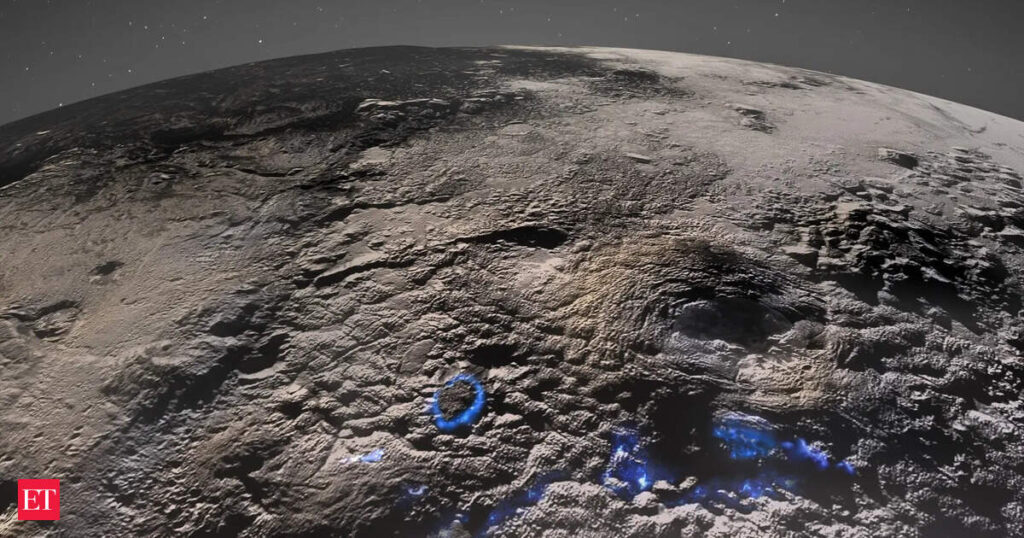
The 2002 XV93 atmosphere discovery has surprised astronomers studying distant worlds beyond Neptune. A small icy object in the Kuiper Belt may be surrounded by gas, creating a mystery about how such a fragile atmosphere could survive. Scientists expected an object this size to lose any gases quickly because its gravity is extremely weak.
The finding came after researchers observed 2002 XV93 passing in front of a distant star. The event created a rare opportunity to study the object’s surroundings from Earth. Instead of simply blocking the starlight, the object appeared to reveal signs of something around it.
The object is about 470 kilometers wide, almost the same distance as the length of the Grand Canyon. At this size, scientists believe gravity should not be strong enough to hold gases for billions of years. Any atmosphere should have escaped into space long ago. That raises a deeper question. If 2002 XV93 still has surrounding material, where did it come from? The answer could reveal new information about collisions, icy surfaces, and hidden activity on distant worlds.
Why the 2002 XV93 atmosphere discovery shocked scientistsThe 2002 XV93 atmosphere finding surprised researchers because the object appears too small to maintain a stable atmosphere. Larger planets and moons can keep gases because their gravity prevents particles from easily escaping. Small icy bodies face a very different challenge.
Astronomers suggest that the possible atmosphere around 2002 XV93 may not be ancient. Instead, it could have formed recently through a dramatic event. One possibility is a collision with another icy object traveling through the Kuiper Belt.
 Live Events
A comet-like body hitting 2002 XV93 could have released trapped gases from beneath the surface. Such an impact may create a temporary cloud around the object. The released material could remain visible for some time before disappearing into space.
Another explanation involves possible icy volcanoes. Unlike volcanoes on Earth that release molten rock, icy volcanoes can push frozen materials, vapors, and gases outward. This process could continuously refresh the environment around the object.The 2002 XV93 atmosphere mystery also shows how limited current observations can be. Scientists detected the possible presence of surrounding material, but they could not determine its exact composition.Could the 2002 XV93 atmosphere reveal hidden activity in the Kuiper Belt?The future of the 2002 XV93 atmosphere research depends on continued observation. Scientists believe time may provide important clues about the object’s true nature.
If the surrounding material disappears within a few years, it could suggest a temporary event. A recent collision may have created a short-lived plume that slowly faded away after the impact.
However, if the 2002 XV93 atmosphere remains stable or changes repeatedly, researchers may have evidence of ongoing activity. Regular variations could support the idea of internal processes releasing gases from the surface.
The discovery also expands our understanding of the Kuiper Belt. This distant region contains countless icy objects left from the early formation of the Solar System. Studying them helps scientists understand how planets and smaller bodies evolved.
A small object like 2002 XV93 may hold clues about the history of the entire Solar System. Its surface could preserve materials from billions of years ago, while new activity reveals that these worlds are not completely frozen or inactive.
The 2002 XV93 atmosphere research shows why exploration of distant space remains important. Every unexpected observation forces scientists to rethink old assumptions.
What the 2002 XV93 atmosphere mystery means for future space researchThe 2002 XV93 atmosphere mystery could reshape how scientists study small objects in the outer Solar System. For decades, researchers believed tiny icy bodies were mostly inactive remnants from the Solar System’s formation. This discovery suggests some of them may still experience changes even after billions of years.
Future observations will help determine whether the surrounding material is temporary or part of a longer process. Advanced telescopes may track changes in brightness, surface activity, and possible gas emissions around 2002 XV93. These details could reveal the object’s true condition.
FAQs:Q1. What makes the 2002 XV93 atmosphere discovery unusual?
The 2002 XV93 atmosphere discovery is surprising because scientists found possible surrounding material around a small 470-kilometer-wide object. Its weak gravity should not allow gases to remain for a long time. The finding suggests a recent impact, icy volcanic activity, or another unknown process may be creating fresh material around this distant Kuiper Belt object.
Q2. Could the 2002 XV93 atmosphere change our understanding of space objects?
The 2002 XV93 atmosphere research may change how scientists view small icy worlds beyond Neptune. If future observations confirm lasting gas or repeated activity, it could prove that some distant objects are more dynamic than previously believed. The discovery highlights that even tiny Solar System bodies may hide complex geological processes.