
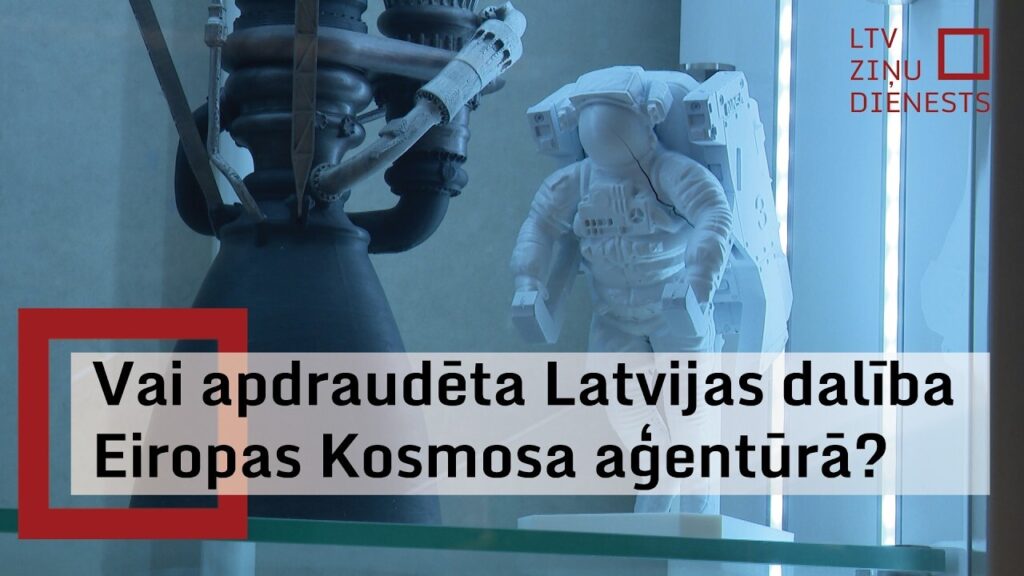
Latvia joined the European Space Agency in 2020; however, funding for the country’s continued membership is no longer included in the multiannual budget for next year, according to Minister of Education and Science Ilze Indriksone (National Alliance). Is Latvia’s membership in the agency at risk? There is no answer to that yet, Latvian Television reported on June 11.
Latvia has been an associate member of the European Space Agency for six years. Although Latvia is not a major spacefaring nation, participation in the agency has provided benefits for the national economy, as well as for education and science.
Over the past few years, dozens of different projects have been carried out; for example, Latvian scientists at the Institute of Physics succeeded in demonstrating, for the first time in the world, a new type of electricity generation method that is particularly suitable for deep-space missions. It is called thermoacoustics, which in space converts the heat of nuclear fuel into sound and then converts the sound into electricity.
Artūrs Brēķis, a leading researcher at the Institute of Physics at the University of Latvia (LU), said: “In my opinion, this directly demonstrates that every euro invested in the space sector comes back with a return.”
Moreover, space and new technologies are of great interest to students.
“Well, students don’t want to work on ideas that have been ground down for decades in scientific institutions. Here, when it comes to radically new, revolutionary technologies, I simply see that interest myself. Students come to me,” noted Brēķis.
Participation in the agency has provided various benefits, but it is not free.
And, as it turns out, no funds have been allocated in the state budget for membership in the coming years, stated the Minister of Education and Science.
“In the multi-year budget for 2027, there is no funding in this line item for the membership fee as an associate member of the Space Agency. Those years have passed, and apparently the government has either not assessed the situation or has concluded that it is no longer relevant. I very much hope that is not the case. But right now, just seeing this figure, I was very surprised,” said Indriksone.
To continue participation, more than six million euros would be needed next year.
“You are finding out now that funding for participation is not planned, but they at the agency already know this,” said Dāvids Štēbelis, the European Space Agency’s industrial coordinator in Latvia. He is also a board member of the Latvian Space Industry Association. Štēbelis pointed out that withdrawal would pose a serious risk to reputation and the willingness to cooperate with Latvia. Several cooperation agreements have been concluded over the years, and there are commitments.
“These [commitments] are crucial not only in the commercial sector but also in strengthening defence capabilities. Several examples can also be seen in Ukraine, where it is precisely these competencies and capabilities that enable the necessary ability to protect and defend oneself. They are like a huge door through which we can access an entire sector,” said Štēbelis.
When asked if there are precedents where a country joins and then withdraws, Štēbelis said: “No, this is a strategic decision at the national level.”
Without membership in the Space Agency, the scientific and commercial sectors effectively become isolated, experts noted.
Seen a mistake?
Select text and press Ctrl+Enter to send a suggested correction to the editor
Select text and press Report a mistake to send a suggested correction to the editor
Tell us about a mistake