
Back to Article List
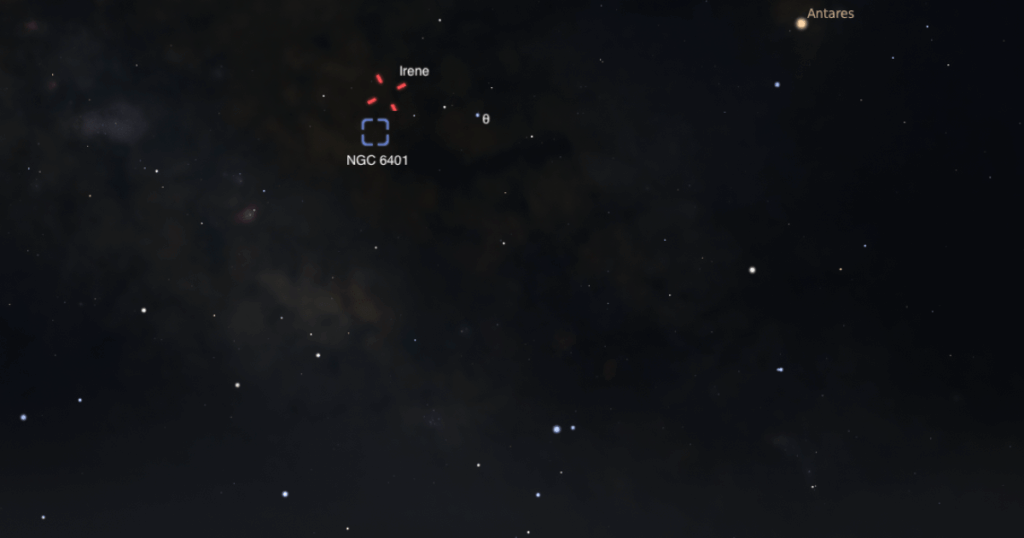
Asteroid Irene is nearly at at opposition and high in the south late tonight and overnight, near the center of the Milky Way.
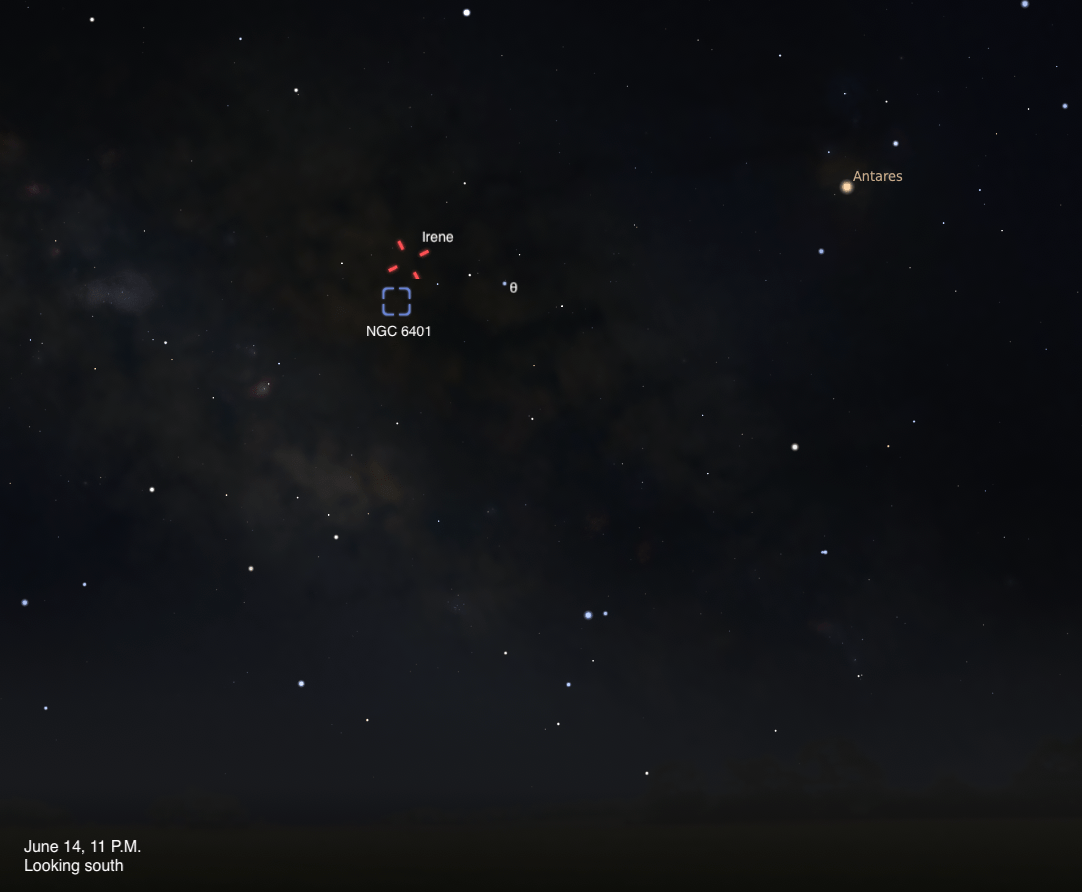
Asteroid Irene floats amid the crowded plane of the Milky Way in Ophiuchus. Even if you have trouble spotting the asteroid, try for nearby globular cluster 6401 instead. Credit: Stellarium
Looking for a sky event this week? Check out our full Sky This Week column.
June 13: Catch Comet 220P/McNaught
Asteroid 14 Irene reaches opposition at 6 A.M. EDT tomorrow morning, making now a great time to catch it. Glowing at mid-9th-magnitude, Irene is already 20° high in the south an hour before midnight and stands highest around 1 A.M. local daylight time. It’s located in Ophiuchus, near the plane of our galaxy, where you’ll also find rich clusters and numerous nebulae. It’s about 3.6° northeast of 3rd-magnitude Theta (θ) Ophiuchi. If you can spot bright orange-red Antares, look to the region left of this standout star.
Related: Discover deep-sky gems in Ophiuchus
Not far from Irene’s position is the compact globular cluster NGC 6401, which glows at roughly the same magnitude as the asteroid. You’ll find it just 1.6° southeast of Irene’s position, or 3.9° east-northeast of Theta Oph. Even if you have trouble spotting Irene against the crowded background stars, you should be able to pick up the globular much more easily.
Sunrise: 5:31 A.M.
Sunset: 8:30 P.M.
Moonrise: 4:31 A.M.
Moonset: 8:41 P.M.
Moon Phase: New
*Times for sunrise, sunset, moonrise, and moonset are given in local time from 40° N 90° W. The Moon’s illumination is given at 10 P.M. local time from the same location.
Alison Klesman is senior editor of Astronomy magazine. She holds a Ph.D. in astronomy and has studied a variety of topics, from minor planets to supermassive black holes.