
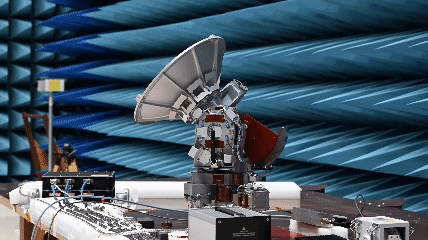
On 12th June, ESA showed what it takes to prepare a satellite’s communication system. The second-generation satellites of Galileo, Europe’s satellite navigation system, are being built. The new fleet will carry reconfigurable payloads, offering stronger, more reliable positioning, navigation, and timing services. Along with those will be intersatellite links, which will enable Galileo satellites to talk directly to one another in orbit. After extensive testing, the antennas for these links are ready to be integrated onto the satellites.
Today, Galileo relies on exchanging information between satellites and ground stations. This means a satellite must be visible from Earth to send or receive data. The planned intersatellite links change this by enabling in-space communication between satellites. Information about timing and location can be shared without depending on a ground pass. If a ground-visible satellite is not in view, a message can be relayed through another satellite
Before the antennas can fly on the new satellites, they undergo thorough tests to confirm they perform reliably in space. Thales Alenia Space and Airbus Defence and Space lead the two families of Galileo Second Generation satellites under contract with ESA, the Galileo design authority for the European Union.
Each Galileo Second Generation satellite will include two intersatellite link terminals, allowing direct in-orbit communication with other satellites in the same generation. The terminal’s pointing system will rotate the antenna every 40 seconds to align with a different target satellite. Over the satellites’ anticipated 15-year lifetime, this results in about 12 million reorientations. Reliability, then, is paramount.
Testing, and testing, and testing – for seven months
In a seven‑month test at Beyond Gravity’s facilities in Switzerland, the antenna pointing mechanism for Thales Alenia Space completed 15 million reorientations, demonstrating endurance for the planned operational life. As those tests concluded, another model underwent electromagnetic compatibility and micro‑vibration testing at ESA’s technical center in Noordwijk, the Netherlands, as part of the flight hardware assessment. After delivery to Thales Alenia Space in Spain, the mechanisms are attached to the intersatellite link panel and prepared for shipment to Rome for satellite integration. Video here
While the intersatellite links are being tested and attached to the satellites, the ground segment is being deployed and tested as well to ensure its smooth integration with existing Galileo satellites. Even with the new capability, the ground segment remains essential for monitoring the system, sending corrections, and acting as the system’s control center. The links will add resilience and improve timing and ranging measurements, ultimately boosting Galileo’s overall performance.
 Published by James Hydzik
James Hydzik is a technology geek focused on the junction of engineering, writing, and coffee. He joined Orbital Today in 2020 to help make sense of the Johnson government’s decision to buy OneWeb. Since then, he has taken on interviewing and editor-in-chief roles. James learned the ropes of editing and writing with Financial Times magazines, The World Bank, PwC, and Ericsson. Thus far, interviewing New Space movers has put the biggest smile on his workaday face. The son of an Electrical Engineer, James understands the value of putting complex topics into clear language for those with a lay person’s understanding of the subject. James is a European transplant from the United States, and as ex-KA3LLL, he now holds European amateur radio licenses. His next radio project is a portable 10GHz EME (moonbounce) station, as it combines his childhood interests in antennas and space.