
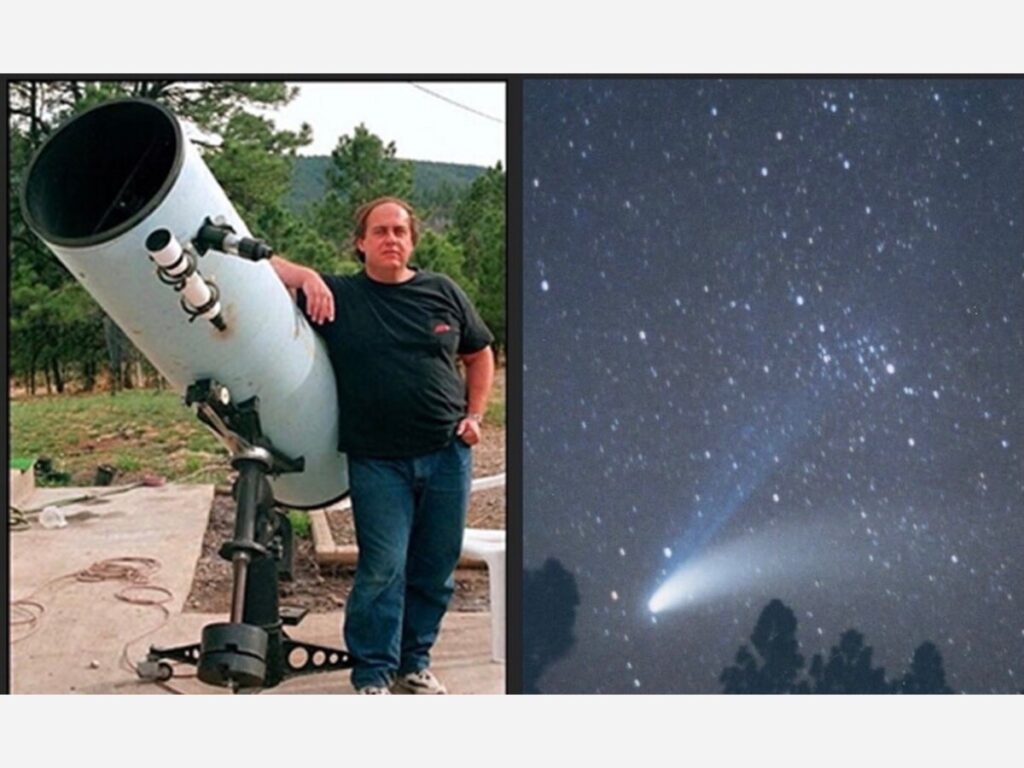
ALAMOGORDO — On the night of July 22–23, 1995, Alan Hale wheeled his 16-inch Meade Starfinder reflector telescope out of the garage of his Cloudcroft home and pointed it at the constellation Sagittarius. He had just finished observing periodic Comet Clark and was waiting for another comet to clear the horizon when he swung toward the globular cluster M70 — and found something that had no business being there. A fuzzy, diffuse object hung in the eyepiece like a smudge on the sky.
He checked his star charts. He checked his email. He checked the Central Bureau for Astronomical Telegrams database. Nothing. No one else had reported it. Hale, a meticulous man with decades of comet-hunting discipline behind him, sent two emails to the CBAT team notifying them of what he’d found — and then waited.
He did not yet know that a few hundred miles to the southwest, near Stanfield, Arizona, an amateur astronomer named Thomas Bopp had spotted the same object through a friend’s telescope that same night. Cell service being what it was in rural Arizona in 1995, Bopp had to drive all the way home to send a telegram — an actual telegram — to the CBAT. Hale’s email had arrived first. When the International Astronomical Union confirmed the joint discovery on July 23, 1995, the object was designated C/1995 O1, and it carried both men’s names into history: Comet Hale-Bopp.
Dr. Alan Hale, the Alamogordo-raised astronomer who gave our hometown a permanent address in the astronomical record, died on June 6, 2026, at his home in Cloudcroft. He was 68. His wife, Vickie, confirmed the news. Health issues had forced him to retire from regular visual comet observing as of 2025.
He leaves behind a legacy that stretches from the clear desert skies above the Tularosa Basin all the way to the outer reaches of our solar system — and every school, library, and amateur stargazing club in between.
ROOTS IN THE DESERT
Alan Hale was born on March 7, 1958, in Tachikawa, Japan, where his father was serving in the United States Air Force. The family later settled in Alamogordo, and it was here that the cosmos first captured him. Clear desert skies and a stack of library books on astronomy his father gave him in the first grade set the course of his life.
He wasn’t just a casual observer. Hale was introduced to cometary observing by an article on Comet Tago-Sato-Kosaka in the February 1970 issue of Sky & Telescope. After observing it in his 4½-inch Sears refractor and then seeing Comet Bennett two months later, he was hooked. He was twelve years old.
That early fire didn’t flicker. It carried him through Alamogordo High School, into the United States Navy, where he served from 1976 to 1983, and on to the U.S. Naval Academy, where he graduated from the physics program in 1980. After his service, he joined the Jet Propulsion Laboratory, where he worked on the Deep Space Network for three years, contributing to one of humanity’s most ambitious programs of planetary exploration, including missions associated with Voyager 2. He then returned to New Mexico, completing his Master’s degree and his Ph.D. in astronomy at New Mexico State University in 1989 and 1992. His doctoral dissertation, published in The Astronomical Journal in January 1994, focused on orbital coplanarity in solar-type binary systems and their implications for planetary formation.
The astronomical community had already taken notice of him before his most famous night. In 1991, Eugene and Carolyn Shoemaker named asteroid 4151 Alanhale in recognition of Hale’s careful visual comet observations — a quiet honor that predated his comet discovery by four years.
THE NIGHT OF THE DISCOVERY
By the summer of 1995, Alan Hale had logged hundreds of comet observations over his lifetime, and had largely given up on the dream of discovering his own. Recognizing his professional and familial responsibilities, Hale had stopped spending his nights searching for new comets, but he still held true to his goal of observing every comet he possibly could in his lifetime.
That fateful night, the object he found near M70 was his 199th comet. The one that bore his name.
The two co-discoverers didn’t meet in person until years later, but their names will forever be inextricably linked to one of the greatest comet discoveries in modern times. Hale and Bopp, separated by a state line and a communications gap, had looked at the same piece of sky on the same night and seen the same thing. The universe, it seems, had decided to be found.
What happened next was unprecedented in modern astronomical history. Comet Hale-Bopp became one of the most viewed comets in recorded history, appearing a thousand times brighter than Halley’s Comet at the same distance from the sun, and visible to the naked eye for an extraordinary eighteen months.
At its peak brightness in April 1997, it reached magnitude -1 — brilliant, unmistakable, impossible to ignore. People who had never looked up at the night sky before found themselves doing it. Parents brought children outside. Grandparents recognized something they couldn’t name. In Alamogordo, where the skies are generous and the Milky Way is a routine companion, there was a particular electricity: our guy did this.
The comet’s passage was not without shadow. The comet’s visibility in 1997 also brought one of the darkest chapters in the story of human credulity, when Heaven’s Gate cult members took their lives in the belief that an alien spacecraft was following the comet. Hale, who understood better than almost anyone alive exactly what the comet was and wasn’t, spoke often and frankly in its aftermath — about science, about the human need for wonder, and about the responsibility that comes with discovery.
BUILDING SOMETHING LASTING
The comet made Alan Hale famous. What he did with that fame defined him.
Upon completing his Ph.D., Hale discovered that astronomical opportunities were limited. So he founded the nonprofit Southwest Institute for Space Research in 1993 — before Hale-Bopp, before the world knew his name. It later became the Earthrise Institute, an organization focused on using astronomy to encourage international and intercultural understanding. The mission was not abstract. Hale believed, with the earnest conviction of someone who had spent a lifetime watching the sky, that what human beings share is larger than what divides them — and that a comet overhead is proof of it.
He returned to the Alamogordo area to put that belief to work. He worked at the New Mexico Museum of Space History as its staff astronomer and outreach education coordinator, bringing the cosmos down to earth for students, families, and curious visitors from across the region. He gave lectures and interviews, taught online courses, wrote columns for newspapers and magazines — including, fittingly, Sky & Telescope, the publication that had sparked his obsession at age twelve — and authored three books, among them Everybody’s Comet: A Layperson’s Guide to Hale-Bopp.
He was a relentless advocate for dark skies preservation in a region that remains one of the finest stargazing corridors in North America. He understood that what he had experienced as a child lying in the dark outside Alamogordo — that wordless, clarifying encounter with the scale of the universe — was something worth protecting. Not as a tourist amenity. As a human inheritance.
According to the last count on the Earthrise Institute website, he observed 533 separate comets in his lifetime. Five hundred and thirty-three. Each one requiring a clear night, a patient eye, and the particular kind of hope that keeps an astronomer looking even when decades of searching yield nothing.
WHAT ALAMOGORDO LOSES
There is a version of Alan Hale’s story that belongs to the whole world — the scientist, the discoverer, the educator, the man who co-authored one of the great naked-eye spectacles of the twentieth century. That story is being told in newspapers and astronomy journals from here to London this week.
But there is another version that belongs to us specifically.
It is the version where a military kid from Tachikawa, Japan, moves to a small desert city in southern New Mexico and finds, under these particular skies, the thing that will shape every year that follows. Where a boy reads a magazine article about a comet and decides, at twelve, that this is what his life is for. Where an Alamogordo High School graduate carries the name of this town — quietly, without ceremony — into the scientific record.
Alan Hale came back to this place. He worked here. He advocated for the dark skies here. He understood that the Space History Museum on Indian Wells Road sits in a community that has produced rocket scientists, astronauts, and astronomers not despite its desert isolation but because of it — because isolation, out here, means you can still see the Milky Way.
He is survived by his wife, Vickie, and by the family, colleagues, and students who were shaped by his work. He is survived, too, by every person in this community who ever looked up at a bright point moving slowly across the sky in 1996 or 1997 and felt something they struggled to name — that mixture of smallness and wonder that only the sky can produce, and that Alan Hale spent his life making accessible to anyone who cared to experience it.
The skies above Alamogordo this week are the same skies that made him. They remain.
Rest well, Alan. You gave us a comet to remember you by.
Chris Edwards is a staff writer for Alamogordo Town News covering local history, science, and community affairs.
Additional background reporting drawn from Sky & Telescope, the British Astronomical Association, and the Earthrise Institute.
© 2026 Alamogordo Town News • In Memoriam: Dr. Alan Hale, 1958–2026
More News from Alamogordo