
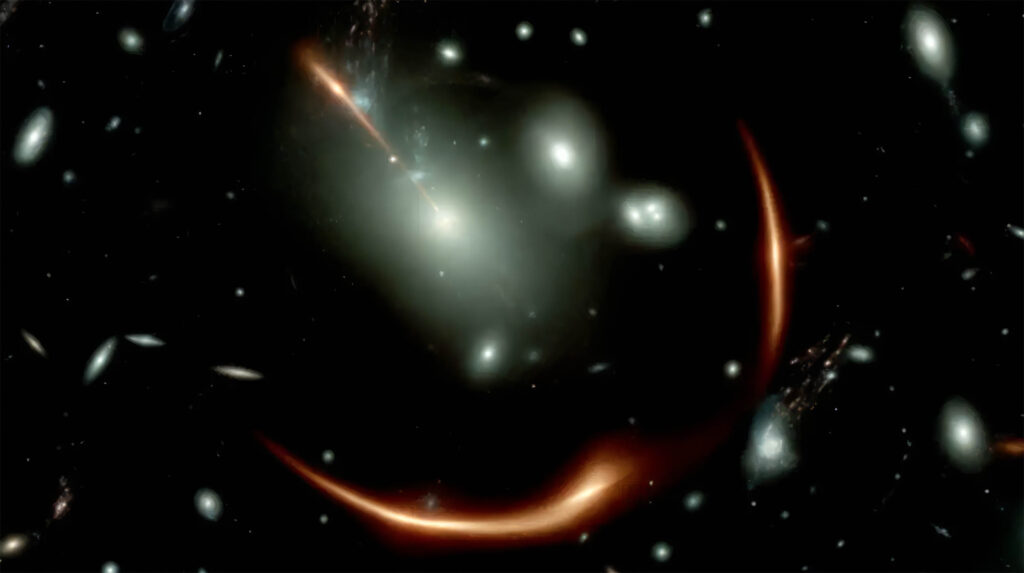
Black holes are often found because they make a lot of noise. As gas and dust fall into them, they can release enormous amounts of energy, lighting up the centers of galaxies and becoming some of the brightest objects in space.
But not all black holes are active. Some are dormant and remain unnoticed, giving no signals for telescopes to detect.

Finding them is much harder, but astronomers have now succeeded in detecting one of the most distant objects of this kind.
The object sits at the center of a galaxy more than 10 billion light-years from Earth. Scientists identified the most distant dormant black hole ever found, pushing the previous distance record nearly 15 times farther.
The discovery offers a rare glimpse into a period when the universe was still young and developing many of the structures seen today.
Finding MRG-M0138
This black hole is located at the center of the galaxy MRG-M0138, and astronomers estimate it has a mass about 6 billion times that of our Sun.
The significance of this discovery lies in its age. Astronomers are studying it during an era when the universe was only about 3 billion years old – roughly one-fourth its present age.
Unlike active black holes, this one does not emit high levels of radiation. As a result, it is essentially dormant and therefore invisible.
Weighing an unseen giant
Using observations made by NASA’s James Webb Space Telescope (JWST), an international team of astronomers has tracked the motion of stars close to the center of the galaxy.
Scientists measured the speed of the stars’ motion and compared how stars near the center moved with those farther away. Using those differences, they calculated the mass of the unseen object responsible for the motion.
“Determining how stars collectively move within the core of this distant galaxy has allowed us to measure the mass of its otherwise undetectable supermassive black hole,” said senior author Professor Richard Ellis of the Department of Physics and Astronomy at University College London (UCL).
“By demonstrating the feasibility of such a technique for galaxies in the early universe, we can now undertake a more complete census of how black holes develop over time and infer their role in shaping galaxy evolution.”
The method, known as stellar dynamics, has been used before to measure dormant black holes in nearby galaxies, including the supermassive black hole at the center of the Milky Way.
However, this marks the first time scientists have successfully applied the technique to an object at such an enormous distance.
When gravity bends light
Normally, observing stellar motions in a galaxy more than 10 billion light-years away would be beyond current capabilities. Nature provided an assist.
A second galaxy positioned between Earth and MRG-M0138 acts as a gravitational lens. Its gravity bends and refocuses light from the more distant galaxy, magnifying the image by about 30 times.
This natural magnification allowed researchers to examine details that would otherwise remain hidden.
“By combining JWST data with gravitational lensing, we could peer inside the black hole’s sphere of influence, where its gravity boosts the speeds of stars,” said lead author Dr. Andrew Newman of Carnegie Science.
“This is one of the best techniques we have to weigh a black hole, so we were excited to extend it to a much earlier period in cosmic history.”
Before this study, the most distant galaxy analyzed using the same approach was only about 700 million light-years away.
Black holes and dead galaxies
This finding can help answer another long-debated question in astronomy: How does the presence of a supermassive black hole affect nearby galaxies?
The researchers discovered not only a dormant black hole but also an inactive galaxy hosting it. Such galaxies are known as quiescent galaxies because they are no longer forming new stars.
Scientists have reason to believe there was once a period when a quasar resided within MRG-M0138, with matter actively falling into its central black hole.
At the same time, large amounts of energy may have prevented the galaxy from forming new stars by heating and disrupting the gas clouds needed for star formation.
Many scientists think this mechanism is important for galaxy evolution. Black holes may regulate the growth of their host galaxies by restricting star formation.
Lessons from MRG-M0138
Scientists have discovered only a handful of dormant black holes this massive, and they found all previous examples much closer to Earth.
That makes MRG-M0138 particularly valuable. It provides a direct look at the relationship between galaxies and their central black holes during a crucial stage of cosmic history.
Astronomers expect JWST and future observatories to uncover many more hidden black holes from the early universe.
Each new discovery will help answer important questions about how these objects formed, how they grew so quickly, why some become dormant, and what causes them to become active again.
For now, one nearly invisible black hole has already opened a new window into the universe’s distant past.
The full study was published in the journal Science.
—–
Like what you read? Subscribe to our newsletter for engaging articles, exclusive content, and the latest updates.
Check us out on EarthSnap, a free app brought to you by Eric Ralls and Earth.com.
—–