
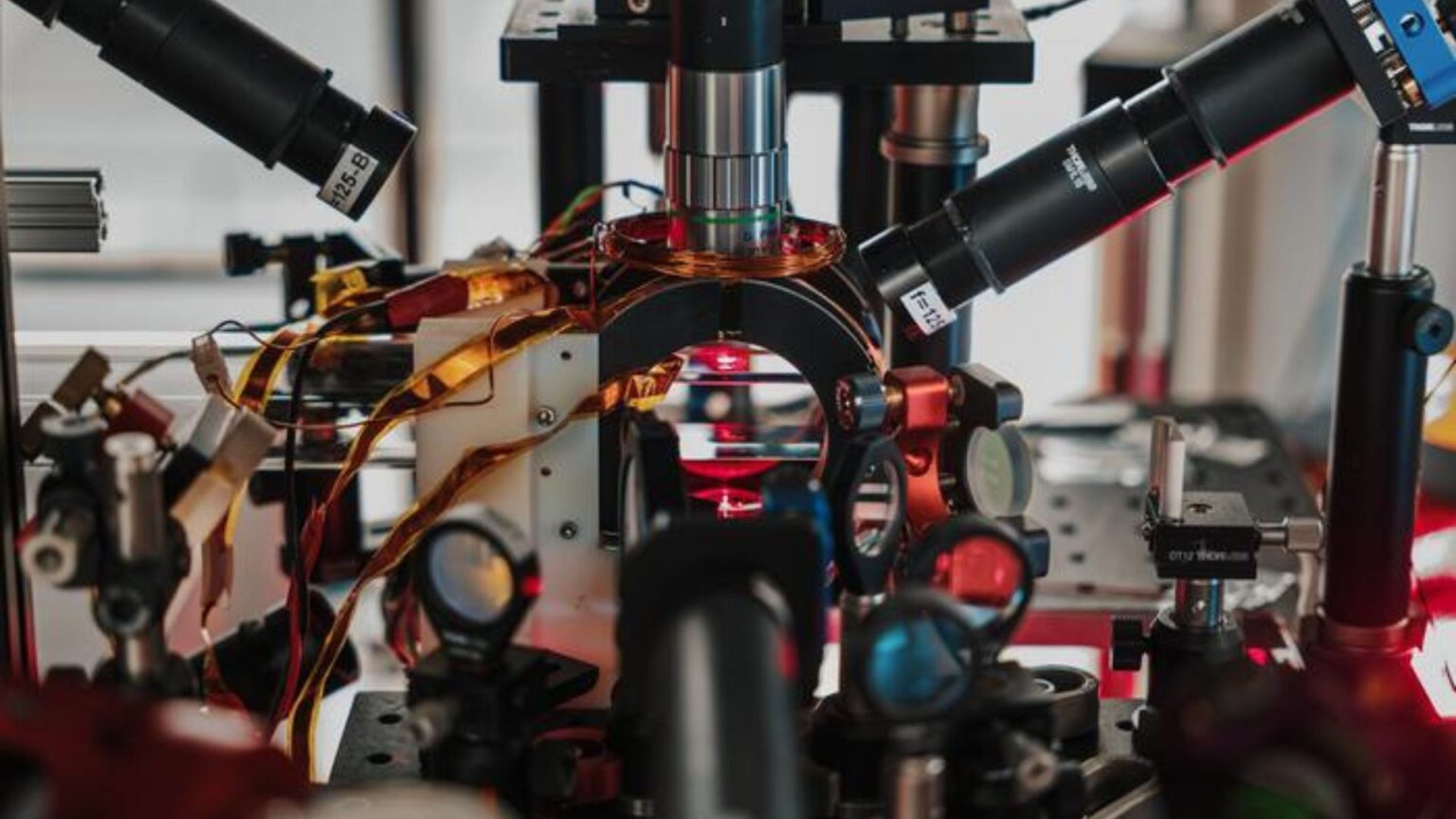
What if time isn’t woven into the fabric of reality at all? A new experiment suggests that the past-to-future march we experience every day could arise from the internal dynamics of a system. Using 24,000 ultracold atoms, scientists built a “mini universe” that allowed them to study how time might emerge without relying on clocks.
The findings, published in Physical Review Research, offer researchers a new way to test ideas that have long remained in the realm of theory. The setup could help scientists explore quantum gravity, the origins of the universe, and the fundamental nature of time inside a laboratory.
Building a mini cosmos
Professor Giovanni Barontini of the University of Birmingham and his team created the miniature universe using a cloud of 24,000 ultracold atoms. The atoms existed just billionths of a degree above absolute zero.
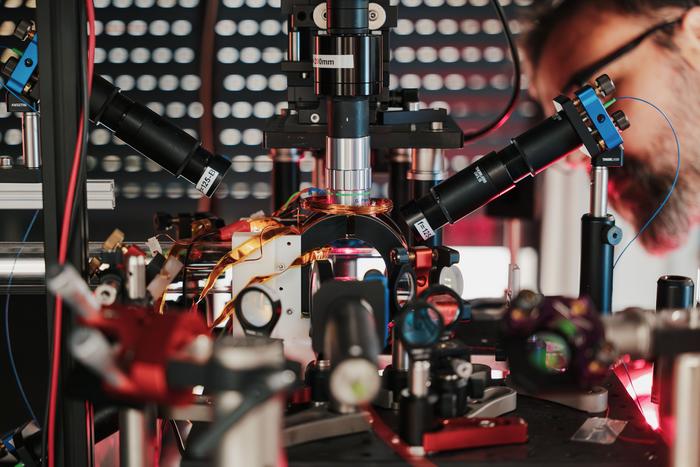 Experiment to trap and cool rubidium atoms close to absolute zero. Credit – University of Birmingham
The researchers confined the particles inside an isolated quantum system. They then used two laser beams to form a thin barrier that divided the setup into two regions. One region remained observable, or “bright.” The other stayed hidden from direct observation and became the “dark” sector.
Inside this simplified cosmos, the bright region repeatedly expanded and contracted. The cycle resembled theoretical versions of a Big Bang followed by a Big Crunch, a scenario in which the universe’s expansion eventually reverses.
Because the system remained sealed from its surroundings, scientists reconstructed the sequence of events using only changes occurring within the mini-universe. They did not need an external laboratory clock.
Time through disorder
The experiment points to a concept known as “entropic time.” Rather than treating time as an independent backdrop to reality, the researchers linked its passage to changes in entropy, or the way particles spread through the system. Atoms moved between the bright and dark regions, altering the distribution of matter.
As those distributions evolved, the system moved forward in time. When the arrangement stopped changing, time effectively stood still. The team found that this version of time flowed in a consistent direction. It also correctly ordered events, even during repeated cycles of expansion and contraction. Its pace could speed up or slow down depending on how entropy shifted within the system.
“In some theories of the universe, especially quantum gravity, time doesn’t appear as a built-in feature,” Barontini said. “Yet in everyday life, time flows from past to future. Why is this so, when most basic laws of physics work the same way forwards and backwards?”
Bringing cosmology to the lab
Barontini said the study provides controlled experimental evidence that changes within a system can define time without relying on an external clock. “It offers new insight into the nature of time in quantum gravity,” he said. “It could be used to describe dynamics just as effectively as conventional time.”
The researchers also showed that quantum mechanics remains mathematically consistent under this framework. They rewrote a version of the Schrödinger equation using entropic time, allowing predictions about how a quantum probability distribution evolves.
The work addresses a long-standing puzzle in physics: If the universe has no fundamental clock, how can events be arranged into a meaningful sequence of “before” and “after”? Perhaps more importantly, the experiment transforms abstract debates into testable science.
The platform could eventually allow researchers to investigate conditions linked to the early universe, probe competing theories of quantum gravity, and even simulate black holes under controlled laboratory conditions.
For decades, many of these questions existed mainly on chalkboards and in complex equations. This miniature universe suggests physicists may finally have a way to put some of them to the test.