
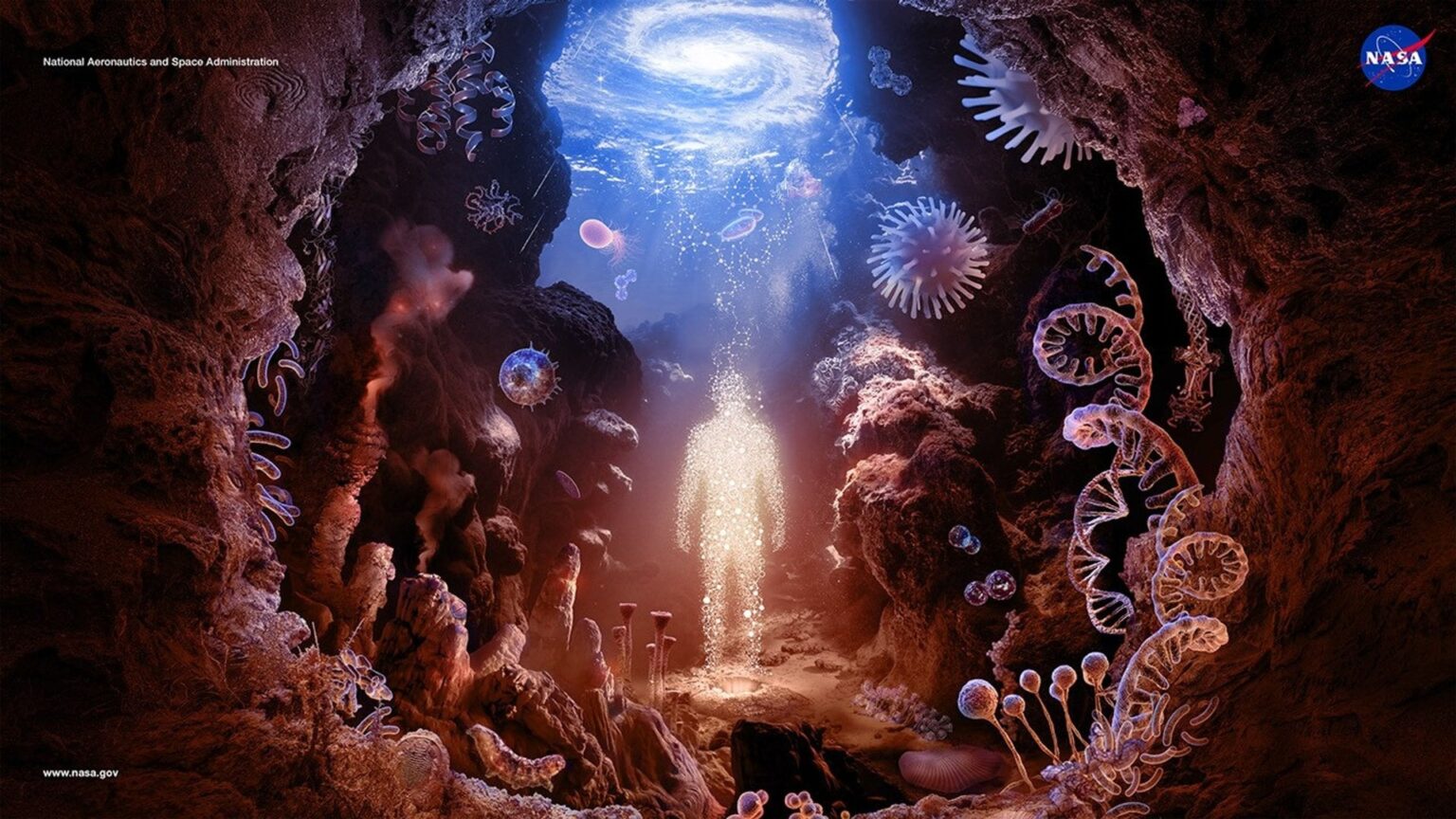
The question of how life began here on Earth, or how simple organisms emerged from chemical compounds, remains a bit of a mystery. While scientists have confirmed through fossil evidence and the geological record that life began roughly 4 billion years ago on the seafloor (around hydrothermal vents), it is still unclear how the ingredients for life came to Earth. The generally-held view is that they were brought here by comets and asteroids from the outer Solar System, which also delivered Earth’s surface water.
This theory states that planetesimals delivered these elements to the inner Solar System during the Late Heavy Bombardment, thought to have occurred between 4.1 and 3.8 billion years ago. However, a new NASA-supported study is providing new information about how primordial Earth acquired life-essential elements (LEEs). Their findings, published in the journal Science Advances, indicate that Jupiter likely played a key role in the process.
The research team hails from Rice University’s Department of Earth, Environmental and Planetary Sciences. As they indicate, the timing of the deliver of LEEs to Earth remains debated, as does the geochemistry of the planetesimals involved. Traditional models attribute it to outer Solar System chondrites, stony meteorites that formed two to four million years after the first solids formed in the Solar System. However, as the team noted, this accretion age rules them out as the earliest source of LEEs.
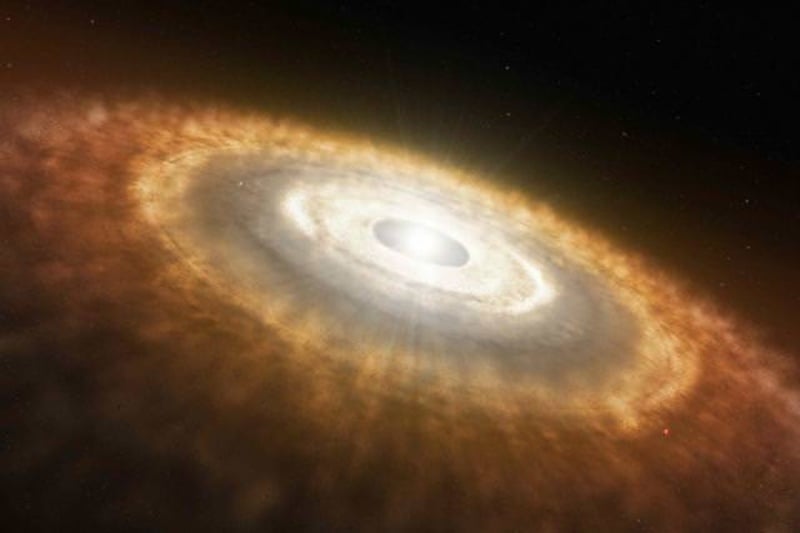 *Artist’s impression of a circumsolar debris disk, from which systems of planets form. Credit: NASA*
To break it down, all life on Earth requires the same basic elements, known by the acronym CHNOPS: carbon, hydrogen, nitrogen, oxygen, phosphorus, and sulfur. These elements formed through the fusion of hydrogen and helium in the first generation of stars (Population III), which were then dispersed throughout the cosmos as clouds of gas and dust when these massive stars went supernova at the end of their short lifespans (tens of millions of years). These and other heavy elements (including silica, iron, and various metals) then coalesced to form subsequent generations of stars and planets.
Roughly 4.6 billion years ago, the Sun formed from a collection of this gas and dust (nebula), experiencing gravitational collapse at the center. The remaining material formed a disk around the new star, slowly accreting to form the Solar planets and planetesimals. What material remained, in the form of asteroids and comets, settled into different orbits, most into the Main Asteroid Belt and the Kuiper Belt. Others, meanwhile, fell into the orbits of planets – like Near-Earth Asteroids (NEAs) or Jupiter’s Trojan and Greek populations.
Over time, many of these objects have crossed Earth’s orbit, impacted the surface, and were recovered as meteorites. The study of these objects provides a window into the early Solar System, a much more chaotic time when Earth was still in formation. Meteorites fall into two categories, both of which originated from planetesimals that formed at different times in our system. These include dense metallic objects (iron meteorites) and stony chondrites, the latter of which constitute the majority of those found on Earth.
The oldest planetesimals are the source of iron meteorites, while chondrites originate from the second generation that formed 2-3 million years later. While some evidence points to chondrites from the outer Solar System delivering the ingredients for life late in Earth’s formation, scientists continue to debate which type of meteorites delivered Earth’s stock of LEEs. The new study suggests that things might have happened differently than traditional models suggest.
Using laboratory experiments and geochemical models, the team reconstructed a map of phosphorus-nitrogen (P/N) ratios across the early Solar System. Their results showed that during the first generation of planetesimals (iron), objects had a higher ratio of P/N in the outer Solar System, which decreased toward the inner Solar System. This trend was reversed in the second generation, where chondrites had higher P/N ratios in the inner Solar System.
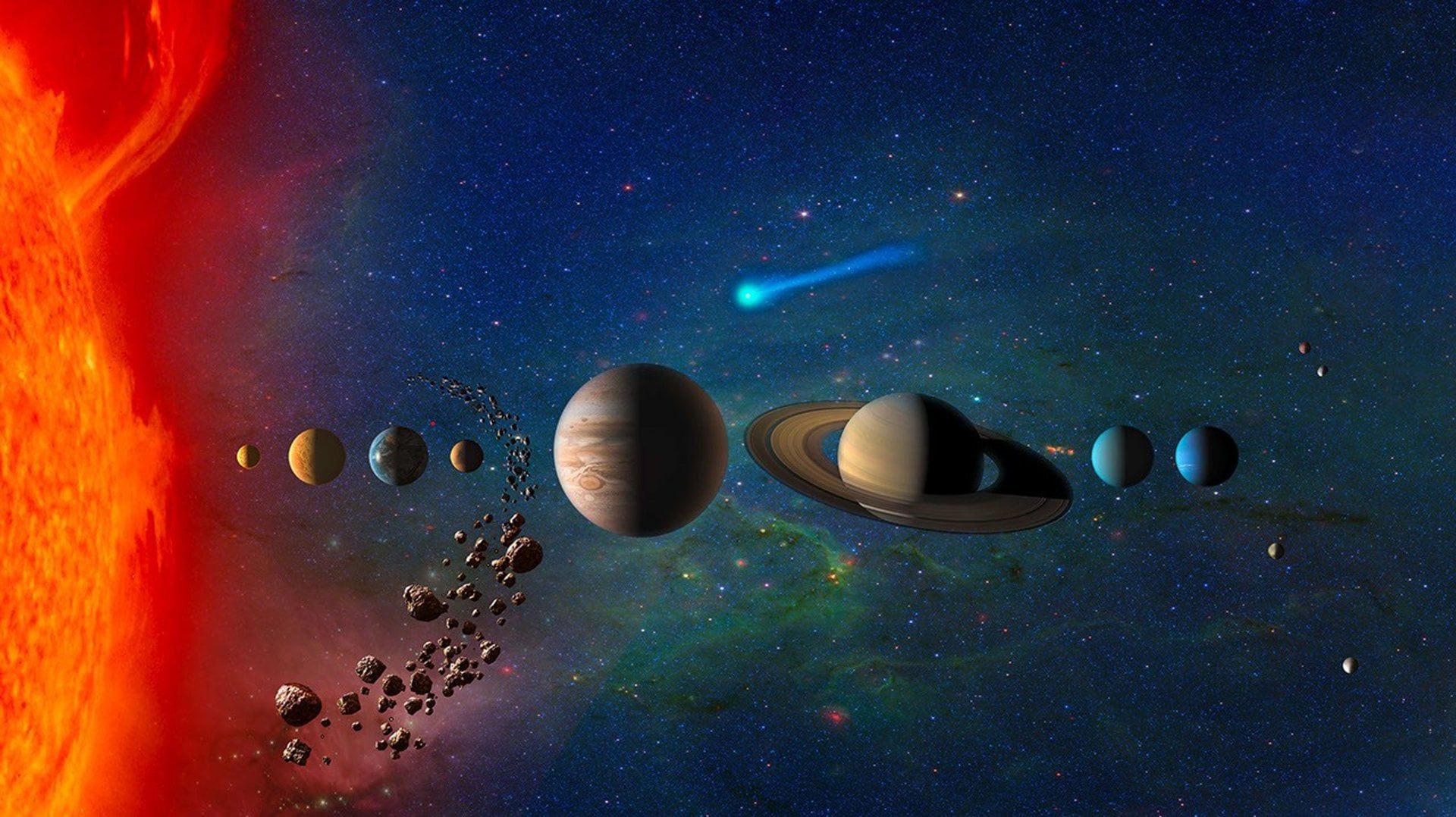 *An illustration of our solar system. The asteroid belt lies between Mars and Jupiter, separating our system into the inner and outer regions. NASA/JPL-Caltech*
The team theorized that during the first generation, an outward flow of material raised the P/N ratio in the outer Solar System. This changed with the arrival of Jupiter, whose gravitational influence restricted the movement of phosphorus and nitrogen from the inner to outer Solar System. This meant that when the second generation of planetesimals appeared, those that orbited within the inner Solar System were left with a higher P/N ratio than their counterparts that orbited farther from the Sun.
These results suggest that, contrary to previous models, Earth acquired its phosphorus and nitrogen (both essential to life) primarily from the inner Solar System, without additional contributions from the outer Solar System. Their findings are reinforced by geochemical accretion models showing that Earth’s present-day P/N signature is best reproduced by inner Solar System planetesimals, regardless of whether they are related to iron or chondrite meteorites. As Rajdeep Dasgupta of Rice University, the senior author on the study, said in a NASA press release:
For our own solar system, Jupiter’s presence and growth history, indeed, seem to have played a critical role in determining the distribution of the basic chemical ingredients necessary for habitable worlds. It remains an open question whether a life-essential element budget similar to Earth’s can be established without a Jupiter-like planet in the population.
“The study suggests that Earth acquired its inventory of the life-essential elements phosphorus and nitrogen primarily from the inner solar system, without requiring a significant contribution from outer solar system chondrites,” added Pathak. As for the other LEEs, the means through which they were delivered to Earth billions of years ago remain to be seen and will be the subject of future research.