
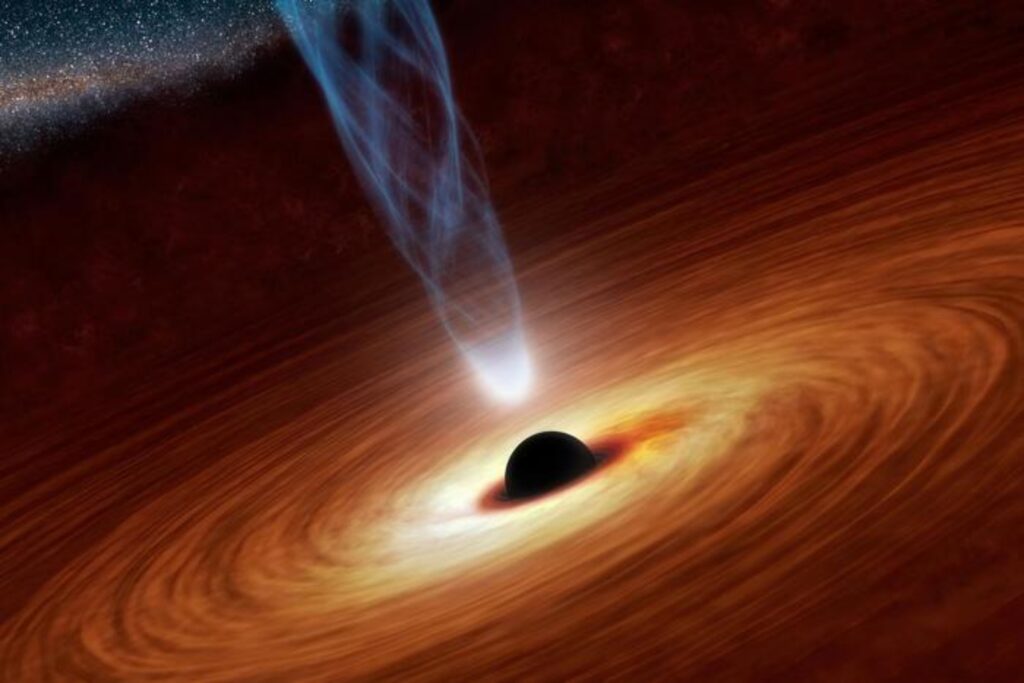
A newly detected flicker from an ancient quasar has caught astronomers’ attention. The signal comes from just 850 million years after the Big Bang, making it the earliest flickering quasar ever observed.
More importantly, the flicker revealed something unexpected about one of the universe’s earliest supermassive black holes.

Quasars are among the brightest objects in existence. They form when a supermassive black hole pulls in enormous amounts of gas and dust.
As this material spirals inward, it heats up and releases vast amounts of energy. Some quasars shine so intensely that they outshine the galaxies that host them.
Quasars in the cosmic dawn
Researchers at MIT and several collaborating institutions traced this newly studied quasar back to the period astronomers call the cosmic dawn.
The discovery offered a rare chance to look beyond a distant point of light and learn something about the black hole itself.
“Although there have been a lot of quasars found in the cosmic dawn, this is the first time we actually see one flickering,” said Gene Leung, a postdoc in the MIT Kavli Institute for Astrophysics and Space Research.
The influence of black holes
Supermassive black holes sit at the centers of galaxies, including the Milky Way. Some contain millions or even billions of times the mass of the sun.
Their influence stretches far beyond their immediate surroundings, helping shape how galaxies grow and form stars.
“Without supermassive black holes, no galaxy would look the way it does today,” said Anna-Christina Eilers, assistant professor of physics at MIT. “Black holes play a major role in shaping how galactic ecosystems look.”
Why a flicker matters
For years, astronomers assumed that supermassive black holes needed more than a billion years to develop.
Observations have challenged that idea. More than 200 supermassive black holes have already been found within the universe’s first billion years.
The problem is that these distant objects usually appear as tiny points of light. Scientists can confirm they exist, but learning details about their structure is much harder.
Flickering changes that. Variations in brightness can reveal what is happening in the disk of gas and dust feeding a black hole.
“People have known that quasars in the nearby universe can flicker,” said Leung. “The flickering comes from fluctuations in the way the gas is being fed into the black hole.”
“And how a quasar flickers tells us something about the structure of a black hole’s accretion disk, and the kind of ‘bites’ that the black hole is eating.”
Looking back more than 13 billion years
Finding a flicker from such an ancient object was not easy. As the universe expands, light from distant objects stretches toward longer wavelengths.
This process, known as redshift, also stretches the timing of events. A brightness change that happens over weeks can appear to take months when viewed from billions of light-years away.
To catch the signal, the research team needed years of infrared observations. They turned to data collected by NASA’s Near-Earth Object Wide-field Infrared Survey Explorer, or NEOWISE.
The space telescope repeatedly scanned the sky over roughly 14 years.
After reprocessing the archival observations, researchers uncovered a quasar from 850 million years after the Big Bang that showed clear brightness variations over time.
“We saw the quasar flickering randomly over the 14-year period, much like a candle’s flame flickers without a fixed pattern,” Leung noted.
The quasar is estimated to be as bright as 12 trillion suns. Its brightness fluctuates by about 20 percent, equivalent to roughly 2 trillion suns.
An old mystery gets deeper
The flickering carried another surprise. By studying how the quasar’s brightness changed across different wavelengths, the team mapped the structure of the accretion disk surrounding the black hole.
Different wavelengths come from material at different temperatures, allowing astronomers to estimate how matter is arranged around the black hole.
What they found was unexpected. The accretion disk appeared thin and flat.
That shape is commonly seen around older, more mature black holes in the nearby universe. Scientists expected early black holes to be feeding aggressively and surrounded by thicker, more turbulent disks.
Instead, this ancient object already looked remarkably settled.
“This provides direct evidence that the same feeding processes and structures observed in the nearby universe were already in place at very early times, despite very different cosmic environments, which had never been seen before,” Eilers said.
“This means something happened even earlier on that led to these systems to look so mature,” Leung adds.
The race to understand cosmic giants
The discovery raises fresh questions about how supermassive black holes grow so quickly.
Astronomers have generally assumed that black holes pass through messy periods of rapid growth before settling into stable systems.
This newly observed quasar suggests those dramatic stages may happen much earlier than expected.
“I think what this suggests is that all the messy, very rapid growth phases that we expect all black holes to go through at some point happen very, very early on, before we see them as these very bright luminous quasars,” said Eilers. “That’s the picture that’s emerging.”
Scientists now hope to find even younger quasars and watch the earliest stages of black hole development.
Each new observation offers another clue about how some of the universe’s largest and most powerful objects appeared so soon after the Big Bang.
The answer may lie hidden in an even older flicker waiting to be found.
The full study was published in the journal Nature Astronomy.
Image Credit: NASA/JPL-Caltech
—–
Like what you read? Subscribe to our newsletter for engaging articles, exclusive content, and the latest updates.
Check us out on EarthSnap, a free app brought to you by Eric Ralls and Earth.com.
—–