
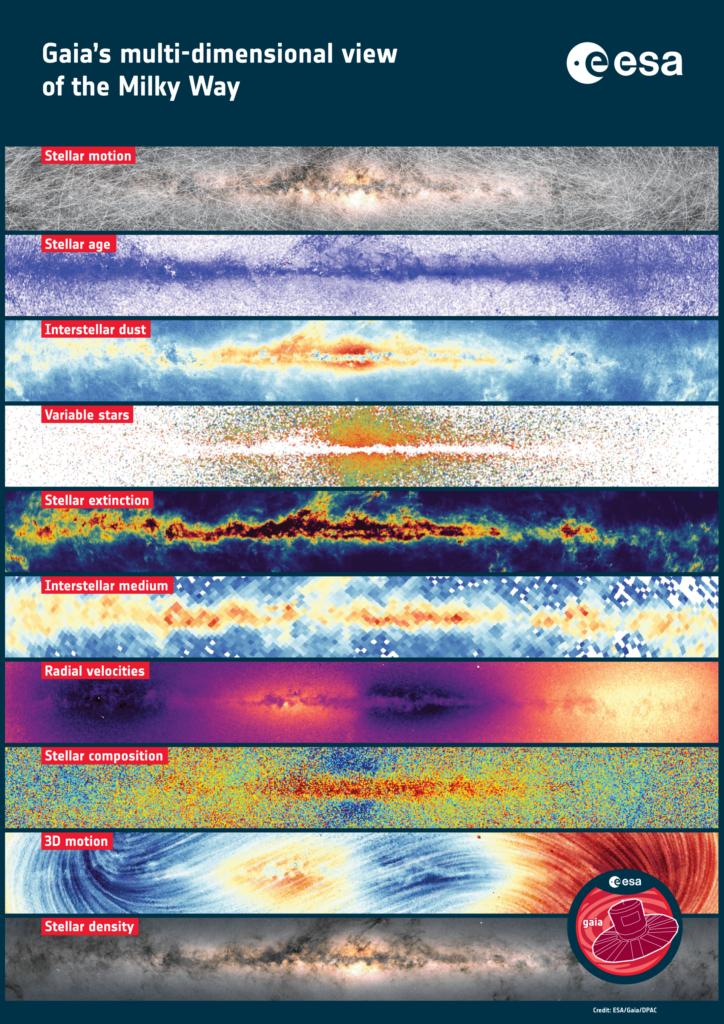
This Gaia poster was created from several Gaia Collaboration sky maps, as published on 13 June 2022 for Gaia’s third data release.
From top to bottom the sky maps represent: (1) the displacement of stars on the sky 400 000 years into the future, (2) the age of stars where blue represents young stars and red represents old stars, (3) the effect of interstellar dust where blue represents less dust and red represents more dust, (4) RR Lyrae variable stars colour-coded with their chemical composition, where blue represents less heavy elements and red represents more heavy elements, (5) stellar extinction where blue represents less extinction and red represents more extinction, (6) map of the interstellar medium where blue represents a small effect seen and red represents a strong effect, (7) line-of-sight velocities of stars where bright areas represent stars moving away from us and dark areas represent stars moving towards us, (8) the chemical composition of stars where red represents an abundance of heavy elements (elements heavier than hydrogen and helium) and blue represents the opposite, (9) an artistic impression of the 3D motion of stars combining the line-of-sight velocity and the velocity across the sky, (10) stars plotted with their brightness and colour at their respective location in the sky.
[Image description: This vertical poster is composed of ten horizontal sky‑map strips, each spanning the full width and showing different colour and texture styles. Some strips appear soft and cloud‑like in blues, greys, or warm oranges, while others use bold, high‑contrast colours such as purples, greens, and yellows arranged in speckled or patterned textures. Several maps feature smooth gradients or swirling shapes, and others look grainy or pixel‑like with dense point patterns. Together, the ten strips form a vertically stacked mosaic of varied colour palettes and visual textures.]