
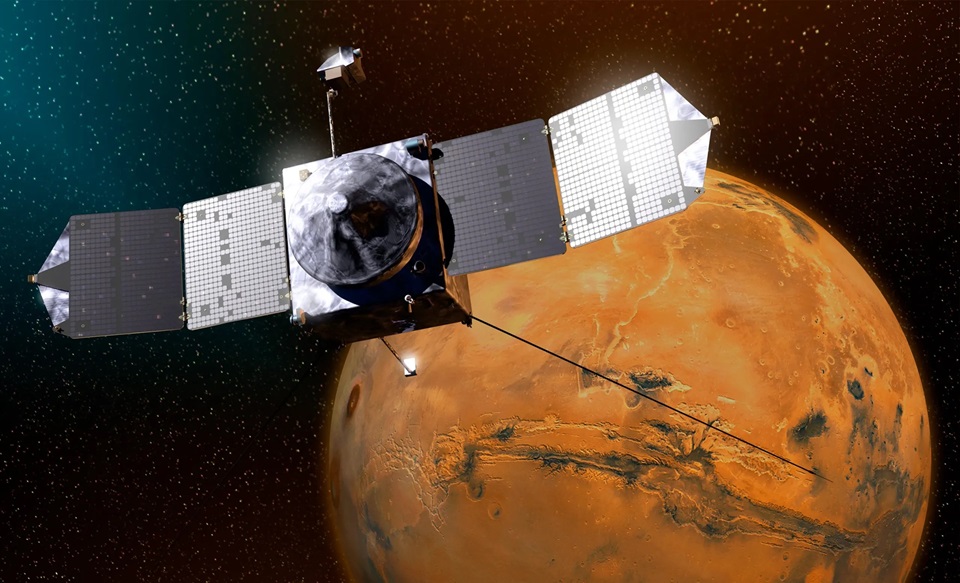
The MAVEN probe has been definitively lost. It was reported on June 3 that contact with the probe had not been reestablished. It is now clear that it is time to take stock of this mission, which has been studying Mars from orbit for 12 years.
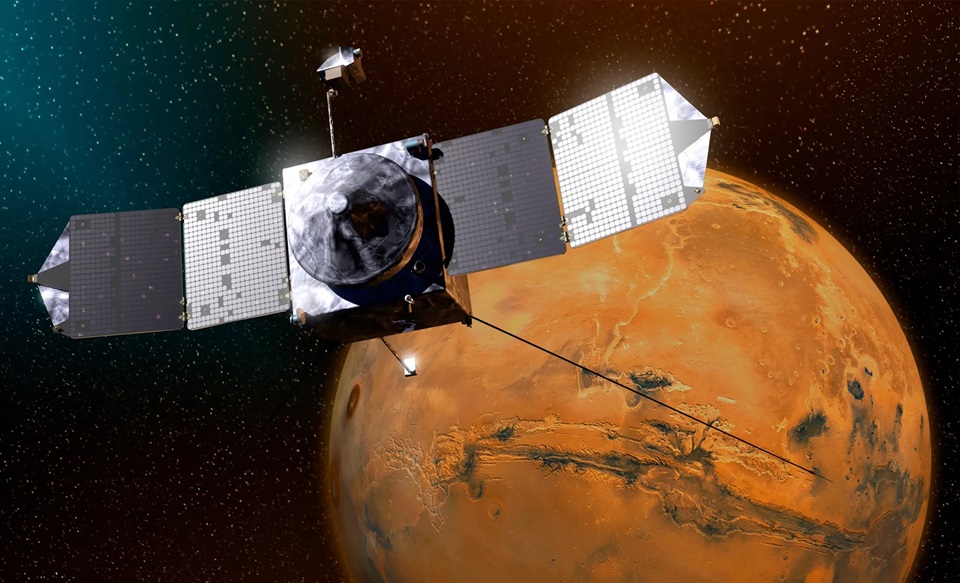 MAVEN spacecraft. Source: www.astronomy.com
12-year Mars mission
NASA has ceased attempts to reestablish contact with the Mars Atmosphere and Volatile EvolutioN (MAVEN) spacecraft and has begun decommissioning the orbiter, thereby concluding a mission that has spent more than a decade studying how Mars lost its atmosphere.
At a press conference on June 3, NASA officials announced that the anomaly investigation panel—which was formed in February following several unsuccessful attempts to reestablish contact with the spacecraft after the signal was lost on December 6, 2025—had determined that MAVEN could not be restored. The spacecraft, which has been operating in Mars orbit since 2014, is now officially being decommissioned. Its data will be archived for future research.
Launched in November 2013 and commissioned in September 2014, the spacecraft completed its one-year primary mission in 2015 and continued to operate through five extended missions over the next decade. MAVEN became NASA’s first mission specifically designed to study the Martian atmosphere. Its primary goal was to help scientists solve one of the greatest mysteries in planetary science: how did Mars, which once appeared to be warm and wet, become the cold and dry world of today? Throughout the mission, the MAVEN science team has published more than 800 papers, and there’s more to come.
History of MAVEN’s findings
Over the course of its 11 years on Mars, the MAVEN spacecraft has radically transformed our understanding of this field. “The MAVEN mission has truly expanded our understanding of the Martian atmosphere and its evolution,” Shannon Curry, MAVEN’s principal investigator and a professor at the University of Colorado Boulder’s Laboratory for Atmospheric and Space Physics, noted in a press release. “Our science team is incredibly proud of all these amazing discoveries.”
In 2015, MAVEN enabled scientists to measure the rate of atmospheric escape, revealing a sharp increase during solar storms. Then, in 2025, MAVEN became the first spacecraft in the world to directly observe so-called “atmospheric sputtering”—a specific process of atmospheric escape in which energetic ions collide with the upper layers of the planet’s atmosphere and eject gas molecules into space. Using 11 years of argon data to confirm this, the team demonstrated that this process has been slowly drying out Mars over billions of years. MAVEN also documented new types of auroras unique to Mars and collaborated with Perseverance to capture the first visible-light aurora ever seen from the planet’s surface.
MAVEN has also made a significant contribution to the “Mars Relay Network”—a network of orbital spacecraft that facilitates data transmission between rovers on the surface and Earth. According to NASA, over the course of its mission, MAVEN handled approximately 8 percent of all relay sessions scheduled by the rover teams, but transmitted nearly 18 percent of all data sent by these missions to Earth—demonstrating performance far exceeding its technical capabilities.
Loss of contact with MAVEN
MAVEN’s last contact with Earth took place on December 6, 2025, in the middle of what was supposed to be a routine flyby on the far side of Mars. At the start of the flyby, all of the spacecraft’s systems were operating normally. But after it passed by, there was silence: NASA’s Deep Space Network detected nothing.
Over the following weeks, ground crews spent their time sending “blind” commands in the hope of triggering a reboot. By the end of December, they had to suspend operations: Mars had moved between Earth and the Sun (a periodic period of lost communication known as solar conjunction), which temporarily made radio communication with any object on Mars impossible.
Attempts to reestablish contact resumed in January 2026: both the Deep Space Network and the National Science Foundation’s 100-meter Green Bank Telescope in West Virginia scanned the cosmos for any signs of a signal. Neither detected anything. In February, NASA convened an anomaly review board to assess what had already been done, determine the likely status of the spacecraft, and decide whether there was still a possibility of restoring it.
Causes of malfunction
As part of a radio astronomy experiment that was already underway on December 6, ground-based receivers recorded signals from MAVEN. JPL engineers reviewed these recordings and were able to extract specific segments of useful telemetry data.
The data obtained from these fragments proved to be alarming. When MAVEN emerged from behind Mars, it was spinning at a rate of approximately 2.7 revolutions per minute. According to Mike Moreau, MAVEN project manager at NASA’s Goddard Space Flight Center, “that’s faster than expected, and… it points to a problem from which the spacecraft likely wouldn’t be able to recover.”
Based on this, the commission has put forward a theory of what likely happened: uncontrolled spinning prevented the solar panels from charging the batteries, which ran out of power within a few hours, until the radio system lost power entirely. Why the spacecraft began spinning in the first place remains unknown. The commission’s full report on the root causes is expected later this year.
A look into the future
There are currently four spacecraft in the Mars data relay network—Mars Odyssey, Mars Reconnaissance Orbiter, as well as the European Space Agency’s Mars Express and Trace Gas Orbiter—and mission leaders say that MAVEN’s absence has not caused any major disruptions so far.
But the fleet is aging. In May, the agency announced a tender for the creation of the “Martian Telecommunications Network”—a specially designed communications infrastructure intended to support the next generation of unmanned, and eventually manned, missions to the Red Planet. MAVEN was never intended to be this kind of specialized initiative, but in the end, it became just that. Responses from participating companies are due by June 15. What is created next will be based on the experience gained during MAVEN’s operation, right up until the moment it ceased operations.
According to www.astronomy.com