
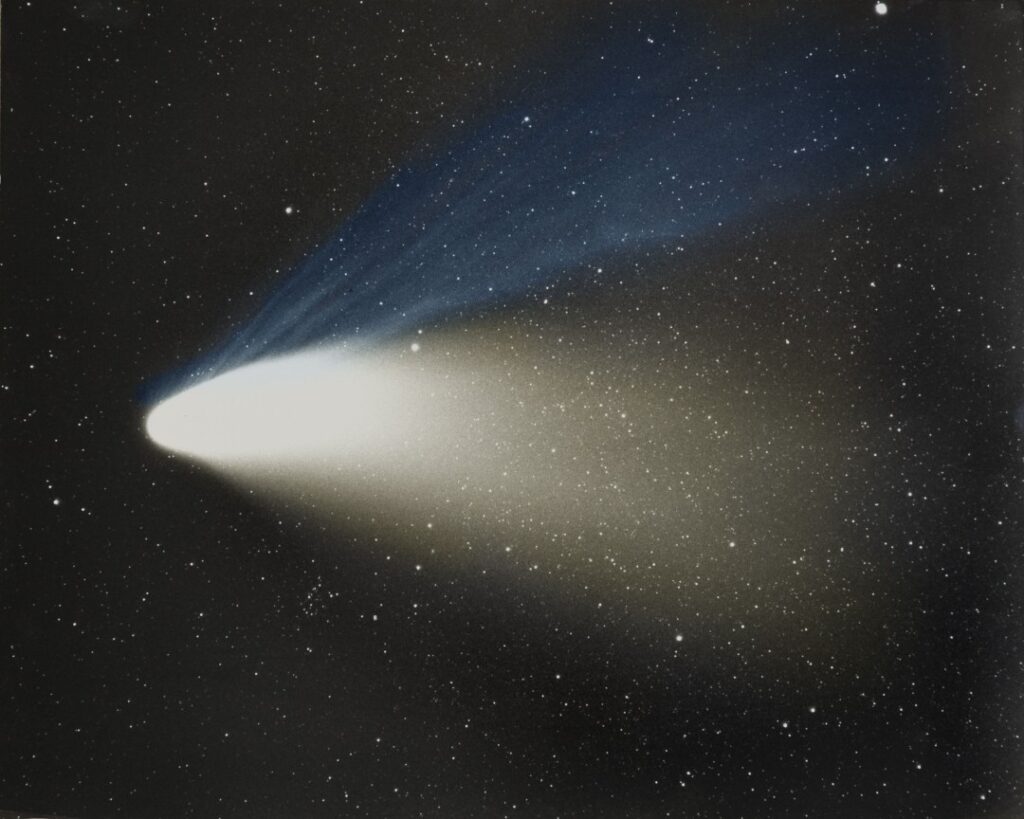
Alan Hale, the New Mexico astronomer who helped introduce the world to comet Hale-Bopp, died June 6 at his home in Cloudcroft, a mountain village renowned for its stargazing opportunities. He was 68. His wife, Vickie, said the cause has not yet been determined, but he had recently experienced complications from surgery, the New York Times reports.
Hale, who held a Ph.D. in astronomy but was running a small education company in 1995, was scanning a star cluster from his driveway when he noticed “something kind of weird nearby” and tracked the fuzzy object for three hours. He emailed its coordinates to the Central Bureau for Astronomical Telegrams. Arizona observer Thomas Bopp reported the same object by telegram soon after, and the comet ultimately bore both their names. Bopp died in 2018.
Astronomers soon realized Hale-Bopp was unusually large and bright and would make a close pass through the inner solar system. Visible to the naked eye for a record 18 months starting in 1996, it became a global sky spectacle—even over light-drenched cities—and drew Hale onto lecture stages and to an observing session with then-Vice President Al Gore. The comet was also linked to the 1997 Heaven’s Gate mass suicide, whose members believed a spacecraft trailed in its wake. “I fully expected there to be suicides, ” Hale said, per the Telegraph. “Score another victory for ignorance and superstition.”
Hale was born in Japan, where his father was stationed with the US Air Force, and grew up in New Mexico. A lifelong interest in astronomy began with books his father checked out from a base library for him, and he got his first telescope at age 11, the Times reports. He earned a bachelor’s degree in physics from the US Naval Academy and worked at NASA’s Jet Propulsion Laboratory after serving in the Navy. With jobs in the astronomy field limited, he founded the Southwest Institute for Space Research, later renamed the Earthrise Institute, in 1993. After the discovery of Hale-Bopp, he wrote several books and regularly appeared on the lecture circuit. “After all my education,” he said, “what is giving me a chance to provide for my family is this accidental discovery I’ve made.”
Hale, who had scanned the skies for decades, had largely given up on finding his own comet by the time Hale-Bopp came along, Sky & Telescope reports. According to an April update on the Earthrise website, he observed 533 separate comets over the years. His lifetime wasn’t long enough to view Hale-Bopp’s return: The comet isn’t due back in the inner solar system until around 4385.