
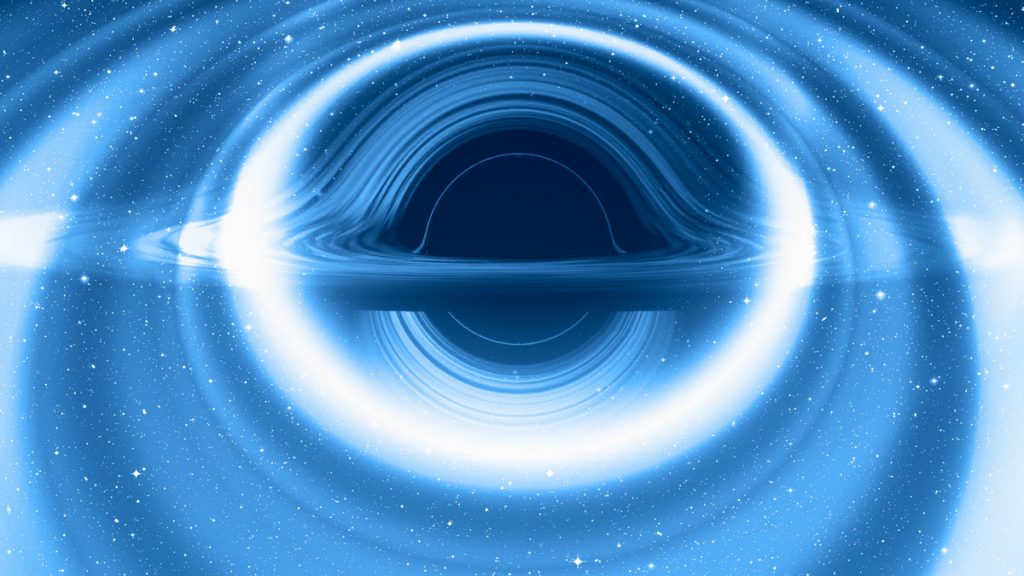
We may not know what dark matter is, but we keep getting whiffs of it.
“We are reaching a point where the observational evidence for dark matter is simply undeniable,” said Mayank Sharma, a Virginia Tech graduate student in physics.
Each new discovery teaches us more about the invisible substance that far outweighs all visible matter in the universe — such as how gravity is the only known force that has any effect on it and that dark matter gathers like a thickening cloud of black smoke around supermassive black holes.
That last one is new, reported in a recent Virginia Tech-led publication in Physical Review D.
Using an astrophysical technique called echo mapping, researchers offered evidence to support this theory, long held but unconfirmed by particle physics.
Dark matter discrepancy
Gravity pulls on all the luminous material of the universe, sending stars and galaxies whizzing around at a breakneck pace — much, much faster than they should, in fact.
The turbo boost comes from the gravitational pull of unseen dark matter.
“There is a huge discrepancy,” said Nahum Arav, Virginia Tech physicist. “What we see is much less than what we need.”
The extra speed points to dark matter’s influence in the vast distances across the universe. But what happens at the brink of a black hole?
Dark matter doesn’t jostle
Black holes are regions in space where gravity is so strong that it drags and twists the very fabric of space-time.
Scientists can see regular matter falling toward a black hole. Dust, gas, and plasma knock around in a boisterous accretion disk, causing friction, losing momentum, and spiraling inward.
But dark matter doesn’t jostle. It can’t interact strongly with itself or with visible matter. All it knows is gravity. With no mechanism to shed energy, theory predicts that dark matter simply hovers thickly on the outskirts — although this behavior can’t be observed with standard telescopes.
While discussing the problem with Gonzalo Herrera, a former Virginia Tech postdoctoral associate in particle physics, Sharma saw a possible way forward.
“We could actually test this prediction using a technique in astronomy, which allows you to measure the distance to the surrounding gas by looking for echoes of light.”
Echoes of light? Sounds made up.
Also known as reverberation mapping, light echoes are a well-established technique for measuring black hole mass.
When material falls toward a black hole, it releases a burst of energy that causes the accretion disk to pulse. The pulse of light travels outward until it strikes surrounding gas, which absorbs and re-emits the light in a secondary pulse, like an echo.
Astronomers detect the initial flash and, after a delay, its echo.
Because light travels at a constant speed, the delay reveals the gas’s distance from the black hole. The initial signal also contains fingerprints of the black hole, where intense heat and radiation strip the gas of electrons. This effect is less pronounced in the echo signal, which is farther away from the black hole.
By comparing the signals, scientists can use the mathematical relationship between distance, lightspeed, and mass to calculate how much dark matter surrounds the black hole.
Applying this method to 14 distant galaxies, the team found five cases where mass increased with distance faster than visible matter alone could explain.
“These galaxies are definitely showing a hint that there is extra material that cannot be explained by just the supermassive black hole,” said Sharma.
Data limitations mean the results are a proof of concept, not a definitive detection, but the study outlines a clear path to confirmation.
Future observations could confirm — or rule out — the theory
If the presence of dark matter is confirmed in future studies, then astronomers will have to consider its effects in their studies of supermassive black holes and their environments. On the other hand, if the theory is ruled out, particle physicists will have to go back to the drawing board to understand what dark matter actually is.
Either way, “the prospects are exciting,” Sharma said.