
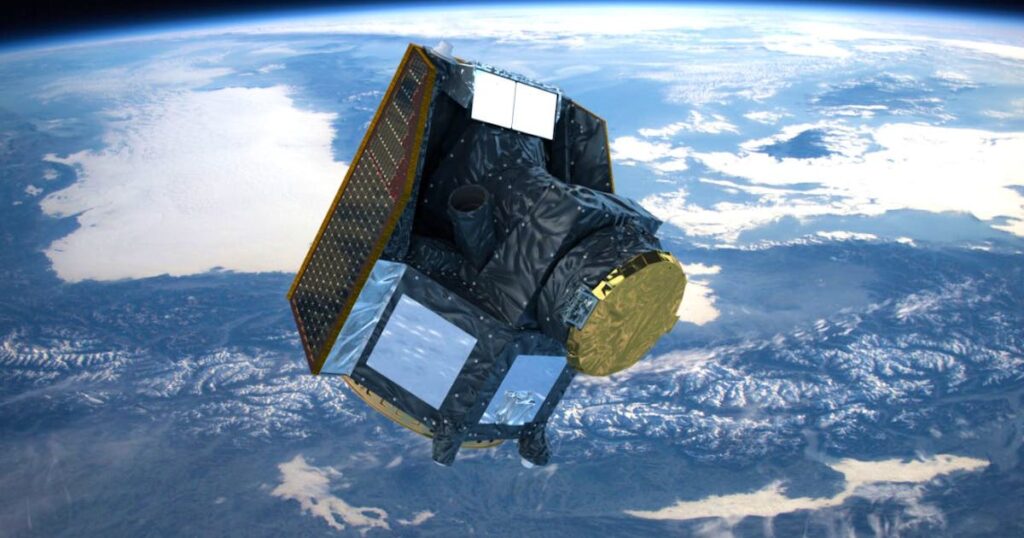
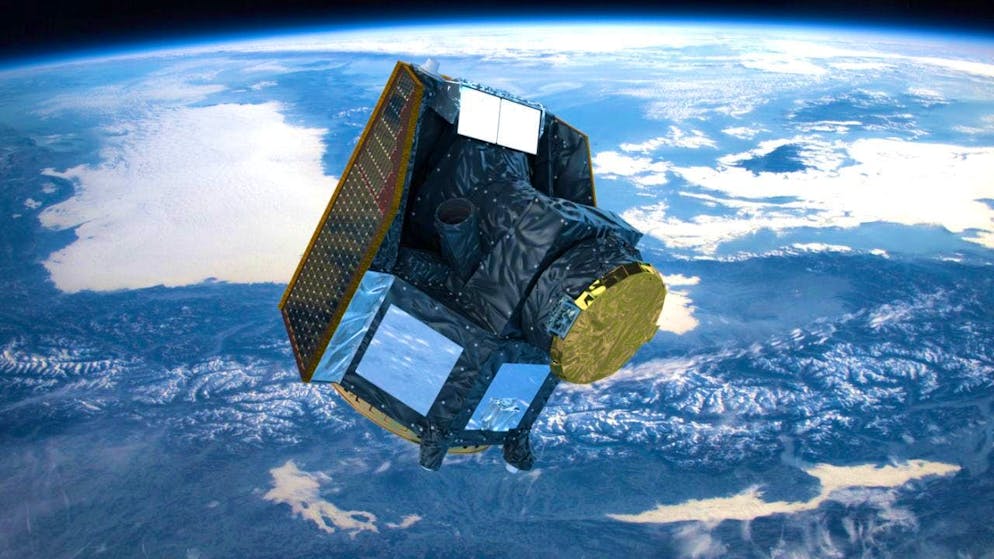
The Cheops space telescope hasn’t finished its research yet: ESA has extended the mission. (File photo)
Keystone
The Cheops space telescope will continue its research: The European Space Agency (ESA) has extended the Swiss-led mission through 2029.
After ESA had already extended the mission for the first time by three years in 2023, the responsible science committee has now decided on a further three-year extension, as the Universities of Geneva and Bern announced on Thursday.
Under the leadership of the University of Bern and ESA, the space telescope was built by a European consortium. Since its launch in December 2019, it has been studying planets outside our solar system. The control center is operated by the University of Geneva.
Among the discoveries to date is the detection of a deformed exoplanet. Due to strong tidal forces, it has the shape of a rugby ball, not a sphere. In addition, the discovery of a planet orbiting the star LHS 1903 challenged conventional theories regarding the arrangement of planets within a system.
12 additional missions extended
In addition to Cheops, the other 12 missions, whose current science phase expires at the end of 2026, have also been extended, as announced by the ESA. These include the well-known James Webb and Hubble space telescopes, as well as the Bepicolombo, Hinode, IRIS, Mars Express, Proba-3, SOHO, Solar Orbiter, XMM-Newton, Einstein Probe, and XRISM missions
Switzerland is actively involved in nearly all of these projects through technology or leadership; only in the case of Hubble and the Einstein Probe is its role limited to financial co-funding by ESA and the use of data.