
The Instituto de Astrofísica de Canarias (IAC) and the University of La Laguna are leading an international study on dark galaxies. ULL PhD student Guacimara García Bethencourt, together with her thesis supervisors Arianna Di Cintio and Sébastien Comerón, both lecturers in the Department of Astrophysics at the ULL and researchers at the IAC, presents a pioneering study in Astronomy & Astrophysics on one of the most intriguing objects in modern astrophysics: dark galaxies, systems rich in gas and dark matter but incapable of forming stars, and therefore invisible to traditional telescopes.
The study comes at a highly topical moment. In recent weeks, both NASA and the ESA have announced the discovery of the first observational candidates, including the Cloud-9 object, which has been confirmed by the Hubble Space Telescope. These detections have placed dark galaxies at the centre of the cosmological debate.
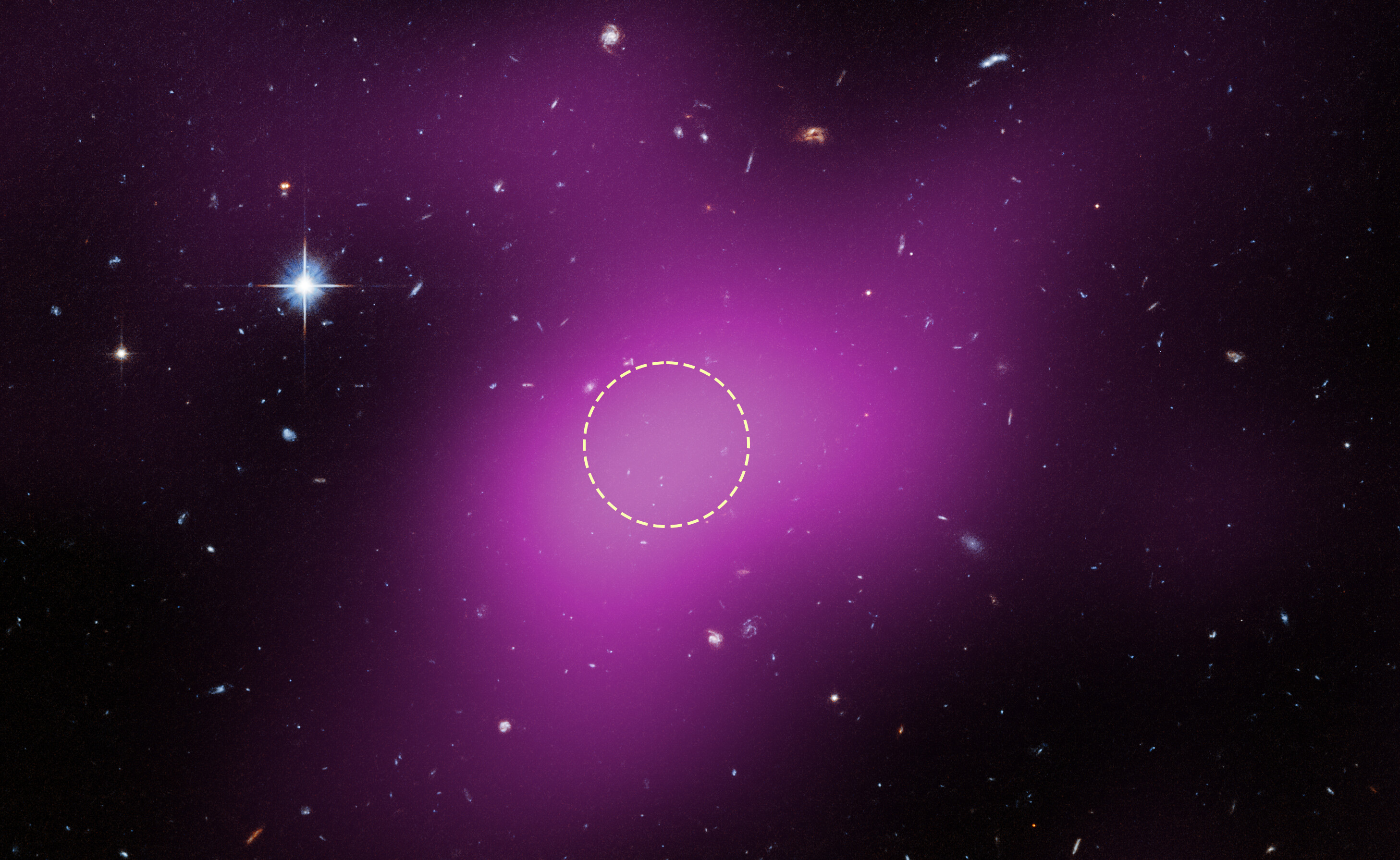
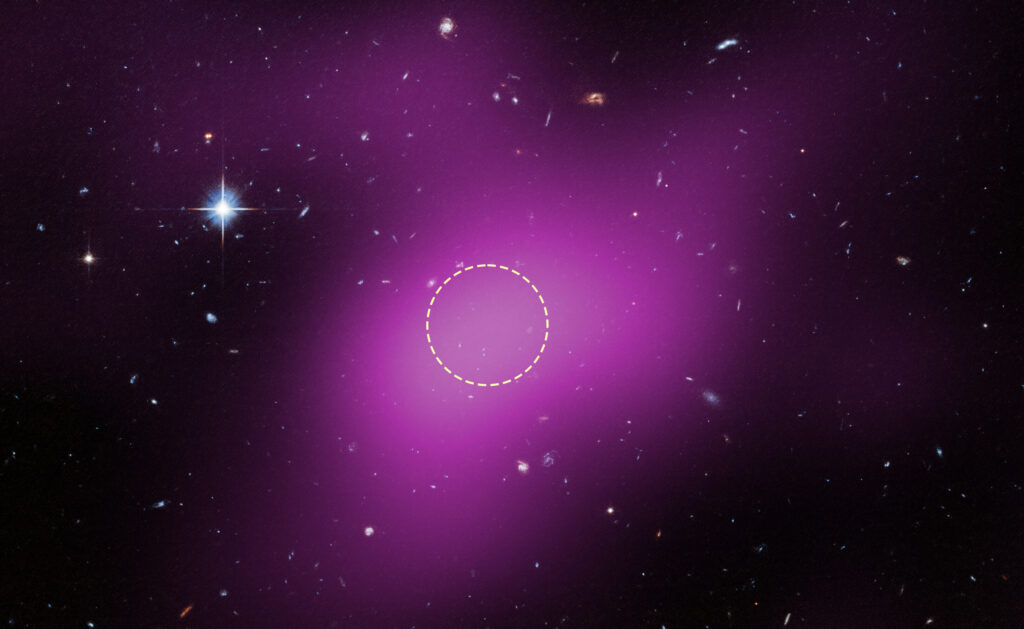
This image shows the location of Cloud-9, which is 14 million light-years from Earth. The diffuse magenta is radio data from the ground-based Very Large Array (VLA) showing the presence of the cloud. The dashed circle marks the peak of radio emission, which is where researchers focused their search for stars. Follow-up observations by the Hubble Space Telescope’s Advanced Camera for Surveys found no stars within the cloud. The few objects that appear within its boundaries are background galaxies. Before the Hubble observations, scientists could argue that Cloud-9 is a faint dwarf galaxy whose stars could not be seen with ground-based telescopes due to the lack of sensitivity. Hubble’s Advanced Camera for Surveys shows that, in reality, the failed galaxy contains no stars.Science: NASA, ESA, VLA, Gagandeep Anand (STScI), Alejandro Benitez-Llambay (University of Milano-Bicocca); Image Processing: Joseph DePasquale (STScI)
In this context, the new study is at the forefront of the field of galaxy formation and evolution, using state-of-the-art cosmological simulations such as HESTIA (IP N. LIbeskind, AIP) and NIVARIA-LG (IP A. Di Cintio, IAC-ULL) to unravel how these ‘ghost’ objects form and evolve.
‘The results show that these galaxies form in dark matter halos with specific properties, in which the gas never reaches the densities required to trigger star formation,’ explains García Bethencourt.
Furthermore, the team provides key predictions for their detection: up to eight dark galaxies could be observable in the Milky Way’s immediate vicinity through the emission of neutral hydrogen, paving the way for their detection in future surveys.
This work not only reinforces one of the fundamental predictions of the Lambda-Cold Dark Matter (ΛCDM) cosmological model—the standard theoretical framework describing the origin, evolution and fate of the universe—but also offers a concrete guide to discovering a population of galaxies that, until now, has remained hidden.
‘The universe could be full of invisible galaxies… and we are closer than ever to finding them,’ concludes the researcher.
This research has received funding from the Spanish Ministry of Science and Innovation (MICINN), under the Consolidation of Research programme, grant agreement CNS2023-144669, (PI A. Di Cintio), and the 2024 call for “Knowledge Generation Projects”, Grant agreement PID2024-160009NA-I00, (PI A. Di Cintio).
Article: Guacimara García-Bethencourt et al. “HI-bearing dark galaxy predictions from constrained Local Group simulations: How many and where to find them”, Astronomy & Astrophysics, 2026. DOI: 10.1051/0004-6361/202558801
Contact at the IAC-ULL:
Guacimara García Bethencourt, ggarciab [at] ull.edu.es (ggarciab[at]ull[dot]edu[dot]es)
Arianna Di Cintio, adicintio [at] iac.es (adicintio[at]iac[dot]es)
Sébastien Comerón, sebastien.comeron [at] iac.es (sebastien[dot]comeron[at]iac[dot]es)