
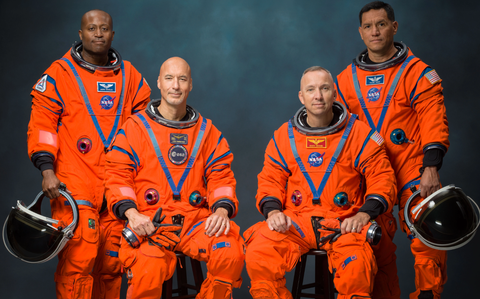
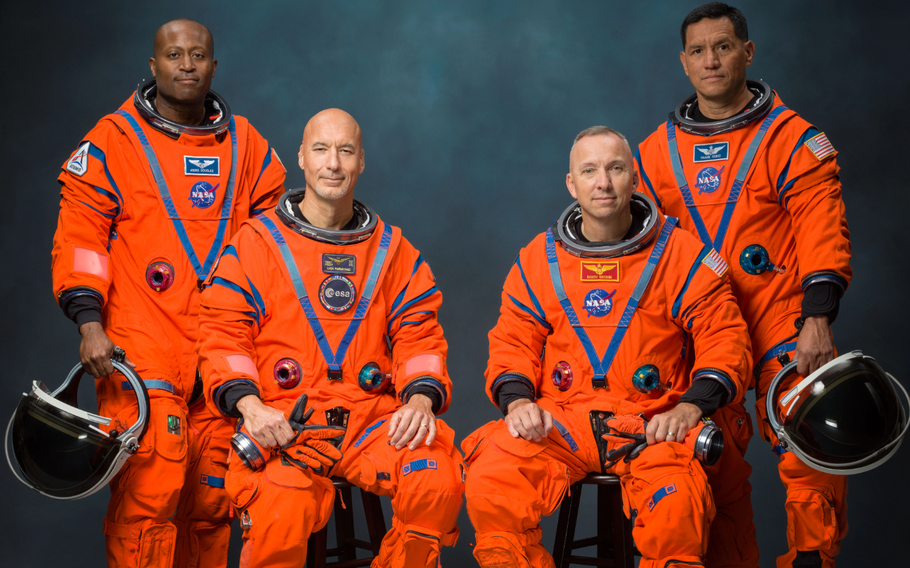
The Artemis III crew, posing for an official portrait, includes: from left, Andre Douglas, Luca Parmitano, Randy Bresnik, Frank Rubio. (Bill Stafford/NASA)
NASA on Tuesday announced the prime crew members and a backup for the Artemis III test flight mission.
The crew includes NASA astronauts Randy Bresnik as mission commander, and Andre Douglas and Frank Rubio as mission specialists; and European Space Agency astronaut Luca Parmitano as the pilot.
“Today we take another bold step in humanity’s return to the moon, building on the extraordinary foundation laid by the Artemis II astronauts,” NASA Administrator Jared Isaacman said. “Their achievements reignited global excitement for exploration, and now they pass the torch to the Artemis III team, Randy, Luca, Frank and Andre.”
NASA also named astronaut Bob Hines as a backup crew member.
The crew will soon begin training on Orion spacecraft systems, as well as assist in the development and operations of the test versions of Blue Origin and SpaceX landers.
Artemis III will carry out a series of challenging tests in low Earth orbit in 2027, designed to demonstrate critical systems needed for future lunar landings, beginning with Artemis IV, the first planned crewed mission to the lunar South Pole in 2028.
The mission includes a multilaunch campaign of the world’s most powerful rockets to test integrated hardware between Orion and the landers, including system interfaces, software, propulsion and communications.
This is the first time an ESA astronaut has been assigned to an Artemis mission.
“Artemis III will push the boundaries of spacecraft operations in orbit. Luca’s assignment as pilot reflects the depth of European expertise in human spaceflight and draws on his extensive operational experience in high-pressure situations,” said Josef Aschbacher, ESA’s director general. “At the same time, ESA’s European Service Module will once again provide the critical capabilities that power Orion, demonstrating Europe’s enduring role at the very heart of the Artemis program.”
Each of the crew members have military experience, across different branches and disciplines.
Bresnik is a retired U.S. Marine colonel who has logged more than 7,000 hours in 95 types of aircraft. After his graduation from the U.S. Naval Test Pilot’s School, he was deployed as an F/A test pilot to Kuwait in support of Operation Iraqi Freedom.
Rubio served more than 28 years in the U.S. Army as an aviator, physician and astronaut after graduating from the U.S. Military Academy in 1998. As an aviator, he flew more than 1,100 hours, including more than 600 hours of combat during deployments to Bosnia, Afghanistan and Iraq.
Douglas graduated from the U.S. Coast Guard Academy with a bachelor’s degree in mechanical engineering and served in the Coast Guard where he conducted search and rescue, marine salvage and drug interdiction operations.
Parmitano became a test pilot for the Italian Air Force in 2007 before being promoted to colonel in 2019. He logged 2,000 flight hours across 40 types of aircraft.
Artemis III will launch the world’s most powerful rockets in short order. Blue Origin’s lander pathfinder, which is able to stay in orbit for multiple weeks, will launch first and await the crew, according to the announcement
During the mission, the agency’s Space Launch System rocket will launch the Orion spacecraft and its crew from NASA’s Kennedy Space Center in Florida to low Earth orbit.
Once the Orion systems checkout, the spacecraft will demonstrate rendezvous and docking capabilities — and for the first time — with test versions from the American commercial human landing systems in development by Blue Origin and SpaceX.
After completing docked operations with Blue Origin, Orion will detach and await Starship. SpaceX’s Starship pathfinder will launch and meet up with Orion to spend about a day connected for checkouts and testing. After that, Orion and its crew will undock and return home, splashing safely down in the Pacific Ocean where a team from the U.S. Navy and NASA will recover the astronauts.
The mission is expected to last for about two weeks, but could change depending on launch, rendezvous and docked operations.