
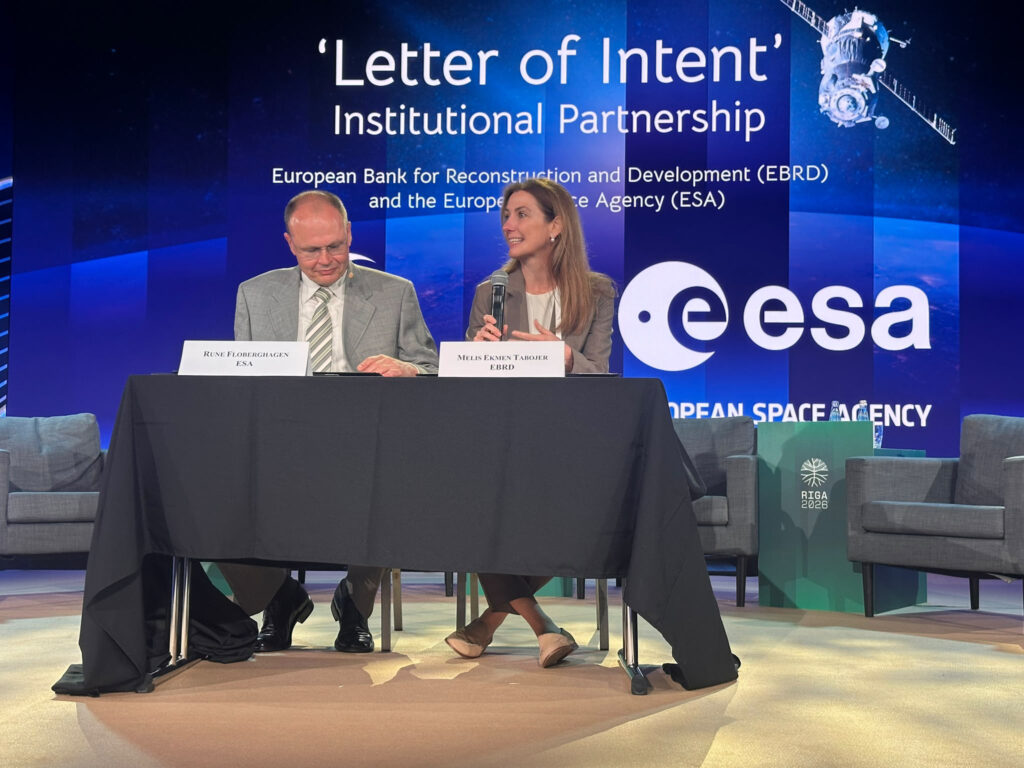
The European Space Agency (ESA) and the European Bank for Reconstruction and Development (EBRD) have signed a new cooperation agreement to increase the use of Earth observation data in development and impact finance projects.
The agreement was formalised during the EBRD Annual Meeting in Riga, Latvia, on 6 June, with the partnership building on nearly two years of exploratory work between the organisations, including pilot activities linked to the EBRD Green Cities programme.
By combining satellite-derived insights with development financing initiatives, both institutions aim to improve project planning, implementation and long-term outcomes.
The expected result is greater integration of space-based technologies into sustainable development programmes, enabling more accurate monitoring, stronger decision-making and enhanced measurement of environmental and social impacts.
Commenting on the collaboration, Simonetta Cheli, ESA’s Director of Earth Observation Programmes, said: “This partnership with the EBRD reflects the strength of European cooperation in addressing global challenges.
“By working together, we can further unlock the potential of Earth observation data and services, ensuring they are fully integrated into development initiatives that deliver real-world impact.
“ESA’s Earth observation programmes are designed precisely for this purpose: to turn space-based knowledge into actionable insights that support sustainable and inclusive development worldwide.”
Expanding the role of Earth observation data
Under the agreement, ESA and EBRD will explore opportunities to apply Earth observation data throughout the development project lifecycle. This includes research, product development, project implementation, monitoring and impact assessment.
Satellite imagery and related services can provide valuable information on environmental conditions, urban growth, climate risks and infrastructure performance.
By incorporating these capabilities into development finance operations, the organisations aim to improve efficiency while strengthening evidence-based decision-making.
The collaboration will also focus on advancing the practical use of satellite services in projects designed to support sustainability, resilience and economic development across the regions where the EBRD operates.
Knowledge sharing and capacity building
Beyond technical applications, the agreement highlights a commitment to knowledge exchange and capacity building.
ESA and the EBRD plan to work together on outreach activities, resource mobilisation and skills development initiatives that promote wider adoption of Earth observation data.
The organisations believe that expanding access to satellite-based information can help governments, financial institutions and project developers make more informed decisions when addressing environmental and development challenges.
Formalising a growing relationship
The letter of intent (LOI) was digitally signed earlier this month by Cheli and Mark Bowman, EBRD Vice President for Policy and Partnerships.
The partnership was subsequently confirmed during an in-person signing ceremony at the EBRD Annual Meeting in Riga.
ESA’s Head of Climate Action, Sustainability and Science Department, Rune Floberghagen, joined EBRD Managing Director for Policy, Strategy and Delivery, Melis Ekmen Tabojer, to mark the agreement.
Bowman added: “We are very pleased to formalise our shared intent to co-operate with ESA, following several pilot exercises.
“Satellite data is extensively used in several sectors in which the Bank works – from assessing the effects of climate change to supporting infrastructure and agriculture projects. We look forward to continuing to expand its application to our clients and countries of operation.”
The new collaboration signals a growing recognition of the value of Earth observation data in supporting sustainable development goals and improving the effectiveness of development finance worldwide.