
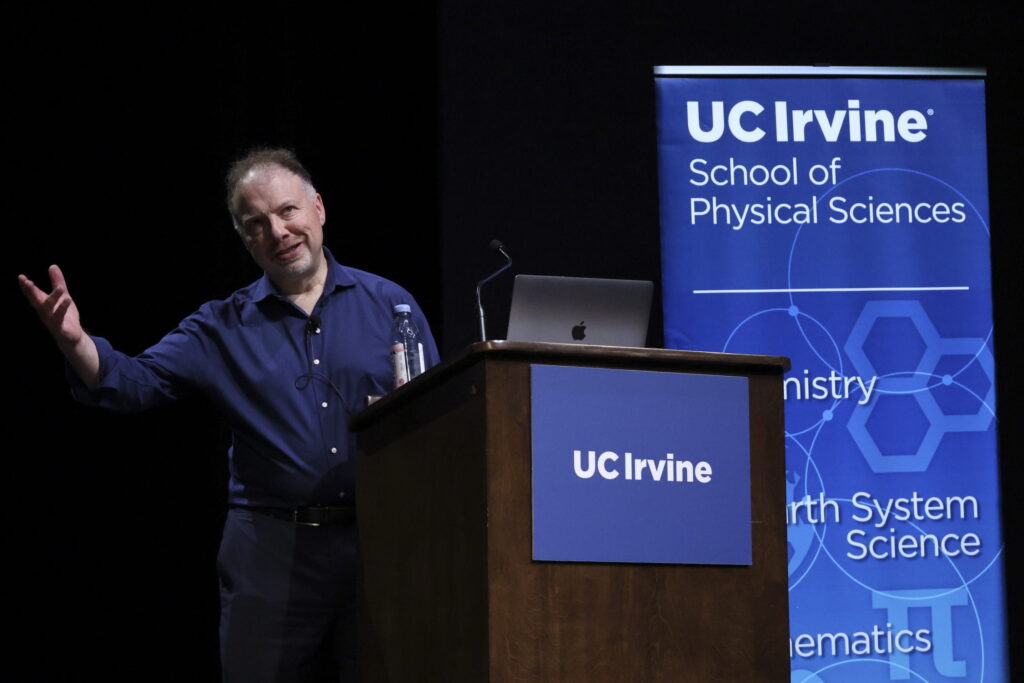
The quest to understand what is causing the rapidly accelerating expansion of the universe was the centerpiece of this year’s Reines Lecture hosted on June 1 by the UC Irvine School of Physical Sciences. Guest lecturer Adam Riess, Bloomberg Distinguished Professor and Thomas J. Barber Professor of physics and astronomy at Johns Hopkins University, enthralled a packed house at the Irvine Barclay Theatre with his account of the history of the problem, from the realization that it was happening a century ago to present-day efforts to grapple with it using the latest space telescopes. Riess, who won the Nobel Prize in Physics in 2011, explained his approach to clocking the speed at which galaxies are moving away from each other which relies on using bright light from exploding stars – supernovae – to measure the distance of galaxies and then examining the color of the light. If it’s “red-shifted” that means the source of the light is traveling away from us. “Why is the universe accelerating now? This is probably the biggest question in cosmology that we don’t really understand,” Riess said. “We have some hand-waving ideas, for example, something very similar to what Einstein had suggested, that the energy of empty space is something, it’s not zero. And that in Einstein’s theory of gravity, this will give rise to repulsive type gravity.” This fundamental question has led to theories of dark matter and dark energy driving the expansion dynamics of the universe. “Physicists have struggled for decades to unite our two best theories of physics — the sort of macroscopic physics, which is Einstein’s general relativity, and the subatomic physics world of quantum theory. And somehow dark energy lives at that crossroad. So, if we can sort of get a clue about what actually happens in nature, maybe it will help us understand physics at a deeper level and lead to something interesting,” Riess concluded. The event was convened by UC Irvine Provost and Executive Vice Chancellor Hal Stern, and Riess was introduced to the audience by Manoj Kaplinghat, professor and chair of the Department of Physics and Astronomy. Before the lecture, UC Irvine student groups, including Astronomy Club, Society of Physics Students and UNITY, welcomed guests and hosted physics demonstrations. The Reines Lecture series honors Frederick Reines, UC Irvine’s founding dean of physical sciences and co-recipient of the 1995 Nobel Prize in Physics for the discovery of the neutrino.
Add A Comment