
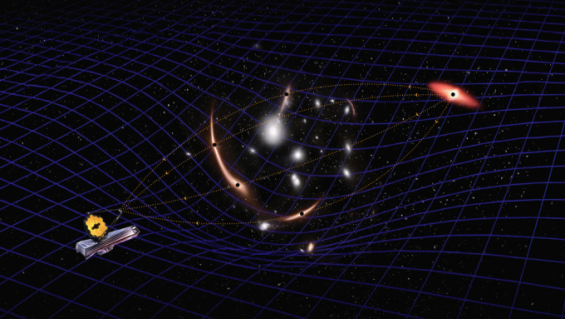
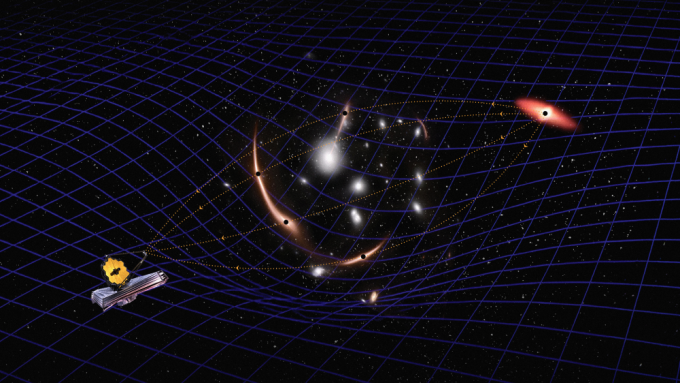
An elliptical galaxy (orange on the right) that existed in the universe about 10 billion years ago is magnified about 30 times by the gravitational lensing effect (center). With the James Webb Space Telescope (left), one can see the light from the actual galaxy bending in multiple directions before reaching us (yellow dashed lines). Provided by Yonsei University.
The mass of a supermassive black hole that existed in the universe about 10 billion years ago but was too distant to be seen clearly has been measured for the first time. It was found to be about 6 billion times the mass of the Sun, suggesting that the black hole may have grown faster than its host galaxy.
Yonsei University announced on the 8th that an international research team including Professor Ji Myung-Kuk of the Department of Astronomy and Space Science has successfully measured the mass of an inactive supermassive black hole that existed in the universe about 10 billion years ago using the James Webb Space Telescope (JWST). The results were published on June 4 in the international journal ‘Science’.
Central galactic black holes are divided into two types. Active black holes vigorously accrete matter and emit bright light, whereas inactive black holes have finished accreting material and emit no light. Active black holes can be observed even in the distant universe, making their mass relatively easy to measure. For inactive black holes, however, their mass must be inferred by measuring the velocities of surrounding stars. As a result, studies have so far been limited to black holes within about 600 million light-years, close enough for detailed analysis of stellar motions.
The team succeeded in measuring a more distant inactive black hole by using the phenomenon of ‘gravitational lensing’. A gravitational lens occurs when a massive object in the foreground bends the light from a background object, making it appear magnified.
Taking advantage of gravitational lensing, the researchers observed a distant galaxy magnified by a factor of about 30 with JWST. They measured the motions of stars around the black hole and used this to calculate the black hole’s mass.
Professor Ji and researcher Cha Sang-Jun, who took part in the study, carried out the ‘lens modeling’ work. Lens modeling is the process of calculating the magnification produced by the gravitational lens. Seven independent research groups each constructed their own lens model, which were then compared and validated to ensure the reliability of the measurement.
The analysis showed that the black hole’s mass is about 6 billion times that of the Sun. Relative to the size of its host galaxy, it turned out to be extremely massive.
In general, black holes are thought to grow while maintaining a roughly proportional relationship with the total stellar mass of their host galaxies. The observed black hole has a ratio of black hole mass to stellar mass that is about 10 times higher than that of galaxies in the same epoch.
The team explained that this implies the black hole grew more rapidly and efficiently than its host galaxy. They noted that this aligns with a series of recent JWST discoveries of active black holes in the early universe that appear excessively massive compared with their host galaxies.
The researchers expect this achievement to mark the starting point for studying massive, inactive black holes in the distant universe, which have been difficult to observe until now. They predict that once next-generation giant telescopes such as the Giant Magellan Telescope (GMT) come online, it will be possible to directly observe inactive black holes at a wide range of distances even without the aid of gravitational lenses.
doi.org/10.1126/science.adx5816
Copyright ⓒ DongA Science. All rights reserved.