
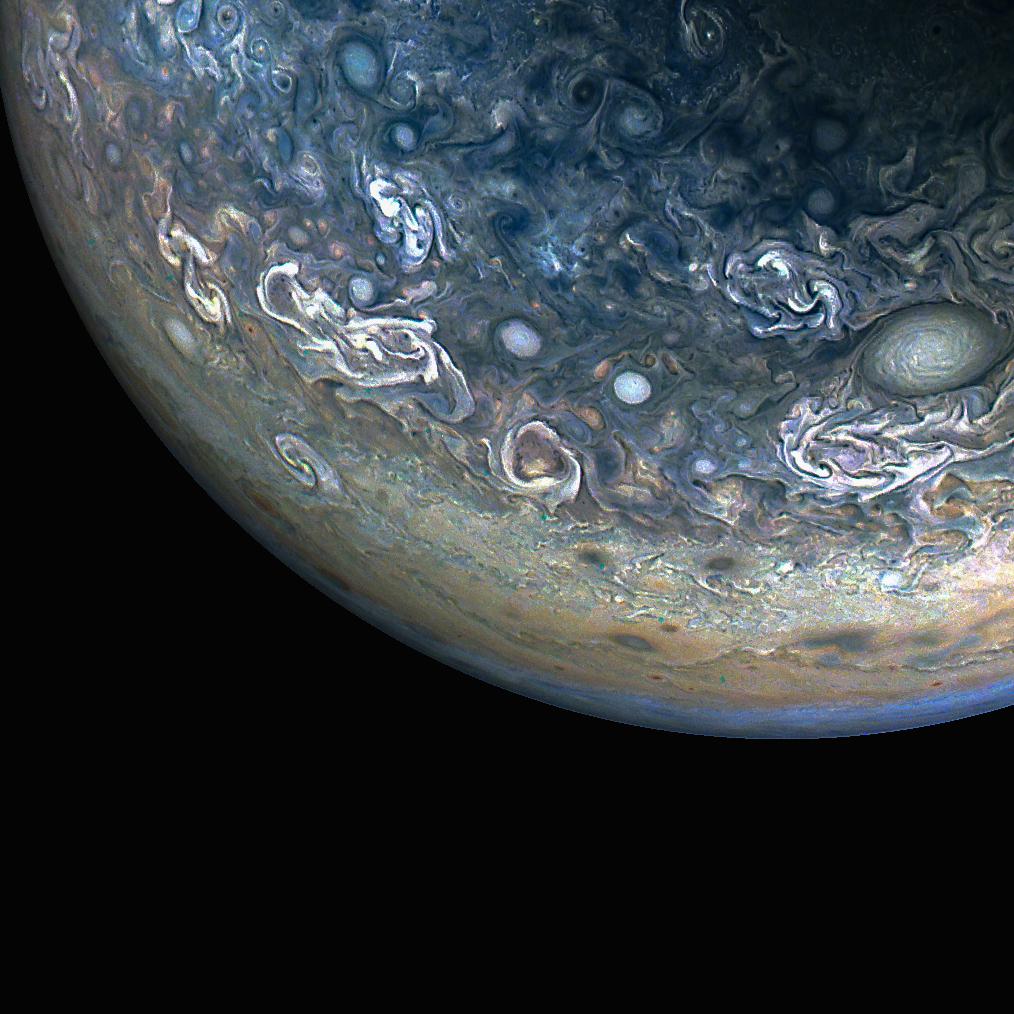
On June 9, 2026, Venus and Jupiter will appear in close proximity in the evening sky, allowing both planets to be observed within the same field of view. Astronomers identify this event as a conjunction, whereas enthusiasts often describe it as a celestial kiss. We have aggregated the most outstanding photographs of both planets, enabling you to appreciate their splendor prior to this event.
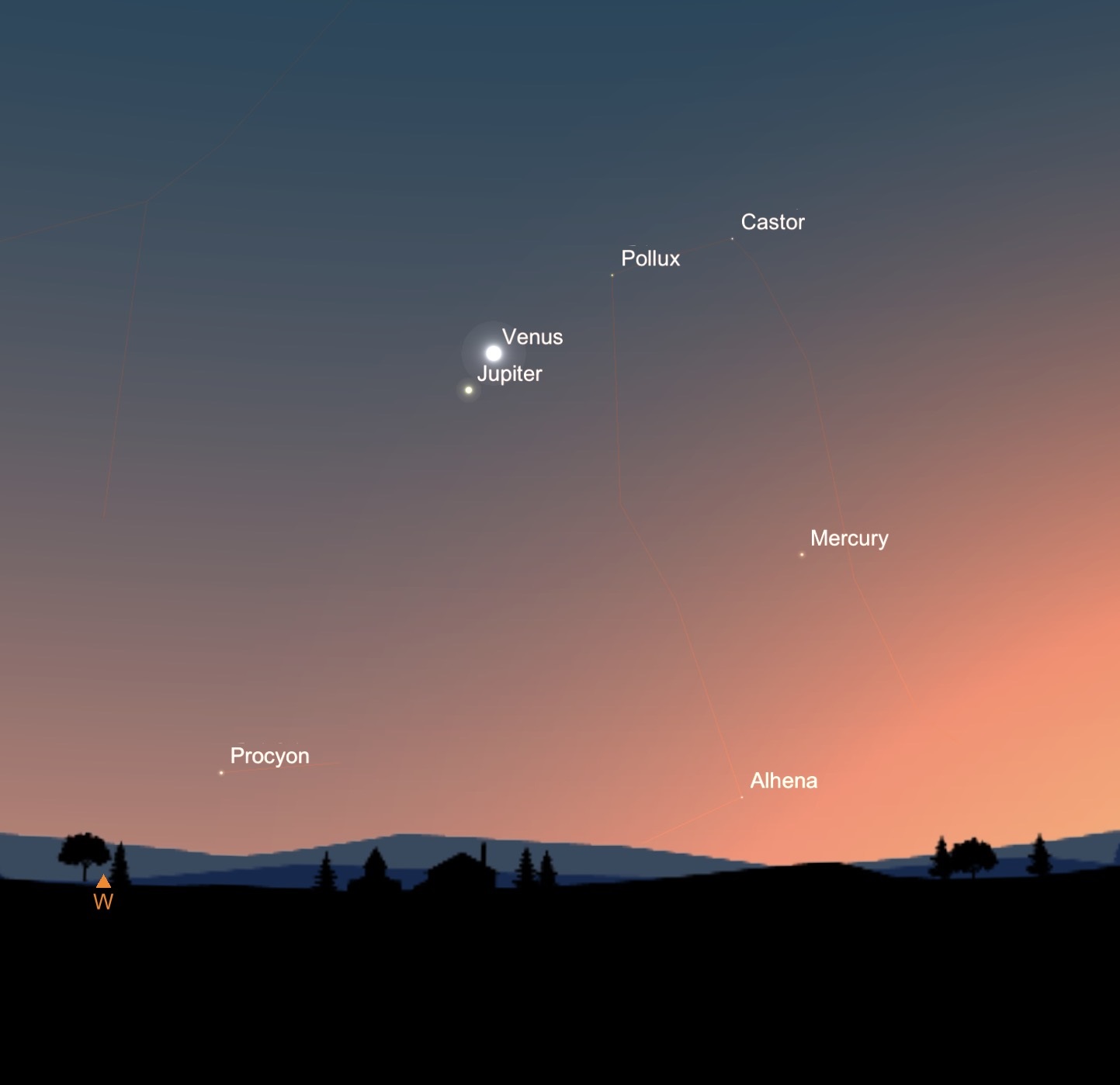 Venus and Jupiter will be observable on June 9, 2026. Source: SkySafari virtual planetarium.
Venus in images captured by space missions.
Venus is the second planet from the Sun and the closest celestial body to Earth. In terms of size and mass, it bears a close resemblance to our planet, which is why it is frequently referred to as Earth’s twin. Nevertheless, surface conditions on Venus are markedly different from those on Earth: temperatures can exceed 467 °C, and the atmospheric pressure is 92 times that of Earth’s.
Venus rotates on its axis in a direction opposite to that of most planets in the Solar System. Consequently, an observer on its surface would witness the Sun rising in the west and setting in the east. The planet completes one rotation in 243 Earth days. Its atmosphere is predominantly composed of carbon dioxide and is enveloped by a persistent layer of sulfuric acid clouds, rendering the surface inaccessible to direct optical observation.
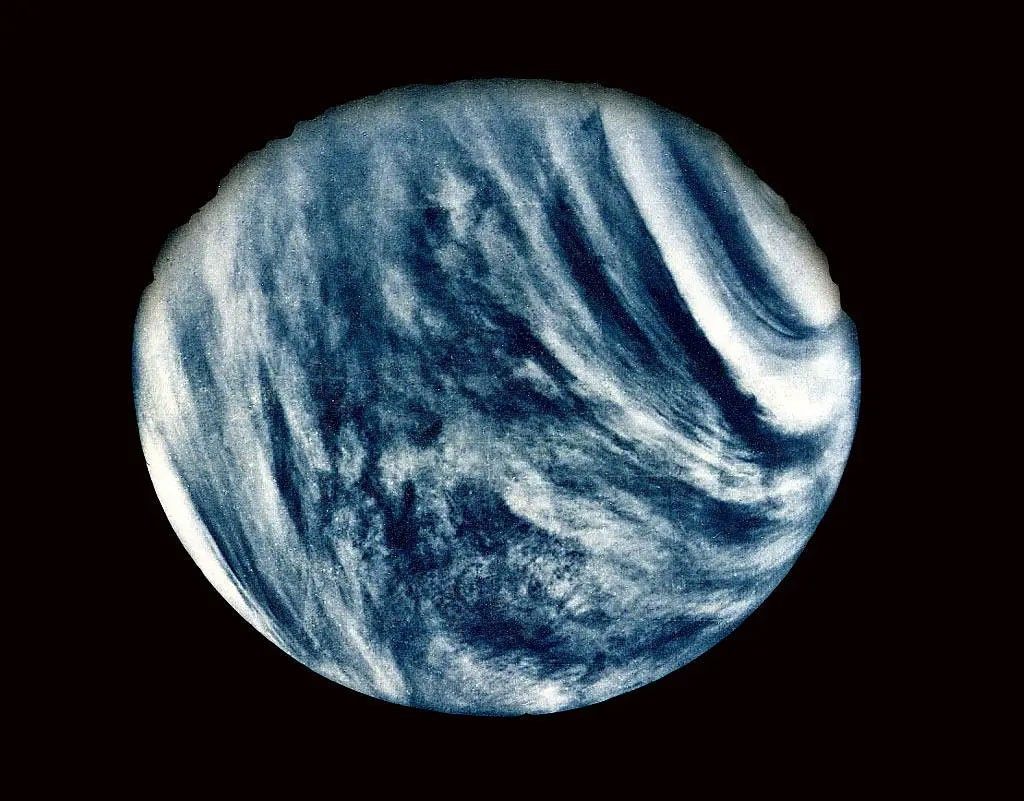
The initial close-up depiction of Venus
 Credit: NASA JPL. Source: science.nasa.gov
Mariner 10 acquired this image of Venus on February 5, 1974, during its initial close flyby of the planet. The image was captured utilizing an ultraviolet filter and subsequently processed with color enhancement to elucidate the structure of the cloud cover. The spacecraft was launched on November 3, 1973, aboard an Atlas-Centaur launch vehicle.
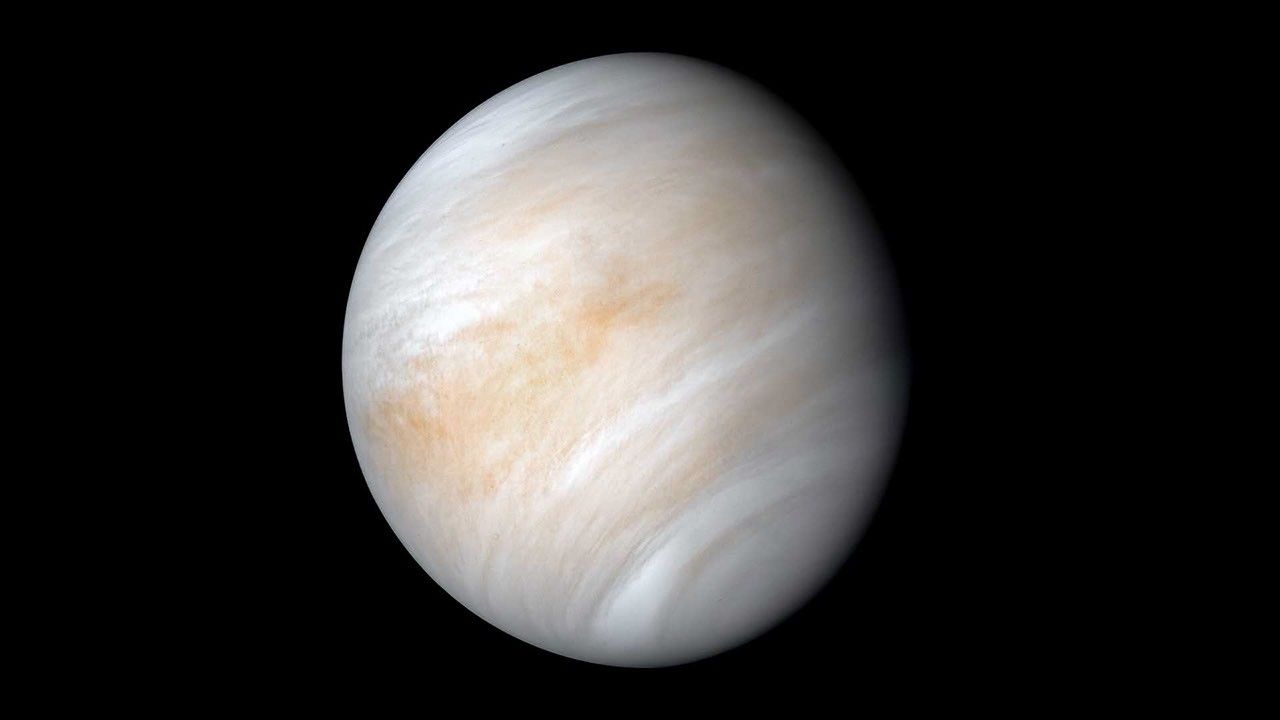
Venus as observed by Mariner 10
 Credit: NASA/JPL-Caltech. Source: science.nasa.gov
This image was captured by the Mariner 10 spacecraft during its departure from Venus. It depicts a planet approximately the size of Earth, entirely enveloped in a pervasive global cloud cover. The image has been enhanced utilizing contemporary software.
The surface of Venus is observed through the cloud cover
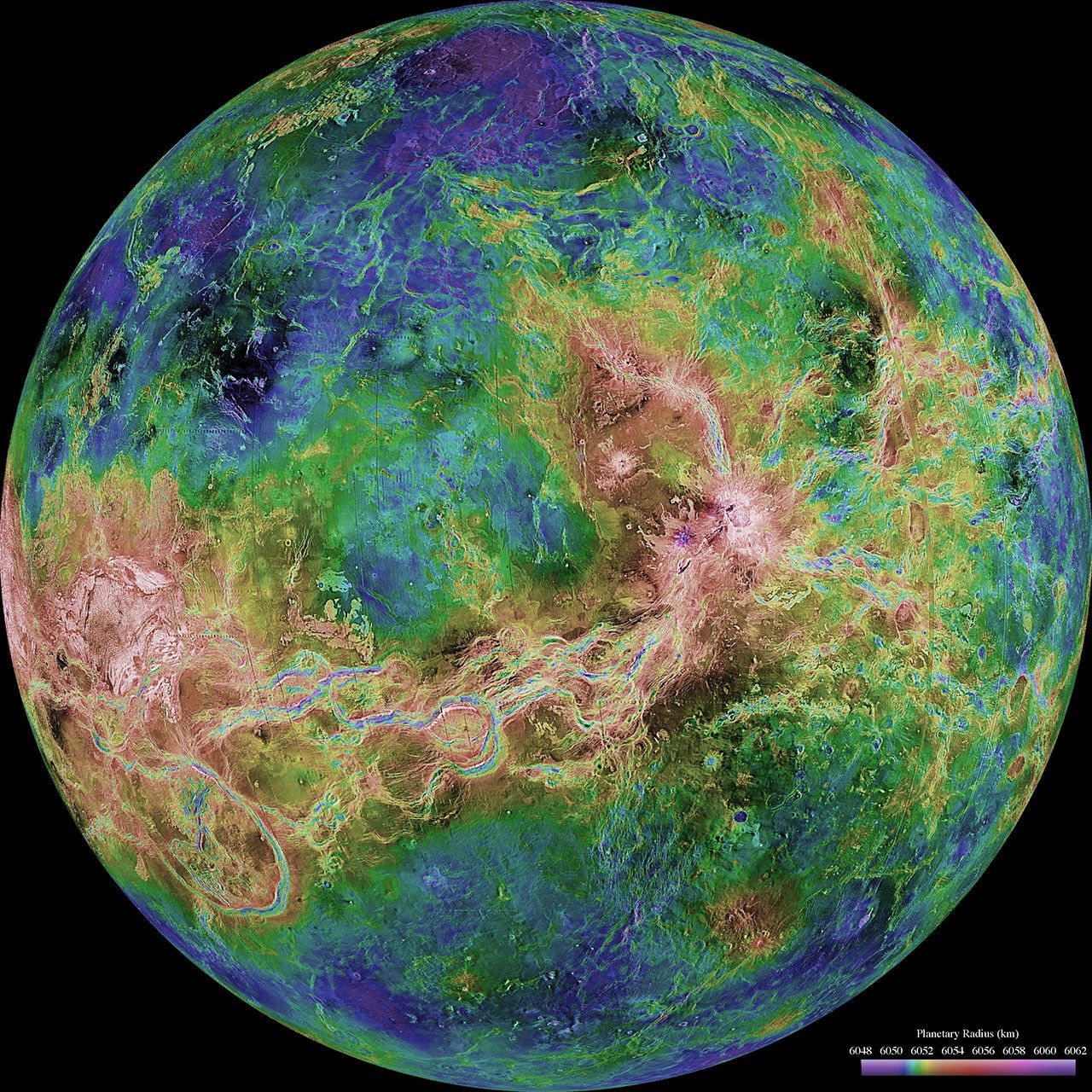 Credit: NASA / JPL-Caltech / USGS. Source: science.nasa.gov
This depiction of Venus’s surface, observed through its dense cloud cover, was generated via radar imaging, specifically utilizing images captured by the Magellan spacecraft, which surveyed over 98% of the planet’s surface. Remaining gaps were supplemented with images from the ground-based radar of the Arecibo Observatory. The composite image was subsequently processed to improve contrast and accentuate intricate details.
The Magellan mission was initiated on May 4, 1989, with the spacecraft being deployed into orbit from the cargo bay of the space shuttle Atlantis on May 5 of the same year. Magellan maintained its orbit around Venus from August 10, 1990, until October 13, 1994, when it was deliberately directed into the planet’s atmosphere.
The night side of Venus
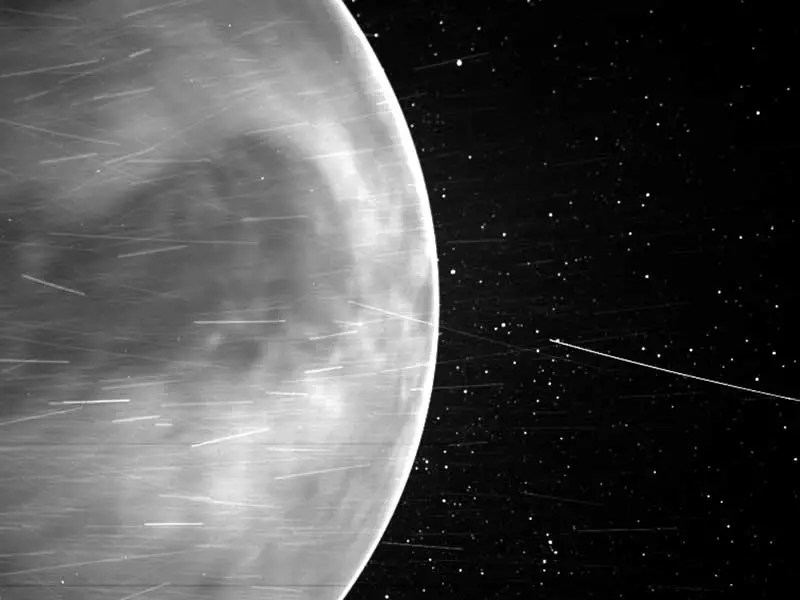 Credit: NASA / APL / NRL. Source: science.nasa.gov
During its flyby of Venus in February 2021, the Parker Solar Probe captured images of the planet’s night side using the WISPR instrument.
The images were captured through a dense cloud cover and exhibit a subtle luminance on the surface, where continental regions, plains, and plateaus are discernible. Additionally, a luminance resulting from molecular oxygen in the atmosphere was observed at the boundary between the planet’s night and day sides.
Jupiter captured in images from the Juno mission
Jupiter is the fifth and largest planet in the Solar System, possessing a mass that exceeds twice the combined mass of all the other planets. Its equatorial radius measures 71,488 kilometers, which is 11.2 times greater than that of Earth. According to astronomical classification, Jupiter is categorized as a gas giant.
The most detailed images of Jupiter are captured by the JunoCam visible-light camera aboard the Juno mission. The spacecraft photographs the planet’s poles, cloud cover, and moons with unprecedented clarity. Since the outset, the mission team has extended invitations to enthusiasts to select subjects for photography and to process the raw images.
Chaotic clouds of the Northern Hemisphere
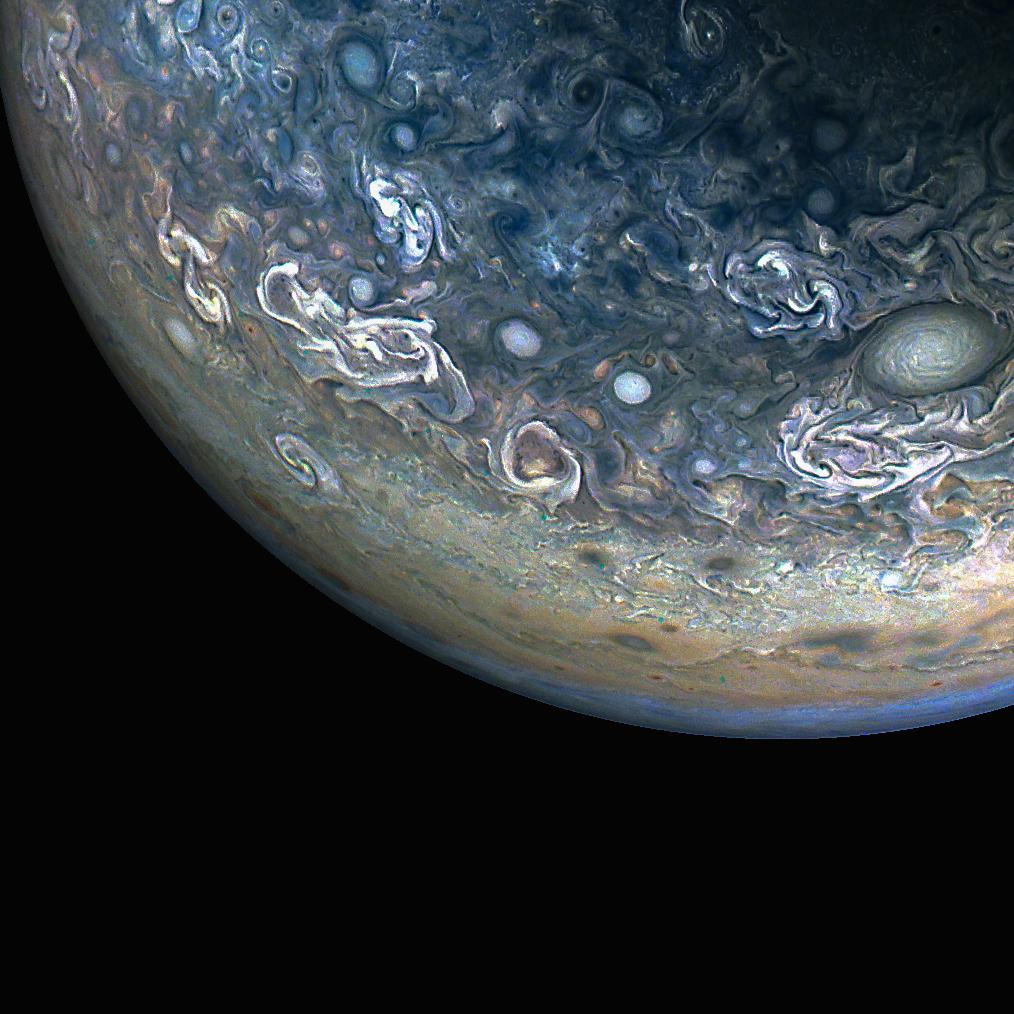 Credit: NASA / JPL-Caltech / SwRI / MSSS; image processing: Gary Eason © CC BY. Source: science.nasa.gov
This image depicts the appearance of Jupiter’s northern hemisphere at close proximity. During Juno’s 61st close flyby of the planet on May 12, 2024, the JunoCam instrument captured this section of the cloud cover. Amateur scientist Gary Ison processed the raw data from the instrument, enhancing the colors and sharpness.
The image depicts an area of folded filaments where the zonal currents responsible for creating Jupiter’s characteristic banded cloud patterns are disintegrating. This results in turbulent cloud formations that exhibit significant changes within a span of merely a few days.
South Pole cyclones
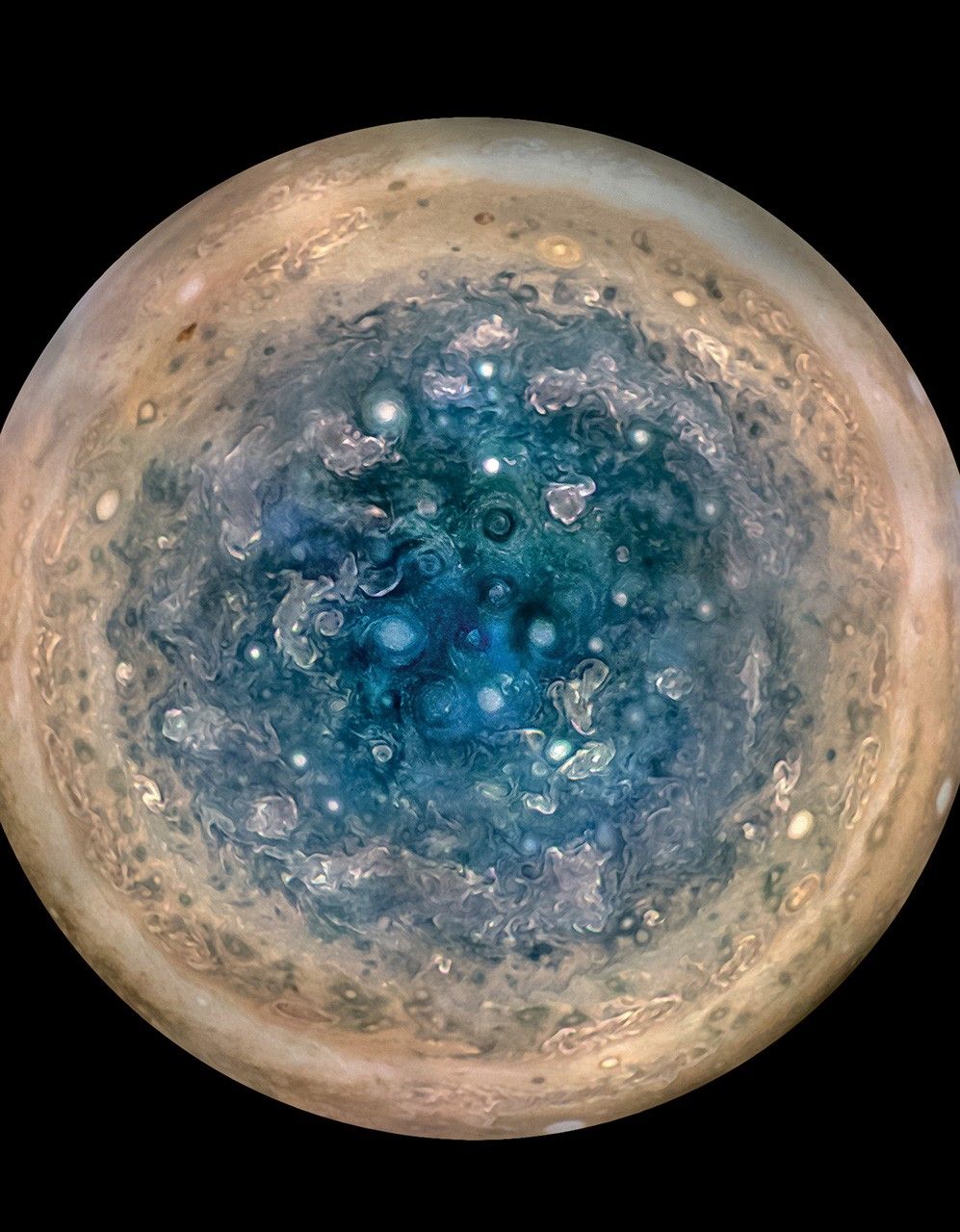 Credit: NASA / JPL-Caltech / SwRI / MSSS / Betsy Asher Hall / Gervasio Robles. Source: science.nasa.gov
The Juno spacecraft captured an image of Jupiter’s south pole from an altitude of approximately 52,000 kilometers. The oval-shaped features within the image represent cyclones, each measuring up to 1,000 kilometers in diameter. These images were acquired during three distinct orbital flybys and subsequently integrated into a single composite image through the application of enhanced color schemes and stereographic projection techniques.
The shadow of Io on Jupiter
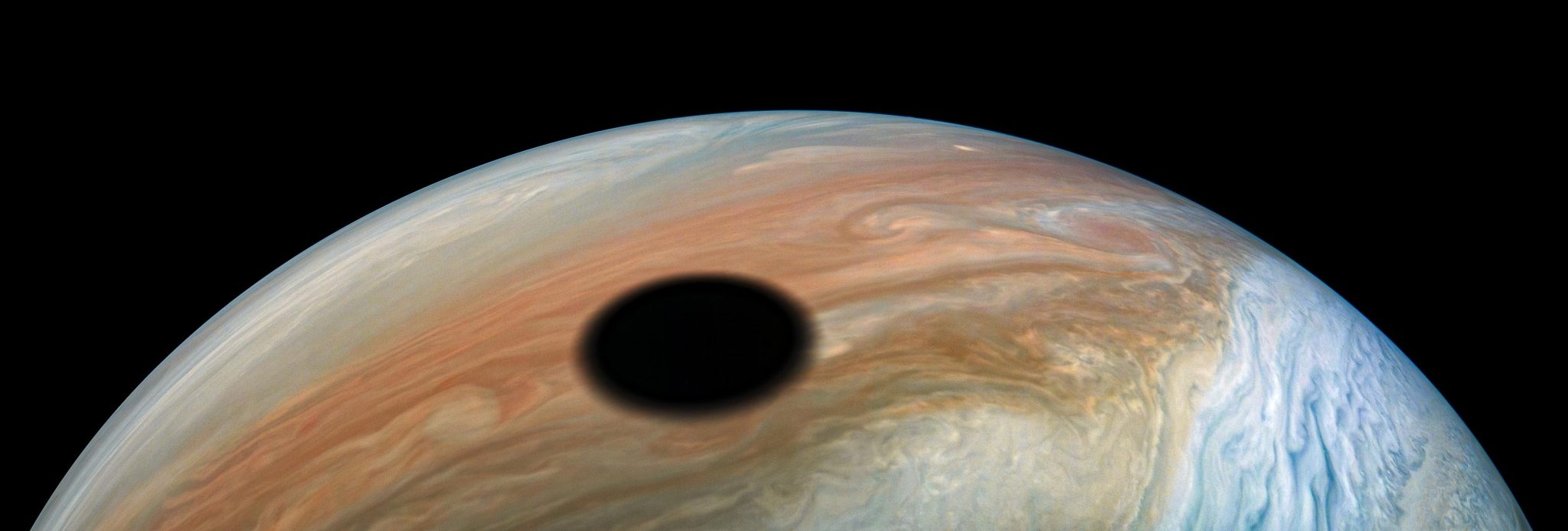 Credit: NASA / JPL-Caltech / SwRI / MSSS / Kevin M. Gill. Source: science.nasa.gov
The dark circle within Jupiter’s cloud cover represents the shadow cast by the moon Io during a solar eclipse. This shadow spans approximately 3,600 km in width, which is roughly equivalent to Io’s diameter. The image was captured on September 11, 2019, during the spacecraft’s 22nd close flyby of the planet, and amateur scientist Kevin M. Gill processed the original images, enhancing the color quality.
Jupiter experiences such eclipses frequently due to its large number of moons and the slight tilt of its axis relative to its orbit. The planet’s axis is tilted by only 3.1 degrees, whereas Earth’s is 23.4 degrees, Mars’s is 25.2 degrees, and Venus even rotates in the opposite direction with an inclination of about 177 degrees. That is why the Sun in Jupiter’s sky never strays far from the equatorial plane, and the moons regularly cast shadows on the clouds throughout the entire Jovian year.
Storms and clouds of the Northern Hemisphere
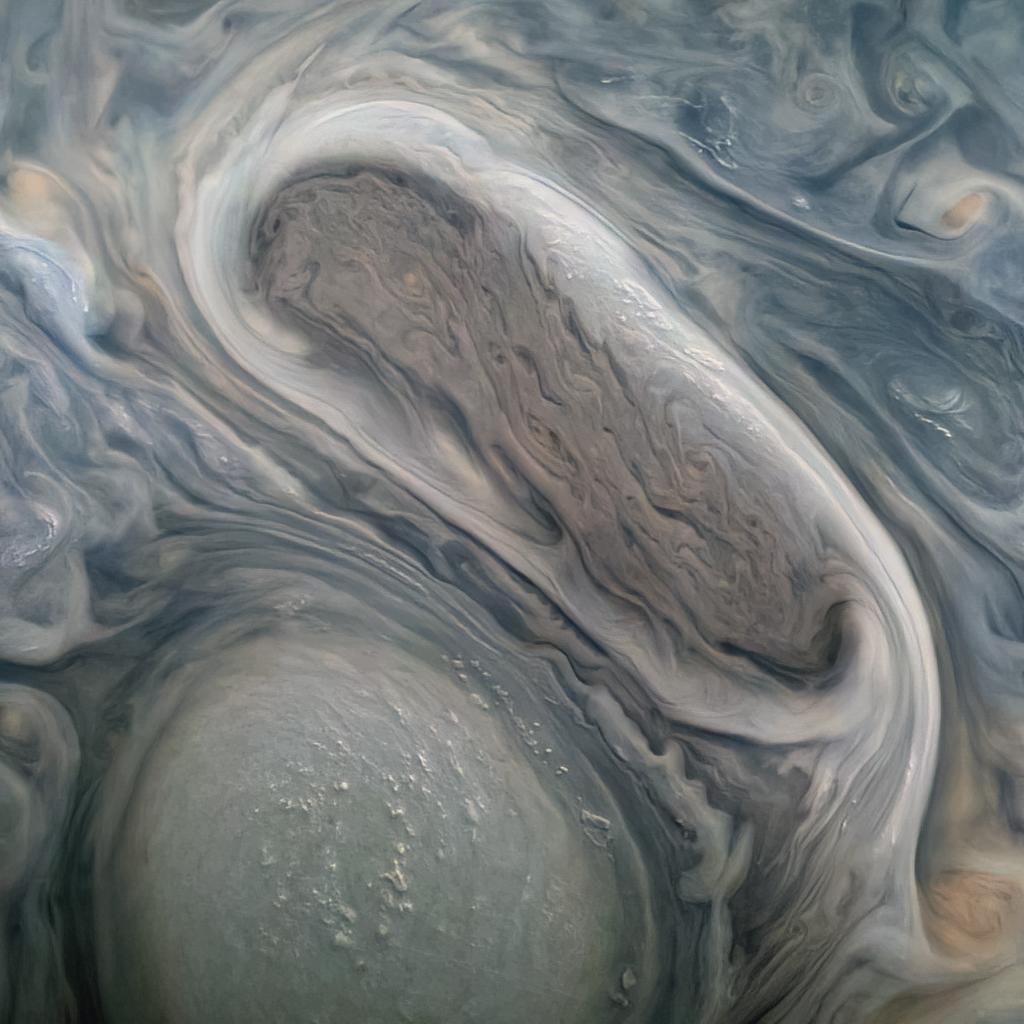 Credit: NASA / JPL-Caltech / SwRI/MSSS; image processing: Kevin M. Gill CC BY. Source: science.nasa.gov
The image depicts two substantial vortex storms situated in Jupiter’s northern hemisphere, captured during the spacecraft’s 38th orbital flyby on November 29, 2021. The photograph was acquired from an altitude of approximately 6,140 km at 50 degrees north latitude, with details as small as 4 km discernible.
Above the lower storm, luminous formations are observable, ascending and projecting shadows onto the cloud layer beneath. Although their apparent size is modest relative to this backdrop, such clouds generally extend approximately 50 km in diameter. Kevin M. Hill processed the original images, enhancing the colors and contrast.
Lightning on Jupiter
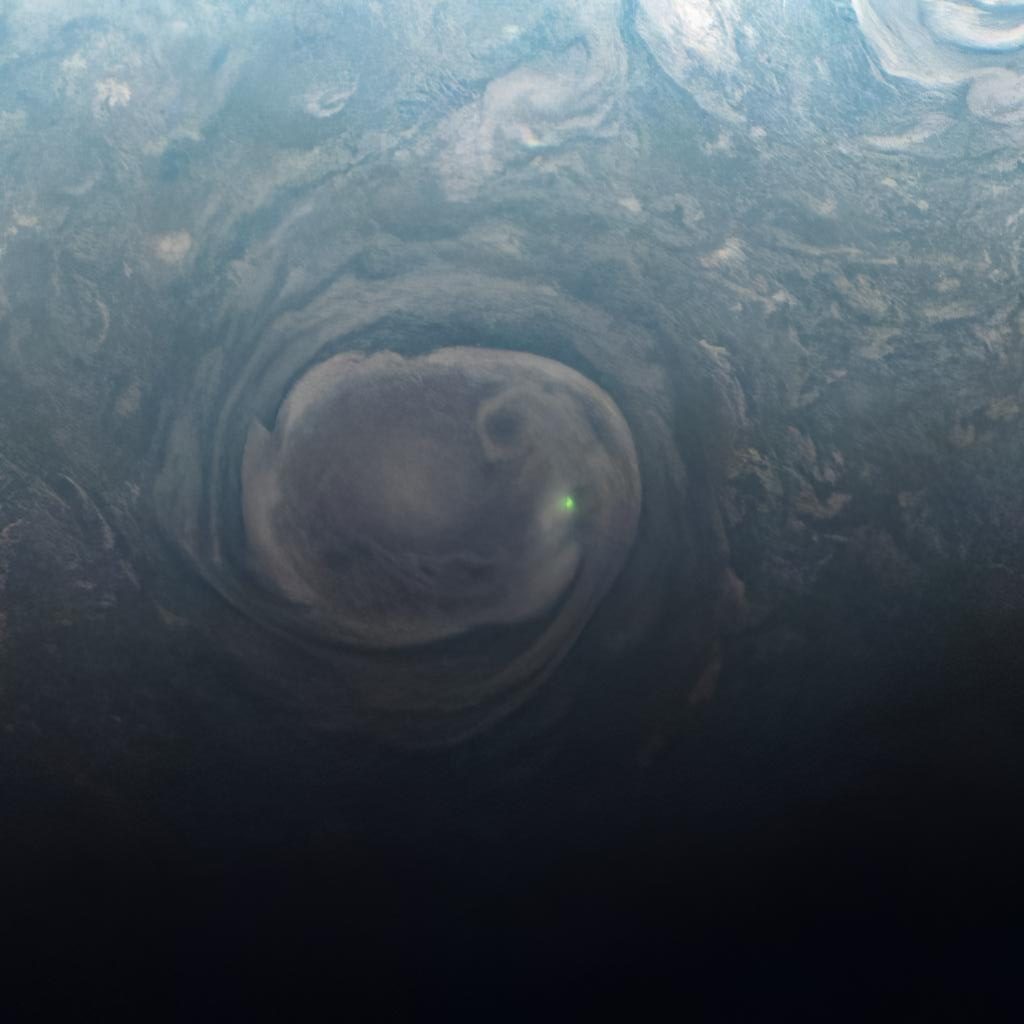 Credit: NASA / JPL-Caltech / SwRI/MSSS; image processing: Kevin M. Gill. Source: science.nasa.gov
During its 31st close flyby of Jupiter on December 30, 2020, the Juno spacecraft captured the glow of a lightning strike in a vortex near the planet’s north pole. The image was taken from an altitude of about 32,000 km above the cloud cover at a latitude of approximately 78 degrees. In 2022, amateur scientist Kevin M. Hill processed the original images from JunoCam.
On Earth, lightning predominantly occurs within water clouds and is most frequently observed in equatorial regions. Conversely, on Jupiter, lightning activity is primarily detected near the poles, with clouds comprising a mixture of ammonia and water.
Jupiter’s Great Red Spot
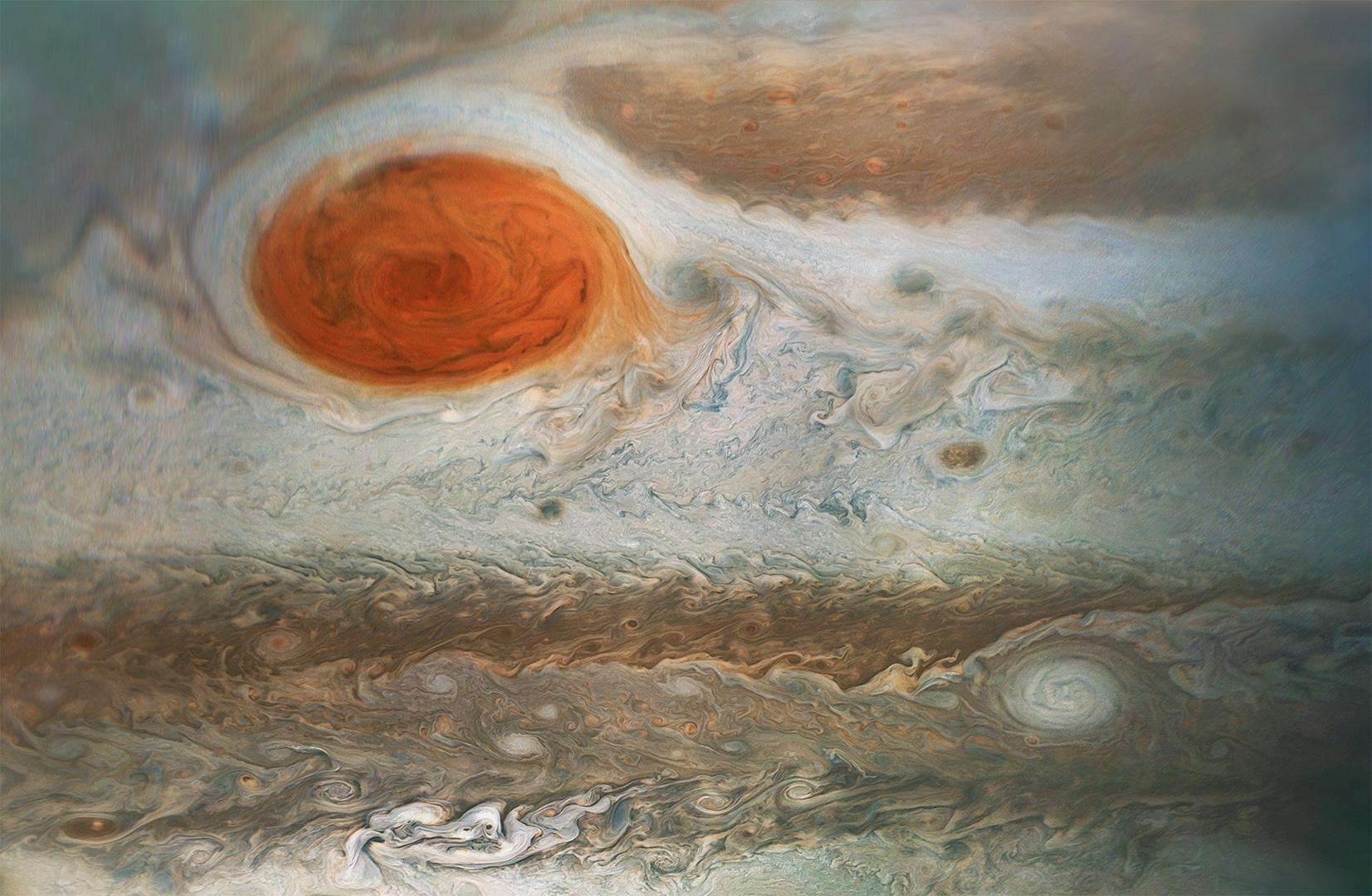 Credit: NASA / JPL-Caltech / SwRI / MSSS; image processing: Gerald Eichstädt, Seán Doran. Source: science.nasa.gov
During Juno’s 12th close flyby on April 1, images of the Great Red Spot were captured from altitudes ranging from 24,749 to 49,299 km above the cloud cover at southern latitudes between 43.2 and 62.1 degrees. The image is a composite of three separate images taken over a 15-minute period. Amateur scientists Gerald Eichstedt and Sean Doran processed the raw data from JunoCam, enhancing the colors.
Sources: science.nasa.gov, science.nasa.gov