
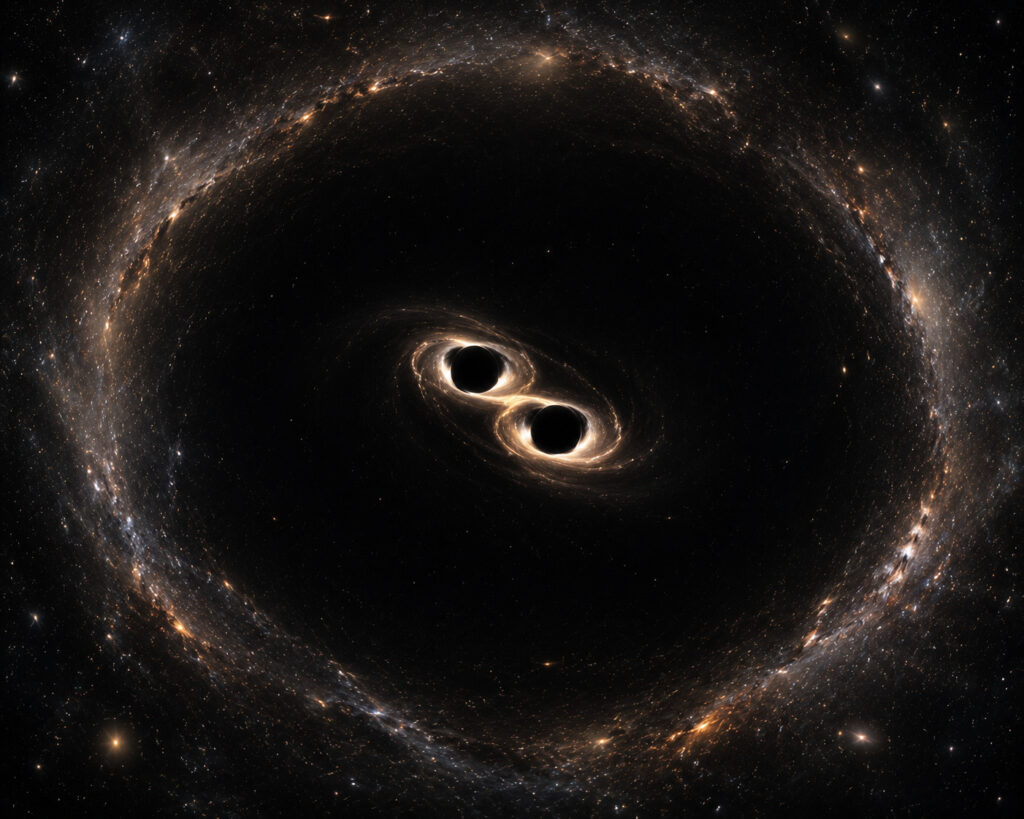
 Artistic depiction, for illustrative purposes online.
Space is usually crowded at the center of a giant galaxy. Stars pack tightly together, shining with the collective brilliance of billions of suns. But at the heart of an enormous galaxy cluster known as Abell 402, something has gone completely wrong.
Astronomers looking deep into the core of this cosmic behemoth just found a massive, dark void. It’s a physical hole in space stretching thousands of light-years across. For two decades, researchers thought space dust must be obscuring the region. But now, data from the JWST shows that there was no dust at all.
Instead, this cosmic hole is the result of a violent, ongoing dance between two of the most massive black holes we’ve ever discovered. Together, these gargantuan black holes weigh a whopping 60 billion times the mass of our Sun. As they spiral towards a merger, they act like a giant broom, slingshotting billions of stars straight out of the neighborhood.
Something We’ve Never Seen Before
The story starts in 2006. The Hubble Space Telescope snapped images that showed a strange dark smudge near a galaxy’s center. At the time, astronomers shrugged it off, assuming cosmic dust was screening the region. More observations from 2018 showed the same thing, and once again, dust was assumed to be the culprit.
But the James Webb Space Telescope (JWST) can peer through cosmic dust. Its infrared camera is good at exactly that sort of thing. This time when researchers looked at that cosmic region, the void was still there. So, it couldn’t be dust.
Simply put, the void in Abell 402 was real.
After eliminating several other fringe explanations, the team led by Michael McDonald of the Massachusetts Institute of Technology concluded that the space really is empty. There are millions or billions of planets and stars missing; but why?
The decisive clue came from the western rim of the cavity. JWST identified a bright infrared point source that looked like an actively feeding supermassive black hole. When the researchers investigated the region using the MUSE spectrograph on the Very Large Telescope, the plot thickened dramatically. They detected two kinematically distinct active galactic nuclei (AGN) sitting on opposite sides of the cavity.
×
Thank you! One more thing…
Please check your inbox and confirm your subscription.
Dance of the Titans
The researchers investigated the structure of the host galaxy on a larger scale. They discovered that the galaxy’s entire central light profile flattens out into a massive, diffuse core spanning 2.2 kiloparsecs (about 7,000 light-years). Astronomers know that these large, flat cores are strong indicators of ultramassive black holes. When galaxies merge, their central black holes meet and sink to the bottom of the gravitational well.
So, the leading theory is that as these black holes circle each other, they create a gravitational slingshot, firing stars and planets out of the center of the galaxy at extreme speeds. Over hundreds of millions of years, this process cleared out the center of the galaxy. Based on the size of A402’s flattened core, the team estimated that a single monster black hole at the center would need to weigh roughly 50 billion solar masses. The two of them together have an even higher mass.
But while this theory is the frontrunner, the researchers also proposed two alternative explanations.
The first alternative involves a phenomenon called post-merger recoil. When two giant black holes finally merge, they can emit gravitational waves unequally in one direction. This acts like a rocket thruster, giving the newly formed single black hole a literal kick out of the galaxy’s center. As the black hole plows through the surrounding space, it destabilizes stellar orbits, causing the central region to rapidly expand and leave a temporary cavity behind.
The second alternative is a structural collapse known as a dipole instability. When a galaxy has a very sharp transition between a flat inner core and a steep outer boundary, the system can become dynamically unstable. Computer models show that this imbalance triggers a massive, rotating lopsidedness — a dipole — in the stellar density. From certain angles, this lopsided distribution looks like a massive dark cavity.
While these are possible, the evidence favors the idea that we’re watching a pair of supermassive black holes merging. The cosmic cavity has sharp edges, which suggests that it’s young (if it were old, natural movement of stars would have smeared out the sharp boundaries over time).
Watching an Extreme Event
This is striking for several reasons. For starters, these are some of the most massive black holes ever observed.
Stellar-mass black holes, formed from collapsing stars, typically range from about 5 to 100 times the mass of the Sun. By contrast, the largest known supermassive black holes, which reside at the centers of galaxies, can reach tens of billions of solar masses — but even among those giants, very few exceed 50–60 billion solar masses. The black holes in this system fall at the extreme high end of that range, making their gravitational influence enormous and their eventual merger a cosmic event of unprecedented scale.
Secondly, this discovery highlights the importance of using a variety of space instruments. The Hubble Space Telescope first identified a mysterious dark region in 2006, suggesting something unusual at the galaxy’s core. Years later, the James Webb Space Telescope (JWST) provided the infrared sensitivity needed to peer through any potential dust, confirming that the void was real. Ultimately, combining observations from multiple instruments — including spectroscopic data from the Very Large Telescope — allowed astronomers to map the dynamics of the black holes and surrounding stars, revealing the true cause of the massive cosmic cavity.
Lastly, this offers us the chance to observe a rare cosmic event. Astrophysicists have long wrestled with the “final parsec problem” — the mathematical paradox of how two giant black holes shed enough energy to actually touch and merge, rather than stalling out indefinitely in orbit.
The A402 system proves that three-body stellar ejections are actively working to shrink these massive binaries. Scientists estimate that this early, high-energy phase of binary hardening lasts only about 40 million years. In astronomical terms, that is a blink of an eye, explaining why we only see this effect in roughly 0.5% of massive galaxies.
Looking ahead, massive space-mapping missions like the Euclid telescope and the Roman Space Telescope will scan millions of galaxies. By searching for similar telltale cavities, astronomers can finally build a reliable clock for black hole mergers and we can understand this process even better.