
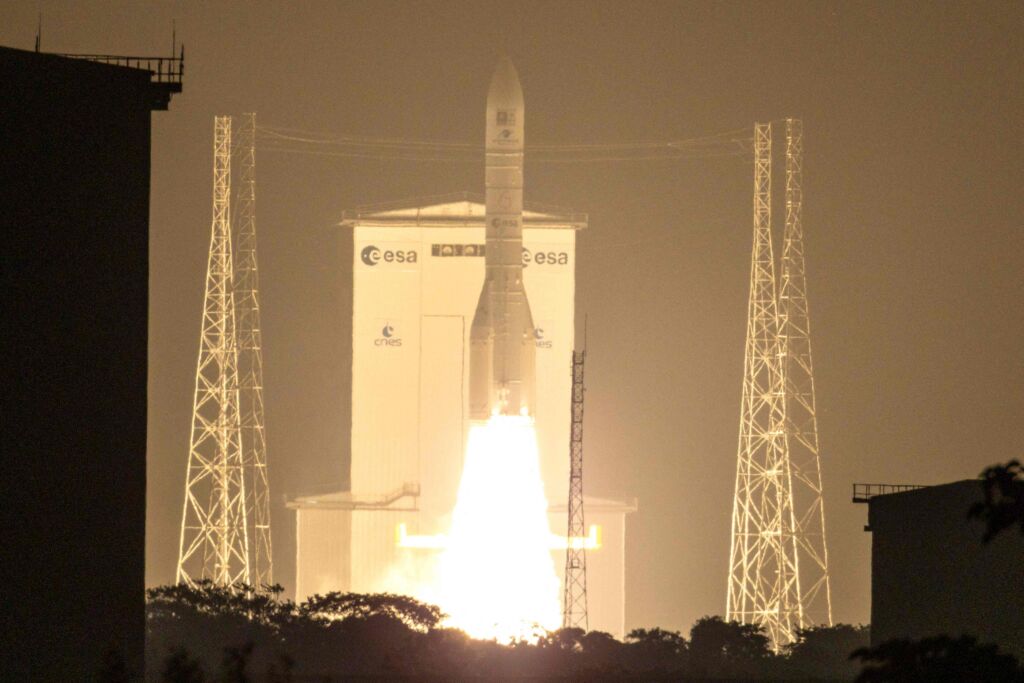
Outer space is getting much closer to the defence of Europe than it used to be. In recent years, a number of factors have converged to make space an enabler for military operations on Earth, a war-fighting domain in its own right, and an arena of strategic competition in which the US, Russia, and China play major roles. As a result, NATO, the EU, and the European Space Agency (ESA), as well as their members, are adapting to the new reality, while Europe is investing more in space.
The link between space and the defence of Europe is epitomised by the fact that Moscow began its full-scale invasion of Ukraine through an offensive operation against the Ka-Sat satellites of the US company Viasat, through a denial-of-service cyberattack targeting ground-based internet modems. Russia succeeded in disrupting the space services the Ukrainian armed forces needed at that critical juncture. Yet, while restoring support from Viasat, Kyiv has turned to other foreign private companies, starting primarily with Starlink but also ICEYE, Planet Labs, and Black Sky to enable its defence trough space.
Space Assets as Enablers of Defence….
Indeed, over the years, Ukraine has successfully used space as an enabler of its military operations by leveraging, in a large scale, high-intensity conflict, the various services that modern militaries expect from satellites. First, global navigation satellite systems, such as the American Global Positioning System (GPS) and the European Galileo, enable not only the location of armed forces and improved logistics, but also the guidance of precision munitions and the synchronisation of operations in real or near real time. Telecommunications satellites constitute the backbone of command, control, and communication (C3) for advanced militaries. In-orbit assets specialised in intelligence surveillance reconnaissance (ISR) nowadays mitigate uncertainty about adversary’s activities and capabilities—particularly if coupled with other sensors, including drones—thus supporting better planning at tactical, operational, and strategic levels. Last but not least, missile defence, including NATO’s Integrated Air and Missile Defence, heavily relies on space-based early warning assets.
Ukraine has successfully used space as an enabler of its military operations by leveraging the various services that modern militaries expect from satellites.
The four-year-long Russia–Ukraine full-scale war has also demonstrated the profound and pervasive integration of international commercial suppliers directly supporting the armed forces. Indeed, the Starlink service has become crucial for Ukrainian forces’ communications, but this dependence has given the CEO of a commercial company a degree of direct influence on the conflict rarely seen in contemporary wars. Furthermore, the excessive integration of foreign space services within certain military C3 or ISR systems allows the country of origin of space systems or services to retain the right to permit or deny access to them. This should be taken into account when the Donald Trump administration makes such a judgment regarding European Allies relying on space services provided by American companies.
…and Targets of Adversary Attacks
Since technologies that depend on satellites in orbit are absolutely fundamental to the defence and national security of advanced countries, space assets become targets for adversary action and should be protected accordingly. China and Russia consider attacks on those assets a cost-effective way to degrade US and NATO military capabilities, whether in the Indo-Pacific or in Europe. Both have developed doctrines and capabilities aimed at countering and denying US and Allied access to space, and in recent years, the Pentagon has assessed that Beijing and, to a lesser extent, Moscow represent the greatest and most imminent strategic threat to maintaining US military superiority.
Space assets become targets for adversary action and should be protected accordingly.
Counterspace capabilities have proliferated, including both kinetic and non-kinetic ones. The first group includes direct-ascent anti-satellite weapons such as the missiles tested by Russia, China, India, and the US over the last two decades, launched from Earth to successfully destroy a satellite in orbit. Non-kinetic actions use the electromagnetic spectrum to perform jamming or spoofing, or to disrupt satellite operations by damaging its electronic components. Cyberattacks like the aforementioned Russian one belong to this category, too. Non-kinetic activities are cheaper than kinetic ones and offer the advantage of plausible deniability to their perpetrators; therefore, they are becoming rather frequent and widespread in the space domain.
In this context, the next frontier is in-orbit servicing—a concept referring to space operations whereby two or more space assets physically interact. From current operations such as refuelling, re-orbiting, maintenance, and repair to the logistics for the new race to the Moon spearheaded by the Artemis Accords, space transportation technologies are making fast and significant progress of a dual-use nature. For example, the same robotic arm that can repair a satellite may well damage it or push it to de-orbit, as successfully demonstrated by a Chinese asset. Moreover, the exponential growth in debris produced by satellites at the end of their operational life has prompted the development of active debris removal technologies, which, once again, are inherently useful for both civilian and military purposes, including offensive and defensive ones.
Space situational awareness is becoming as important as air or maritime ones.
As a result, space situational awareness is becoming as important as air or maritime ones to recognise and deal with the risks and threats in a space domain that is more competitive, congested, and contested than ever. Space competition and congestion also depend on the greater number of space-faring nations than during the Cold War. Beyond major actors such as the US, China, and Russia, a number of middle powers from Japan to India, in Europe, the Middle East, and Asia operate space assets. Geopolitical shifts in the international systems have an impact on space, too. In addition, the US change of paradigm by encouraging private actors such as SpaceX and Blue Origin to manage key infrastructure and services, including access to space and future space stations, accelerates both innovation and uncertainty.
Institutional and Military Adaptation
Against this backdrop, major NATO countries have adapted their institutions and armed forces to protect national security interests in space. The US decision to centralise space responsibilities by re-establishing the US Space Command and establishing the US Space Force in 2019 aims to ensure access to essential space capabilities for both military operations and the functioning of society, while preserving the country’s space superiority in both operational and technological terms. Since 2019, important Allies such as Canada, France, Germany, Italy, Spain, and the United Kingdom have established space commands and tasked their respective air forces to operate in the space domain by developing doctrines, reorganising human resources, and investing in military space assets.
Simultaneously, since 2019, NATO has adopted its first-ever Space Policy and recognised space as a new operational domain, moving beyond the traditional approach of considering it as a force multiplier for military operations. It then established the NATO Space Centre (NSpC) at Allied Air Command in Ramstein, Germany, in 2020. In 2024, the expansion in Alliance’s space activities also led to the creation of the Combined Force Space Component Command and the NATO Space Operations Centre (NSpOC), which replaced the NSpC.
The EU has also recognised the growing linkage between space, security, and defence by adopting in 2023 its EU Space Strategy for Security and Defence, following the identification of space as a strategic domain by the 2022 EU Strategic Compass. The European Commission has elevated the political importance of space by assigning this responsibility first to the Commissioner for the Internal Market, and then to the new Commissioner for Defence and Space, a position established by the second von der Leyen Commission in 2024. The fact that the same Commissioner is responsible for defence and space testifies to the full acknowledgement of the link between the two elements at the EU level. The EU Space Agency (EUSPA) has also been founded to directly manage the Union’s constellations Copernicus and Galileo, including the services and data they provide to security authorities within the EU. As a whole, European space governance has evolved significantly in recent years, with higher ambitions but also greater complexity. The growing importance Brussels attaches to space also has significant budgetary implications. Indeed, the Commission has proposed to allocate €131 bn to defence and space within the 2028–34 financial framework.
European space governance has evolved significantly in recent years, with higher ambitions but also greater complexity.
Meanwhile, over the last couple of years, ESA, which includes non-EU members such as the UK and Norway, has changed its approach to security by interpreting its Convention flexibly. Accordingly, it is cooperating more with the EU to manage space programmes aimed at providing capabilities for Earth observation, navigation, and secure connectivity, fit for defence and security users. At the 2024 ESA council meeting, member states committed the largest contribution in the history of the Agency, with €22.3 bn to be allocated to cooperative space programmes.
The growth in budgets and institutional adaptations on the Old Continent are positive steps in the right direction, helping to both defend European space assets and support the defence of Europe with space services. However, they are not sufficient vis-à-vis the acceleration and intensification of Russian and Chinese threats in space, and given the uncertainty surrounding relations with the US, also in this domain. Moreover, the increase in national investments without European cooperation risks bringing fragmentation, duplication, and ineffective use of public spending. As the nexus between space and defence gets stronger, Europe has to work on both in a strategic way.
This article was written for the Lennart Meri Conference special issue of ICDS Diplomaatia magazine. Views expressed in ICDS publications are those of the author(s).