
For the first time, electrons have been observed around Jupiter as they accelerate to relativistic speeds—that is, nearly the speed of light. The discovery could help refine theories about how high-energy particles are formed throughout the universe.
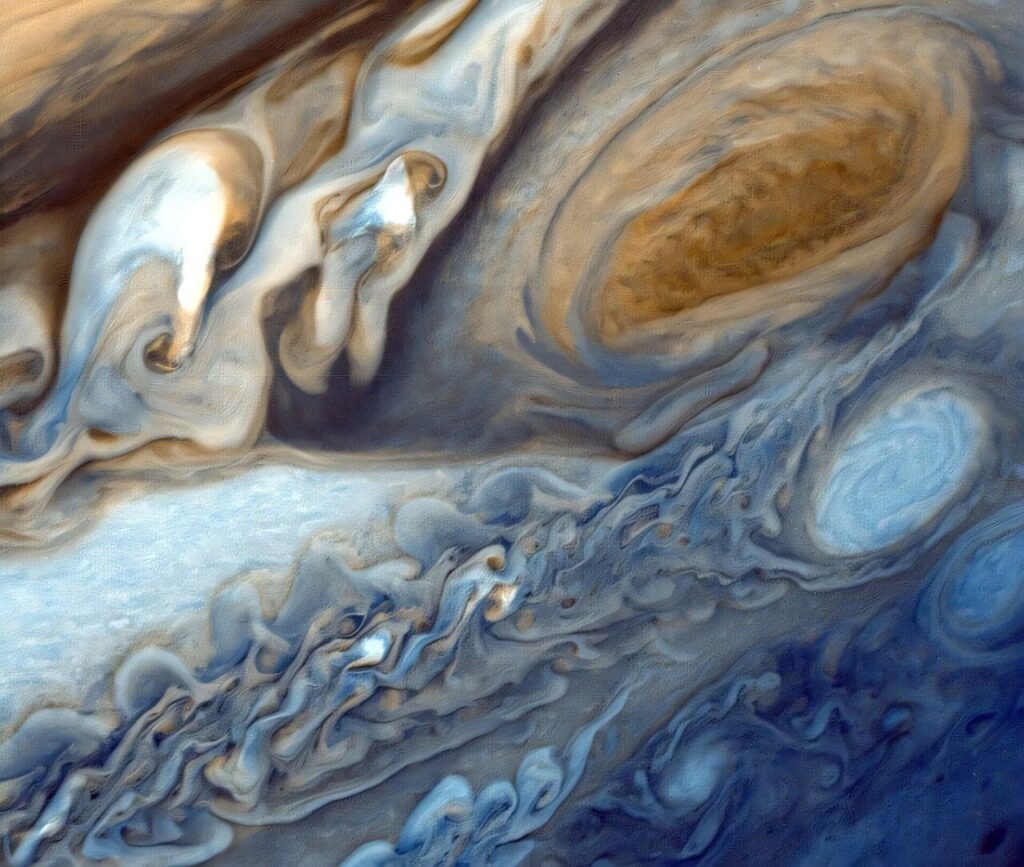
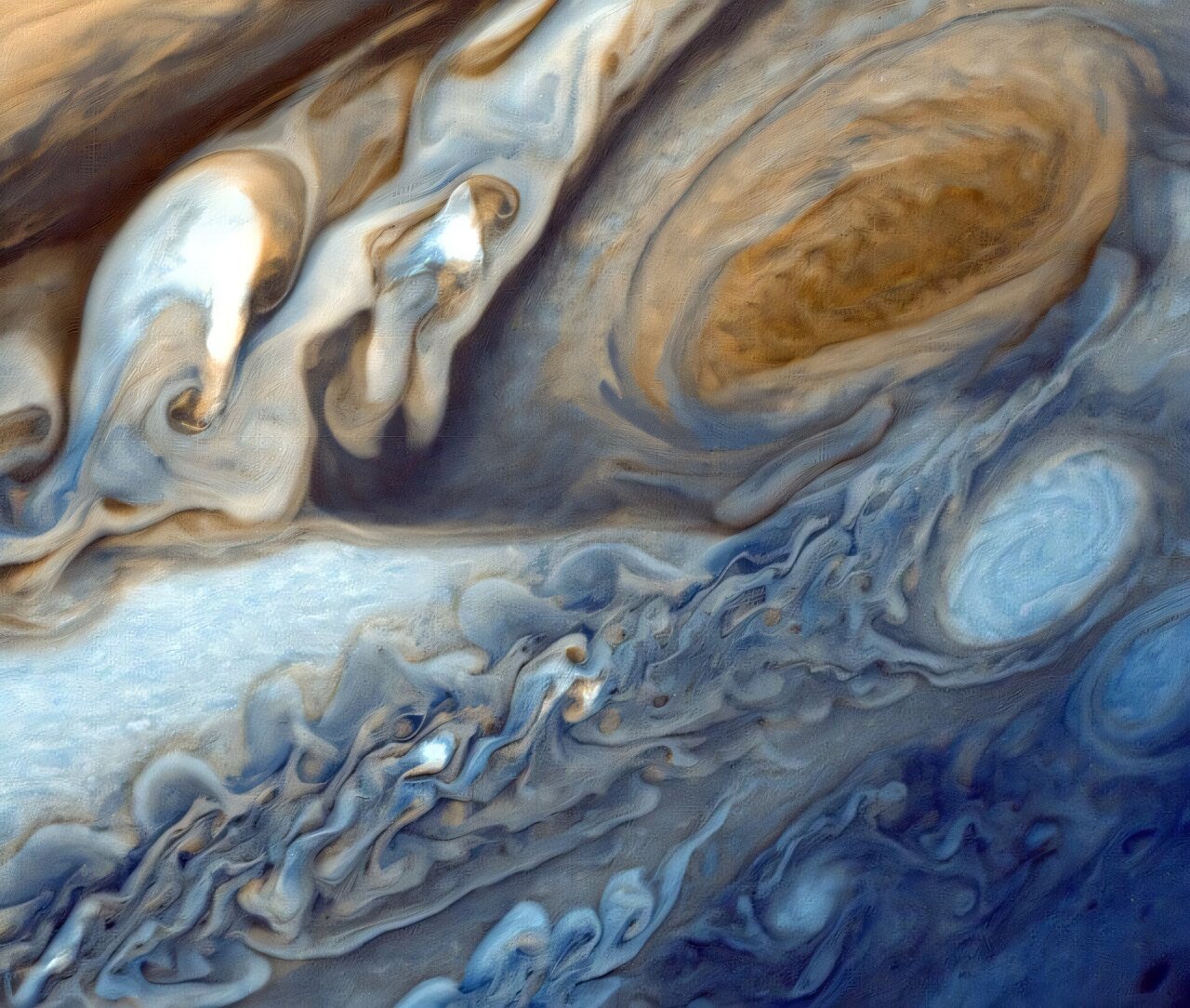 Vortex structures in Jupiter’s atmosphere. Source: nasa.gov
What is a planetary shock wave?
Where Jupiter’s magnetosphere meets the solar wind, a bow shock is formed. This is a sudden change in pressure at the boundary between two media that occurs when an object moves through plasma faster than the local speed of sound. The name comes from similar waves on the water caused by the bow of a ship.
In interstellar plasma, particles are so sparsely distributed that direct collisions between them are rare, so wave energy is transmitted via electromagnetic forces.
Data from the Juno spacecraft
Scientist Savvas Raptis and his colleagues analyzed measurements taken by the Juno spacecraft as it passed through Jupiter’s shock wave. The instruments detected a pre-shock region spanning several planetary radii.
It contains unstable plasma structures that capture particles and accelerate them to relativistic speeds. Scientists have also discovered that the size of these structures depends on the overall scale of the entire shock wave system and determines the practical limit of possible particle energies.
A general pattern
By combining data from Jupiter with measurements from other planetary systems, researchers have established a relationship between the size of unstable structures and the maximum energies of particles. This suggests a potentially unified acceleration mechanism for different types of shock waves.
The authors note that it is not yet possible to test this pattern on distant astrophysical shock waves without new observations. New data and modeling will be needed to verify the universality of the results. The findings have been published in the journal Nature.
According to phys.org