


(© mozZz
– stock.adobe.com)
In A Nutshell
Scientists used a radio telescope array to scan an interstellar object for signs of alien technology and found no such signals.
The team sifted through nearly 74 million radio signal detections, eventually narrowing them down to 211 candidates for closer inspection, all of which turned out to be human-made interference.
After running every candidate through visual inspection, the final count of signals worth following up on was zero.
The study sets a ceiling on how powerful any radio transmitter aboard 3I/ATLAS could be, based on what the telescope would have been able to detect.
An object from outside our solar system came hurtling past Earth last summer, and a team of scientists did something most people didn’t know was possible. They pointed a radio telescope at it and listened. The object, called 3I/ATLAS, is only the third interstellar visitor ever detected passing through our solar system. It was spotted on July 1, 2025, by a sky-survey system in Chile. Most scientists expect it’s a naturally occurring comet. But a team at the SETI Institute wasn’t willing to skip a more provocative question: what if it’s not?
Their reasoning is grounded in something humanity already did. In 1977, NASA launched the Voyager probes into deep space. Those spacecraft will one day drift into other star systems as interstellar objects themselves. If another civilization did something similar, sent a probe out to explore the galaxy, it might look a lot like 3I/ATLAS from the outside. Scientists call these hypothetical alien probes “artifact technosignatures,” meaning detectable signs of technology originating from far away. Whether or not 3I/ATLAS fits that description, the researchers decided, was worth checking.
How Scientists Listened to 3I/ATLAS for Alien Radio Signals
Researchers used the Allen Telescope Array, a radio telescope array of 42 dishes operated by the SETI Institute in Hat Creek, California, with 28 of those dishes active during this campaign, to observe 3I/ATLAS across a broad range of radio frequencies, from 1 to 9 gigahertz. That’s a wide sweep of the radio spectrum, covering territory that hadn’t been thoroughly searched in previous efforts of this kind.
Over five observing sessions totaling 7.25 hours, the team captured roughly 22 terabytes of data, enough to fill millions of books. Their equipment was tuned to detect what scientists call narrowband signals, extremely focused bursts of radio energy at a very specific frequency. That kind of signal is considered a strong indicator of technology, because nature doesn’t tend to produce it. Lightning, stars, and gas clouds broadcast their energy broadly. A radio transmitter, whether built by humans or anyone else, focuses it tightly.
A newly developed software tool called bliss combed through the data and found nearly 74 million individual signal detections. From there, researchers applied a series of filters to strip out known sources of interference: GPS satellites, cellular networks, commercial satellite downlinks, and other human-made radio noise that routinely clutters the airwaves. About 16 percent of the frequency range scanned was thrown out entirely because it was too polluted with interference to be useful.
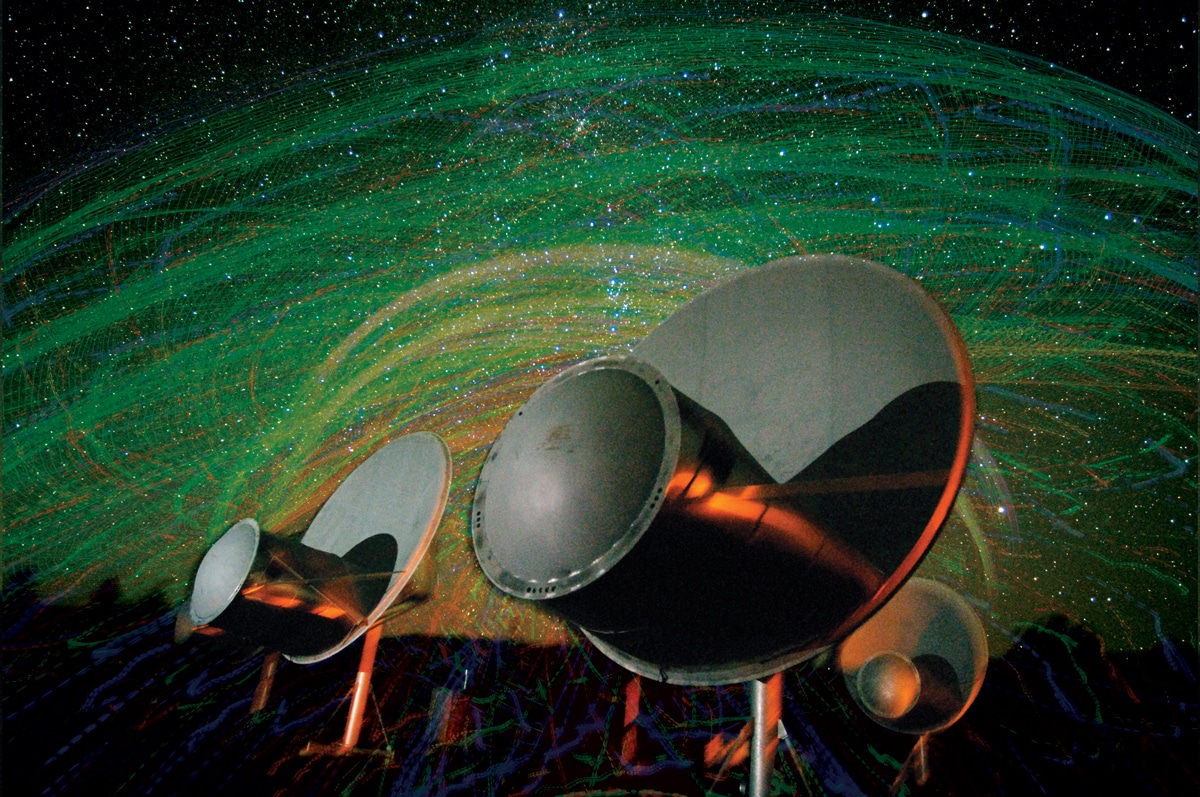
The Allen Telescope Array at the Hat Creek Radio Observatory. (Credit: Seth Shostak/SETI Institute)
Sorting Signal From Noise
After cutting out that noise, the team was still left with roughly 2 million signal detections. Researchers then filtered those based on how they were moving in frequency, specifically whether they were shifting in the way a signal from 3I/ATLAS would, given the object’s speed and direction relative to Earth. A second software tool, called NBeamAnalysis, compared signals detected in the telescope beam aimed directly at 3I/ATLAS against signals detected in a beam pointed slightly off to the side. If a signal showed up only when the telescope was pointed at the object, it was worth a harder look. If it showed up in both beams equally, it was almost certainly coming from somewhere on Earth.
After that filtering, 211 candidates remained. Researchers visually inspected each one. Among those, 11 appeared to come from a point in the sky rather than from the ground, a potentially exciting characteristic. But on closer examination, none of them looked like the kind of clean, focused drifting signal that would indicate a genuine technological source. Some were traced to satellites. Others had characteristics inconsistent with what a real alien transmitter aboard 3I/ATLAS would produce. The final count of signals worth following up on was zero.
What the Silence Actually Tells Us About the Alien Signal Search
Not finding anything isn’t the same as learning nothing. Based on the Allen Telescope Array’s sensitivity and 3I/ATLAS’s distance during observations, roughly 3.35 astronomical units (about three times the distance from Earth to the Sun), the team calculated an upper limit on how powerful any radio transmitter on the object could be. That limit ranges from about 10 to 110 watts, depending on the frequency. A standard incandescent light bulb uses about 60 watts. So any radio transmitter aboard 3I/ATLAS, if one existed, would need to be operating at a power level barely above that of a household light bulb to have escaped detection entirely.
A previous search using the MeerKAT telescope had covered a narrower slice of the radio spectrum, from 900 to 1670 megahertz. This new work expands the frequency range checked by a factor of roughly 10 and introduces methods, including filtering signals based on the object’s expected motion, that hadn’t been applied to this kind of search before.
Researchers were candid that there is no compelling evidence 3I/ATLAS is anything other than a natural comet. Early observations found it reddish in color, with a developing tail of gas as it neared the Sun, consistent with normal cometary behavior. A tentative rotation period of 16.79 hours has been measured. It reached its closest approach to the Sun on October 29, 2025.
A New Playbook for Future Interstellar Visitors
Scientists behind the study, published in The Astronomical Journal, see this as more than a one-off experiment; it’s a template. As interstellar objects become easier to detect and track, checking each one for radio signals should become standard practice, just as it now is for nearby stars. The tools developed in this search, including the bliss pipeline and the motion-based filtering approach, are expected to be applied to future observations.
3I/ATLAS is only the third such object ever found, but improved sky-survey technology makes it likely that more will follow. Each one offers a narrow window, a passing visitor that won’t come this way again. Whether any of them might carry signs of intelligence remains unanswered. For now, this one arrived in silence.
Paper Notes
Limitations
This study covers only a portion of the radio spectrum, and roughly 16 percent of the frequency range observed was removed from analysis due to heavy interference from human-made radio sources. The authors acknowledge that more advanced interference-removal techniques could potentially recover useful data from those blocked regions in future work. The search was also limited to narrowband radio signals; any technology that does not emit in that format would not have been detected. Additionally, the sensitivity of the Allen Telescope Array is modest compared to some other radio facilities; a separate search using the MeerKAT telescope achieved a much lower power detection limit, though over a much smaller frequency range. The current version of the bliss software has a known artifact affecting certain drift rate measurements, though the authors note this does not cause false negatives in the results.
Funding and Disclosures
The Allen Telescope Array refurbishment and operations received substantial support from Franklin Antonio. Additional contributions came from Frank Levinson, Greg Papadopoulos, the Breakthrough Listen Initiative, and other private donors. The Paul G. Allen Family Foundation provided major support for the design and construction of the array, alongside contributions from Nathan Myhrvold, Xilinx Corporation, Sun Microsystems, and other private donors. The ATA has also been supported by the US Naval Observatory and the US National Science Foundation. Breakthrough Listen is managed by the Breakthrough Initiatives, sponsored by the Breakthrough Prize Foundation. One author acknowledges support from the SETI Institute REU program under NSF Award 2447895. Another author acknowledges support from the DiRAC Institute at the University of Washington, supported through gifts from the Charles and Lisa Simonyi Fund for Arts and Sciences, Janet and Lloyd Frink, and the Washington Research Foundation.
Publication Details
Title: A Search for Radio Technosignatures from Interstellar Object 3I/ATLAS with the Allen Telescope Array | Authors: Sofia Z. Sheikh, Valeria García López, Isabel Gerrard, James R. A. Davenport, Wael Farah, Blayne Griffin, Steve Croft, Luigi F. Cruz, Imke de Pater, Ben Jacobson-Bell, Mark Masters, Karen I. Perez, Alexander W. Pollak, Carol Shumaker, and Andrew Siemion | Affiliations include: SETI Institute, Berkeley SETI Research Center, Furman University, Breakthrough Listen (University of California and University of Oxford), University of Washington, University of Central Arkansas, and others. | Journal: The Astronomical Journal, Volume 172 | DOI: 10.3847/1538-3881/ae6651 | Published: 2026 (accepted April 27, 2026; published June 3, 2026)