
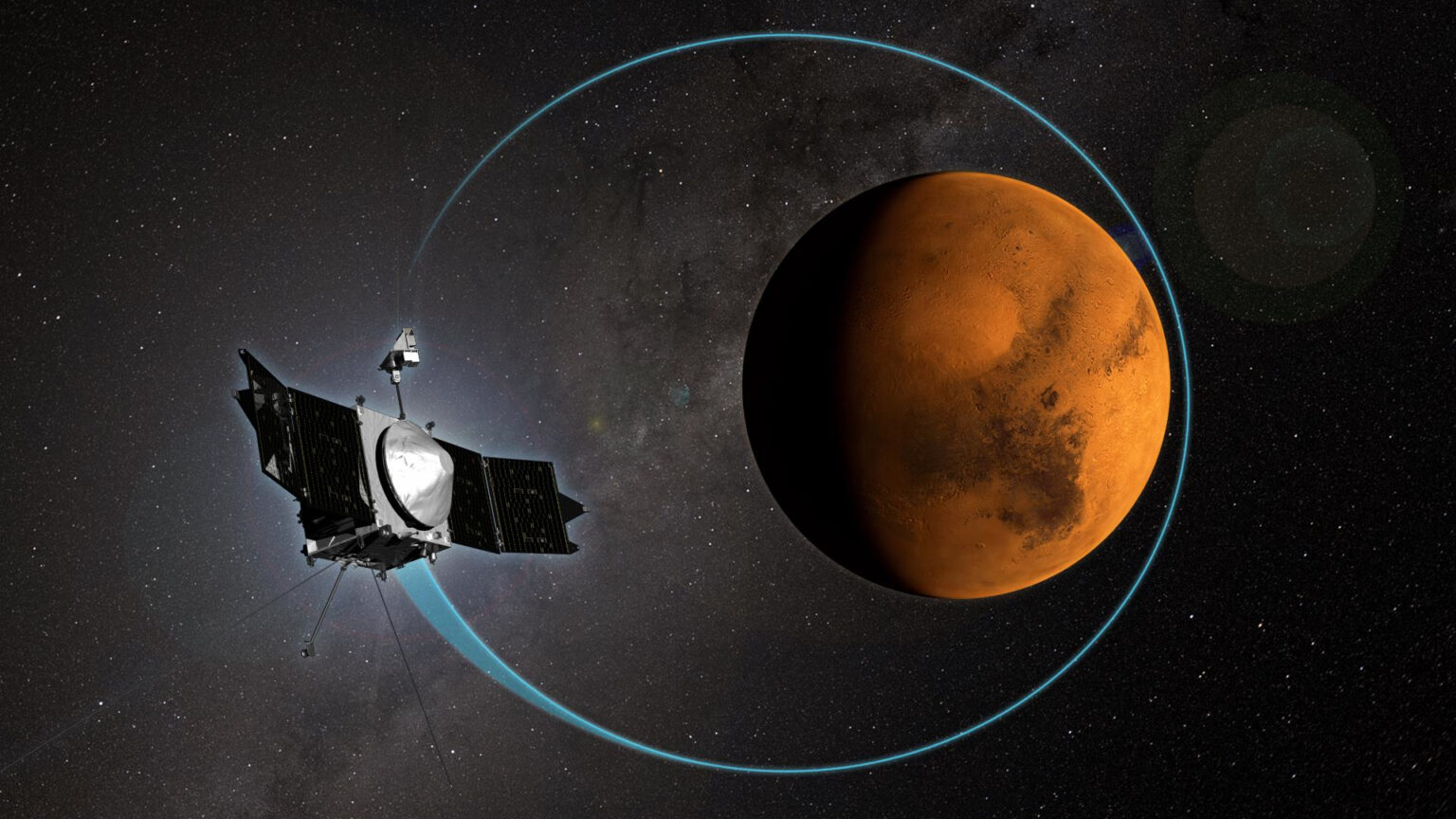
NASA has officially declared the end of its MAVEN mission at Mars after the spacecraft quietly stopped talking to Earth during a routine pass behind the Red Planet in December 2025. Designed to study how Mars lost its atmosphere, MAVEN far outlived its original one‑year mission, spending 11 years in orbit and becoming a workhorse for both science and communications.
A Routine Manoeuvre That Never Ended
On 6 December 2025, MAVEN slipped behind Mars in what’s known as an occultation – a standard part of its orbit when the planet temporarily blocks radio contact with Earth. The blackout was supposed to last less than an hour. When MAVEN re‑emerged, NASA’s Deep Space Network listened for its signal. Nothing came back.
Engineers spent months sending commands “in the blind” and searching recordings for even a whisper from the spacecraft. Later analysis of radio data, originally collected for an unrelated upper‑atmosphere experiment, revealed faint fragments of telemetry. Those showed MAVEN had begun spinning at about 2,7 revolutions per minute – far faster than normal. At that rate, the spacecraft could no longer keep its solar panels aimed at the Sun or its antenna pointed at Earth, likely draining its batteries within hours.
With no way to recover the tumbling probe, NASA has now ended active recovery efforts and started the formal process of decommissioning the mission. MAVEN will remain in its elongated orbit, skimming as low as about 180 km above Mars and swinging out to 4,000 km, for 50 to 100 years before eventually burning up in the Martian atmosphere.
A Legacy Written in Mars’ Lost Air
MAVEN (Mars Atmosphere and Volatile Evolution Mission) launched in 2013 and arrived at Mars in 2014 to answer a big question: how did a once warmer, wetter Mars become the cold, thin‑aired world we see today? Its instruments traced how the solar wind strips away the upper atmosphere, directly measuring escape processes over an entire 11‑year solar cycle.
One standout result was the first clear observation, at any planet, of an escape process called sputtering, where energetic charged particles slam into the upper atmosphere and “splash” neutral atoms into space, like a cannonball into a swimming pool. Over billions of years, that slow leak helped transform Mars’ climate. In 2024, during a powerful solar storm, MAVEN saw atmospheric escape jump by orders of magnitude and even captured global ultraviolet auroras shimmering across the nightside.
Scientists now say we understand atmospheric escape at Mars better than at any other planet, including Earth, largely thanks to MAVEN’s long, steady watch.
More Than a Scientist: a Vital Relay
MAVEN was also a key part of Mars’ communications backbone. From its high orbit, it served as a relay for data from NASA’s surface missions, including the Curiosity and Perseverance rovers. Although it handled only about 8% of relay sessions, it returned nearly 18% of the total data volume.
Four other orbiters can still pass data between Mars and Earth, but most are older than MAVEN. NASA is now looking ahead to a new, commercially provided Mars Telecommunications Network planned for the 2030s, built on lessons from MAVEN and its companions.
For the team that has flown the spacecraft for more than a decade, the loss is deeply personal. Project leaders describe it as losing “a loved one”, but if MAVEN had a tombstone, its principal investigator already has an epitaph in mind: “Best Mars mission ever.”