
The new European Space Agency’s (ESA) incubator in Portugal, ESA BIC Tagus, was officially launched on 26 May at the Oeiras Campus of Instituto Superior Técnico, Universidade de Lisboa. The event brought together researchers, students, entrepreneurs, startups, and international experts to discuss the future of the space economy and the role of new generations in building that future. Under the theme “Space Tech Entrepreneurship in the Artemis Generation 2026–2040”, the event marked the launch of a strategic infrastructure dedicated to supporting space-based business projects.
“Técnico aims to be at the forefront of this transformation by nurturing talent, supporting new companies, and enhancing Portugal’s presence in European and international value chains within the space sector”, said Rogério Colaço, president of Técnico. Emphasising the role of ESA BIC Tagus in transforming scientific and technological knowledge into concrete solutions for society, the president noted that space “has long ceased to be merely a realm of scientific exploration”, it is now emerging as “a new economic, technological, and strategic frontier”.
ESA BIC Tagus, coordinated by Instituto Superior Técnico through Técnico Venture Lab, in partnership with other institutions, is part of ESA’s European network of incubators dedicated to developing startups and space technologies with the potential for global application. Niels Eldering, Head of the Space Solutions Section at ESA, highlighted the historical symbolism of the “Tagus” (that is, Oeiras Campus) as a starting point for new discoveries and new markets. “Entrepreneurs are not just explorers. They are pioneers who create new businesses, new opportunities, and new forms of collaboration”, he stated, advocating for the role of universities as drivers of innovation capable of connecting talent, research, education, and entrepreneurship.
The event also featured presentations of various projects developed by young entrepreneurs and academic teams. IST NanoSatLab presented its satellite projects developed at Técnico, including those already in orbit and future applications related to 5G communications in space. The N3O startup highlighted the development of medium-sized satellites in Portugal, and LUMA showcased how Earth observation and artificial intelligence can support forest monitoring, environmental management, and carbon markets.
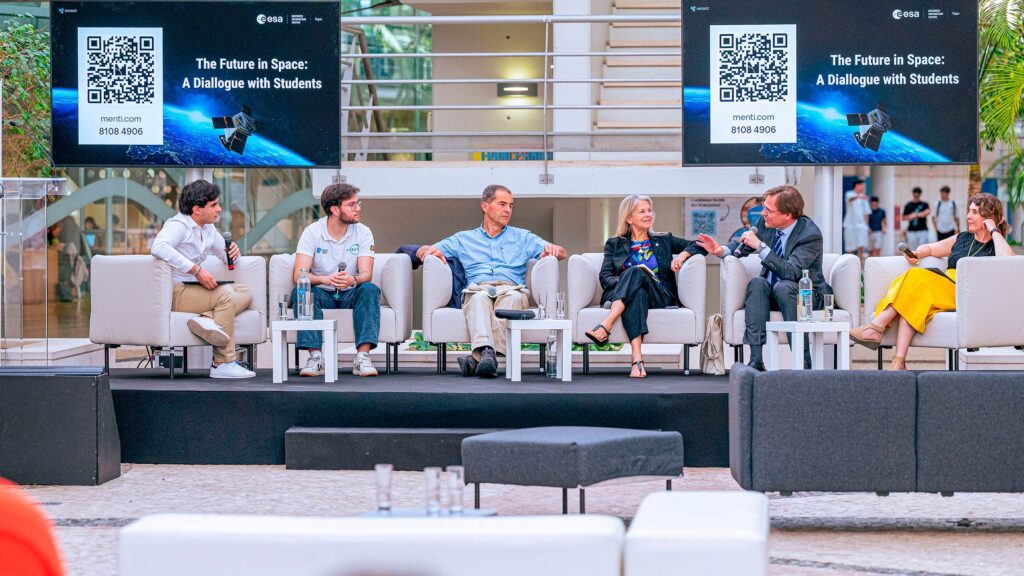
The panel “The Future in Space: A Dialogue with Students”, moderated by Joana Mendonça, vice president of Técnico for the Oeiras Campus, brought together international experts, researchers, and representatives from students’ organisations in a discussion on space exploration, entrepreneurship, and technological innovation.
Miguel Fontinha, from Lisbon’s New Satellite (LISAT), and André Gonçalves, coordinator of the Rocket Experiment Division (RED) at AeroTéc – Aerospace Engineering Students’ Organisation, shared their experience of building satellites and rockets in a university setting, arguing that academic teams are true laboratories for experimentation and entrepreneurship.
According to the students, the opportunity to participate in real missions, test hardware, and compete internationally is essential for accelerating technical skills, developing critical thinking, and laying the groundwork for future space startups. “When we have the opportunity to launch a satellite or test a rocket, the team’s mindset changes completely”, emphasised André Gonçalves, highlighting the importance of learning by doing and the ability to overcome setbacks. Miguel Fontinha noted that projects like LISAT allow students to “dream bigger”, opening new scientific and technological opportunities for Portugal in a rapidly transforming sector.
Dava Newman, former deputy administrator of NASA and current director of the MIT Media Lab, advocated for an international strategy guided by science, collaboration, and the ability to envision long-term goals. “Space forces us to think decades ahead”, she stated. Manuel Heitor, a professor at Instituto Técnico and former Minister for Science, Technology, and Higher Education, also highlighted the need to create a European culture more open to risk, experimentation, and entrepreneurship, arguing that “space forces us to learn how to fail”, also stressing that innovation ecosystems depend on the ability to turn failures into learning and growth.
The event, organised in partnership with MIT Portugal, concluded with a message of collective ambition for the future of the space sector in Portugal. Also attending the event were Sílvia Breu, councilwoman for the Oeiras City Council, and Teresa Fiuza, CIO of Banco Português de Fomento. “May ESA BIC Tagus serve as an open door to new ideas, companies, and ambitions; and may we, from this campus, contribute to building the future of space, connecting Portugal to the world”, concluded Rogério Colaço.