
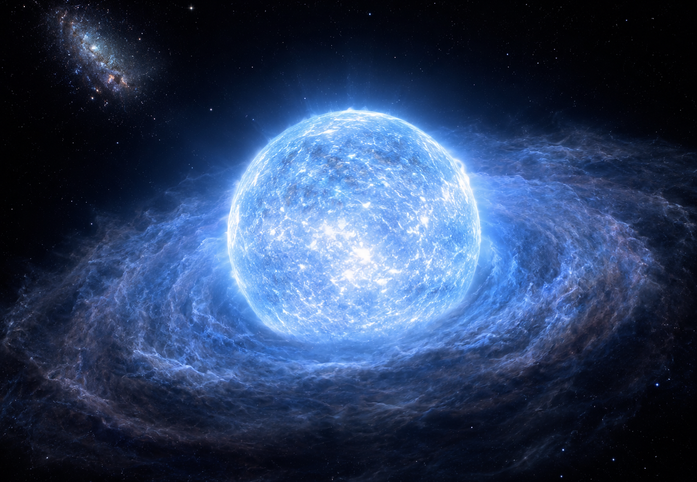
Astronomers may have observed one of the most striking examples of an extremely rare type of explosion that completely destroys a star. Neither a neutron star nor a black hole remains after it.
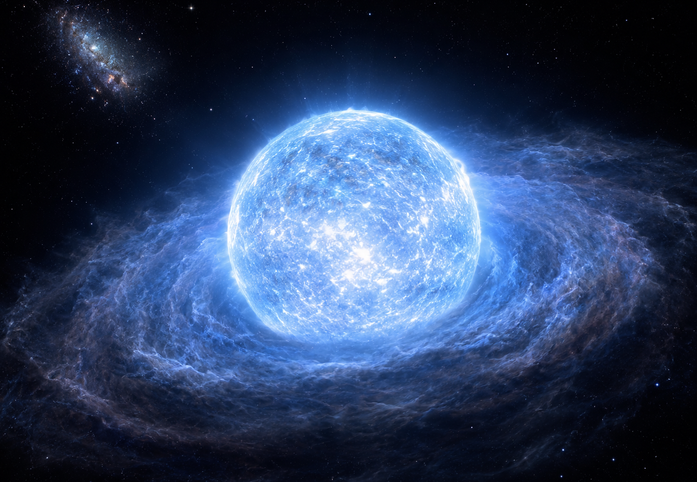 Illustration of a massive blue supergiant in the final moments before a supernova explosion
Suspicious object
The event was designated SN 2023vbw and was first detected by the Zwicky Transient Facility automated sky survey instrument in October 2023. It was observed near a small dwarf galaxy with a low abundance of heavy elements, located approximately 1.3 billion light-years away. It was initially classified as a Type II supernova, which occurs when a massive star exhausts its nuclear fuel and explodes, but several characteristics did not fit this picture.
The researchers conducted detailed observations and simulations of the event and published their results on the arXiv preprint server. After an initial cooling phase, the object’s brightness gradually increased over 190 days, then dropped sharply and entered a slowly fading plateau. The total energy emitted turned out to be more than ten times higher than that of a typical Type II supernova.
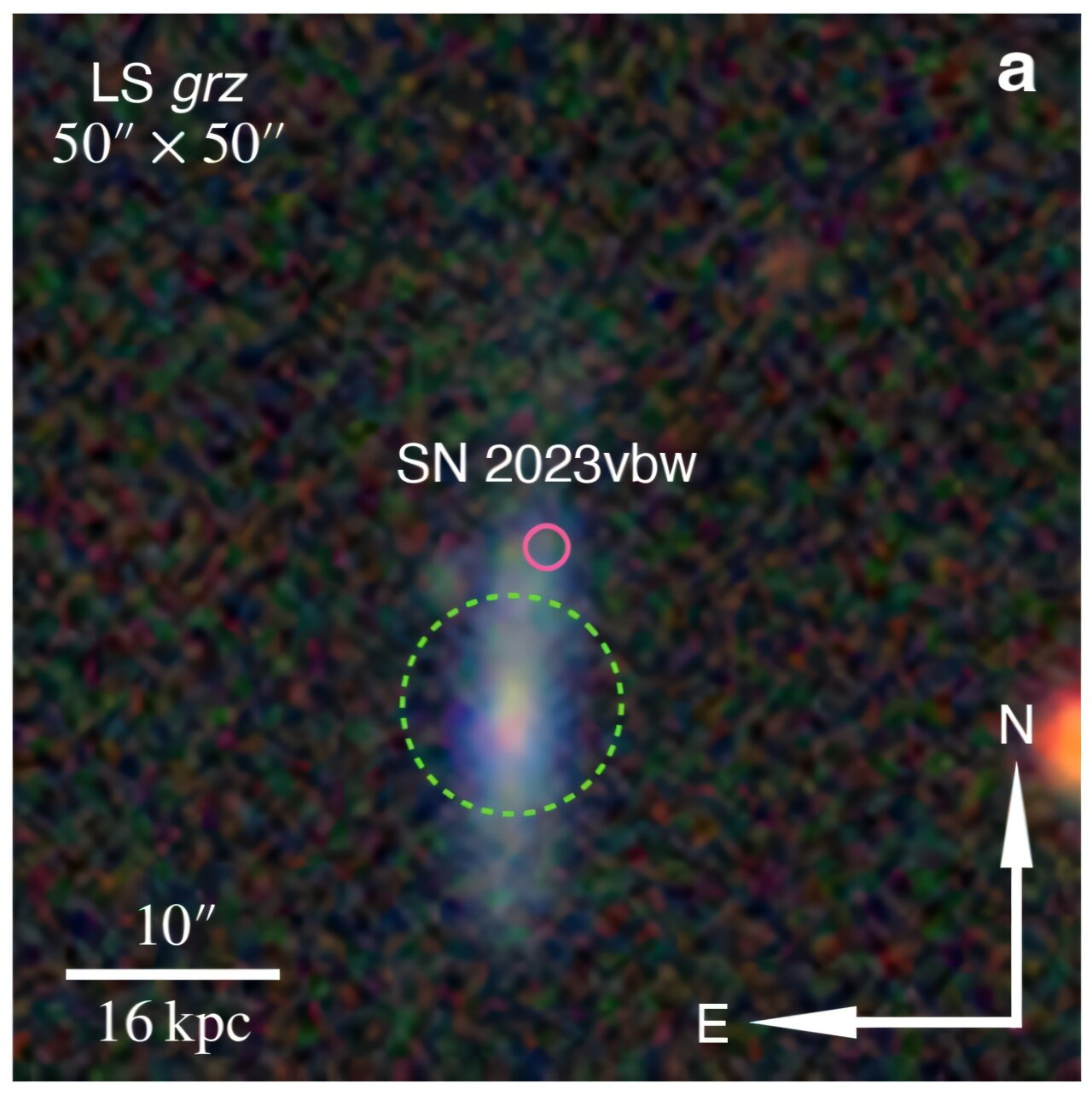 Image of a dwarf galaxy showing the location of supernova SN 2023vbw. Photo: arXiv (2026)
Which star exploded?
Modeling of the light curve suggests that the explosion was most likely caused by an exceptionally massive blue supergiant. The shape of the curve resembles that of another supernova, SN 1987A, which also originated from a compact blue supergiant. However, the new event is much brighter and longer-lasting, indicating a much more massive parent star, which astronomers refer to as the progenitor.
The mass of the ejected material is estimated to be between 170 and 350 solar masses, and the kinetic energy of the explosion is 60 to 130 times greater than the maximum possible for a typical iron-core supernova. The team also suggests that the blue supergiant could have formed as a result of the merger of two massive stars in a binary system. This would naturally explain the presence of a dense, disk-like shell around the object, with which the ejected material collided.
What is a pair-instability?
Supernovae involving pair instability occur in stars so massive that the extreme temperatures in their cores trigger the formation of electron-positron pairs. This process removes the radiation pressure that was preventing the object from gravitational collapse and triggers a thermonuclear explosion of such intensity that the star completely destroys itself, leaving behind neither a neutron star nor a black hole.
Theoretical models predict this fate for stars with initial masses ranging from 140 to 260 solar masses and low abundances of heavy elements. The object under study falls within this range.
Awaiting new data
The supernova remains bright enough for further observations across various wavelength ranges, as it is located relatively close by. These observations are expected to reveal details about the progenitor’s mass loss and nucleosynthesis during the explosion.
Once the new telescopes—including the Vera Rubin Observatory and the Nancy Grace Roman Space Telescope—become operational, scientists expect to detect dozens or even hundreds of similar events. This will help us gain a deeper understanding of the death and evolution of the most massive stars in the universe.
According to phys.org