
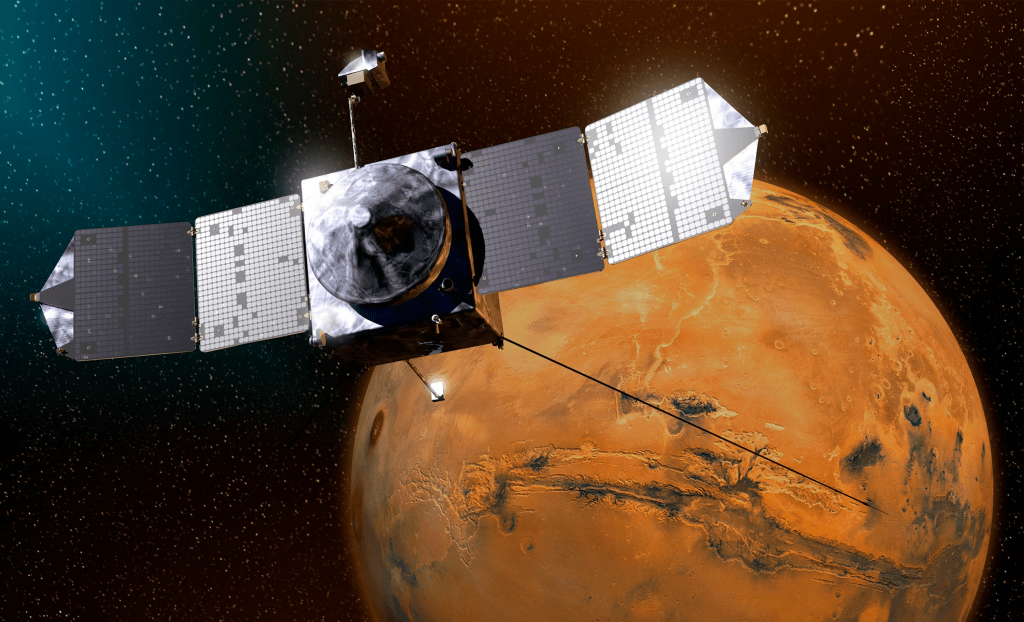
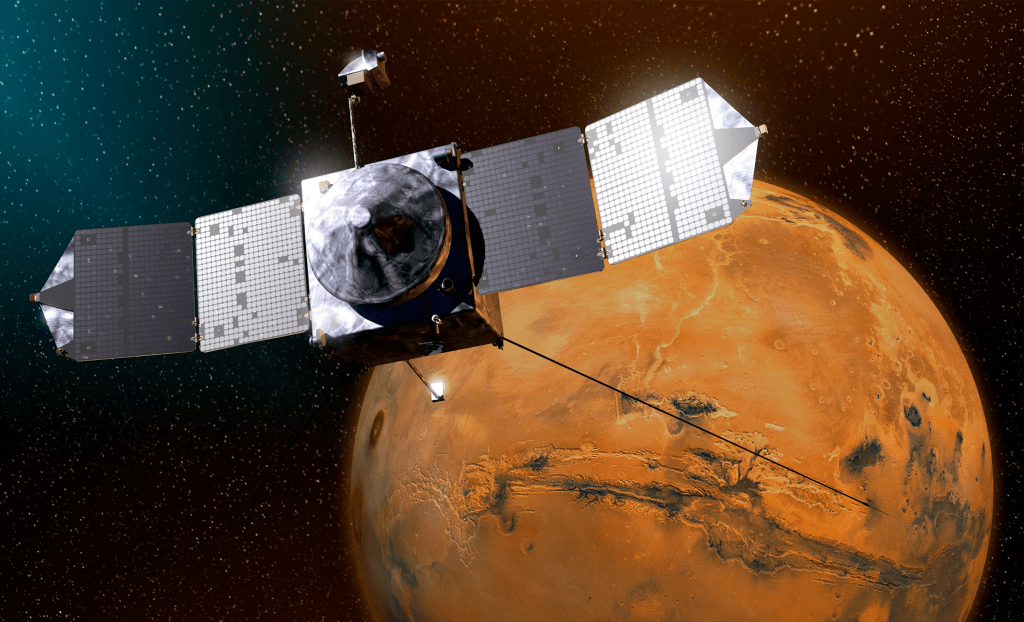
Artist’s concept of NASA’s MAVEN spacecraft at Mars. The spacecraft entered orbit around the planet in 2014 and has completed over eleven years of observing the Martian upper atmosphere, ionosphere, and interactions with the Sun and solar wind to explore the loss of the Red Planet’s atmosphere to space.
Credit: NASA/Goddard/University of Colorado/Laboratory for Atmospheric and Space Physics
After six months of silence, NASA has made it official: MAVEN’s mission at Mars is over. Originally planned for a one-year mission, MAVEN orbited the Red Planet for eleven years, and provided data until late last year.

The agency announced this week that it has ended the Mars Atmosphere and Volatile Evolution mission, closing the book on a spacecraft that outlived its original one-year science campaign by more than a decade. MAVEN launched on November 18, 2013, from Space Launch Complex 41 at Cape Canaveral Air Force Station (now Cape Canaveral Space Force Station), aboard a ULA Atlas V 401. It arrived at Mars in September 2014. It was NASA’s first mission built specifically to study how Mars lost its atmosphere and with it, the warmer, wetter climate the planet may once have had.
Everything Was Fine Until It Wasn’t
Trouble began on December 6, 2025. Controllers were tracking a healthy spacecraft right up until it slipped behind Mars on a routine orbital pass. When it emerged on the other side, the Deep Space Network heard nothing. Tracking data later suggested the orbiter had dropped into safe mode and was tumbling at an abnormally fast rate. This spin that ultimately drained MAVEN’s batteries and knocked out the power to its communications system.
NASA didn’t write the spacecraft off immediately. In February, the agency convened an anomaly review board to evaluate MAVEN’s likely condition and weigh recovery options. The board’s conclusion was blunt: the orbiter can no longer do science or relay data home. Engineers are still digging through telemetry to pin down what triggered the anomaly in the first place, with a final report expected later this year.
MAVEN Accomplishments
Accomplishment
Details
Atmospheric Science
Solved Mars’ missing atmosphere
Confirmed the solar wind and solar storms stripped away most of Mars’ early atmosphere, turning a potentially habitable world cold and arid.
Longest upper-atmosphere record
Built the most complete dataset of Mars’ upper atmosphere ever collected, spanning more than a full solar cycle.
Dust storms and water loss
Showed global dust storms — including the 2018 storm that ended Opportunity — accelerate the escape of water to space.
Measured escape rates
Quantified present-day atmospheric loss, letting scientists extrapolate billions of years of Martian climate history.
Discoveries
New types of auroras
Discovered proton, diffuse, and discrete auroras that can occur anywhere on Mars — not just near the poles as on Earth.
Metal ion layer
First direct detection of a persistent metal ion layer in the ionosphere of any planet besides Earth.
Comet Siding Spring flyby
Observed a comet’s near-miss of Mars in October 2014, just weeks after arriving in orbit.
Extreme solar storms
Captured the May 2024 solar storms at Mars and studied a rare interstellar comet during its extended mission.
Operations
11+ years on a 1-year mission
Outlived its primary mission design by a full decade.
Rover relay workhorse
Relayed data for Curiosity and Perseverance, including support for the Mars 2020 landing.
2019 aerobraking campaign
Reshaped its own orbit mid-mission to improve relay coverage for surface missions.
Paving the way for crews
Radiation data now informs protection and safety planning for future human Mars missions.
Source: NASA / University of Colorado Boulder LASP. MAVEN launched Nov. 18, 2013; last contact Dec. 6, 2025; mission declared ended June 3, 2026.
The mission’s scientific legacy is substantial. MAVEN’s measurements confirmed that the solar wind and solar storms are still actively stripping gas from the Martian atmosphere — the same erosion process that, over billions of years, transformed a potentially habitable world into the cold desert we see today. The orbiter discovered that protons can spark a previously unknown type of aurora on Mars, one that can light up anywhere on the planet rather than being confined to the poles as auroras are on Earth. It also documented how global dust storms accelerate the escape of water molecules into space.
MAVEN earned its keep beyond pure science, too. The orbiter pulled double duty as a communications relay, including supporting the Mars 2020 mission that delivered the Perseverance rover to the surface.
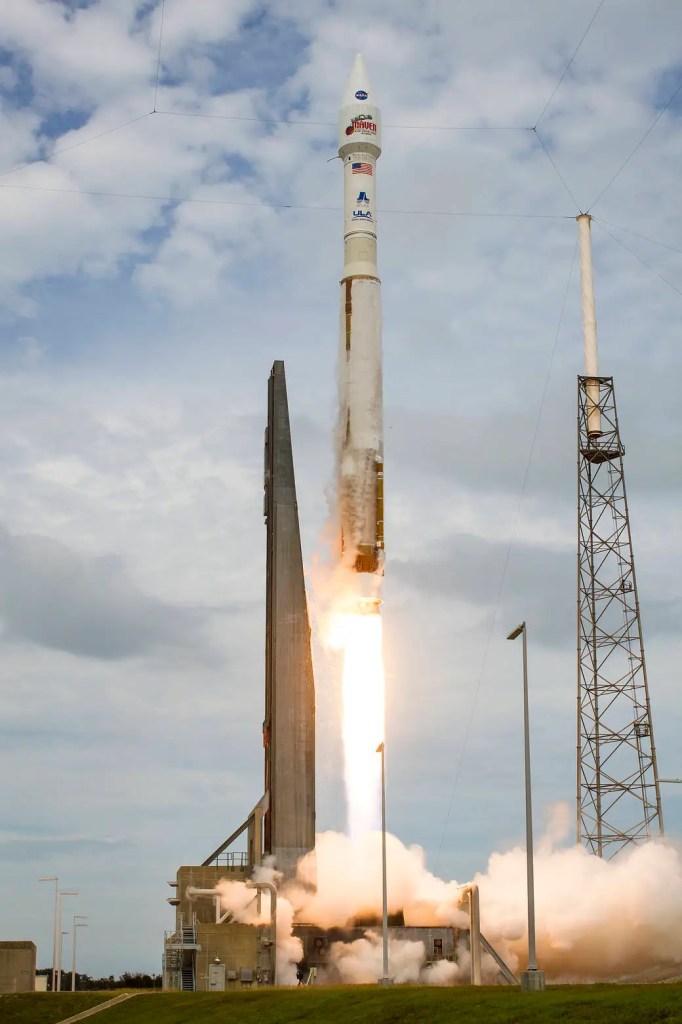
The United Launch Alliance Atlas V rocket with NASA’s Mars Atmosphere and Volatile Evolution (MAVEN) spacecraft launches from the Cape Canaveral Air Force Station Space Launch Complex 41, Monday, Nov. 18, 2013, Cape Canaveral, Florida.