
Ever since comet 3I/ATLAS was discovered, it’s been one of the major talking points throughout the space science community.
The interstellar comet formed in a distant region of our Galaxy about 10 billion years ago, and is briefly passing through our Solar System.
That’s why astronomers have been keen to learn as much about it as we can, while we can.
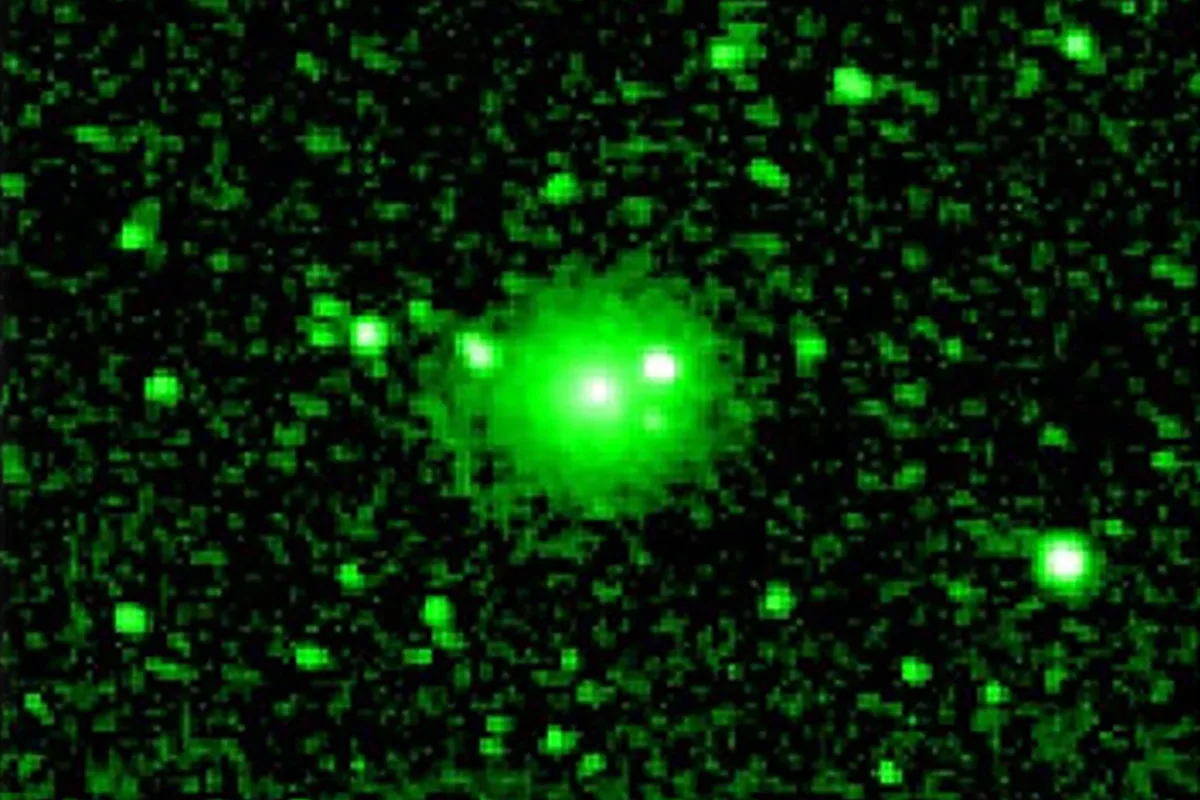 Observations of comet 3I/ATLAS by NASA’s SPHEREx mission in December 2025 reveal organic molecules within its coma. Credit: NASA/JPL-Caltech
And yet despite all we’ve learned about the comet since it was discovered on 1 July 2025, there have been some voices claiming there’s evidence that 3I/ATLAS could in fact be a piece of ‘alien’ technology, built by intelligent life forms beyond Earth.
The vast majority of scientists and astronomers dispute this, pointing to the vast amount of observations and evidence that show it’s behaving exactly like a comet.
However, to test the theory, scientists from the SETI Institute pointed one of the most powerful telescopes on Earth at 3I/ATLAS, solely for the purpose of looking for signs of alien tech.
Here’s what they found.
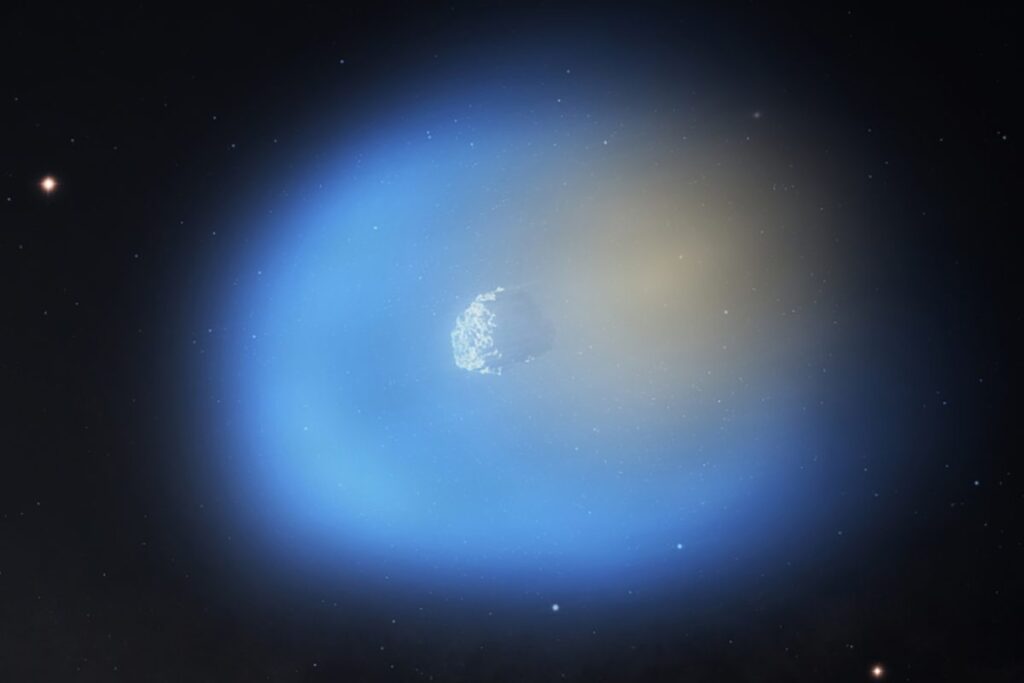
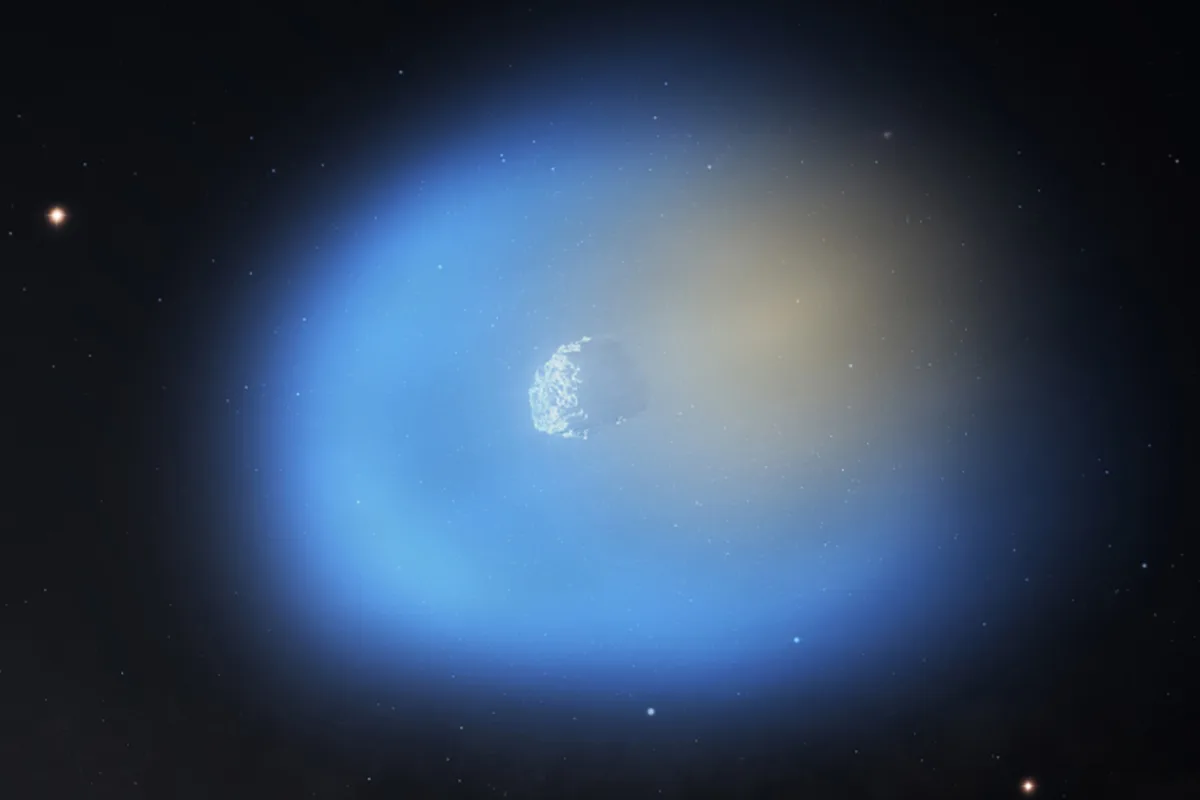 Artist’s impression of 3I/ATLAS passing near the Sun. Methanol gas is shown in blue; hydrogen cyanide is shown in orange. Credit: NSF/AUI/NSF NRAO/M.Weiss
SETI and the search for alien life
SETI – the search for extraterrestrial intelligence – is a science-based approach to looking for signs of intelligent civilisations across the Universe.
The SETI Institute was set up to pursue this goal, and recently used the Allen Telescope Array at Hat Creek Radio Observatory in Northern California, USA, to take a closer look at comet 3I/ATLAS.
They did this by scanning a range of radio frequencies, looking for signs of extraterrestrial technology at comet 3I/ATLAS.
In short, they found none, “as expected based on other astronomical observations showing that the object exhibits natural comet-like composition and behaviour.”
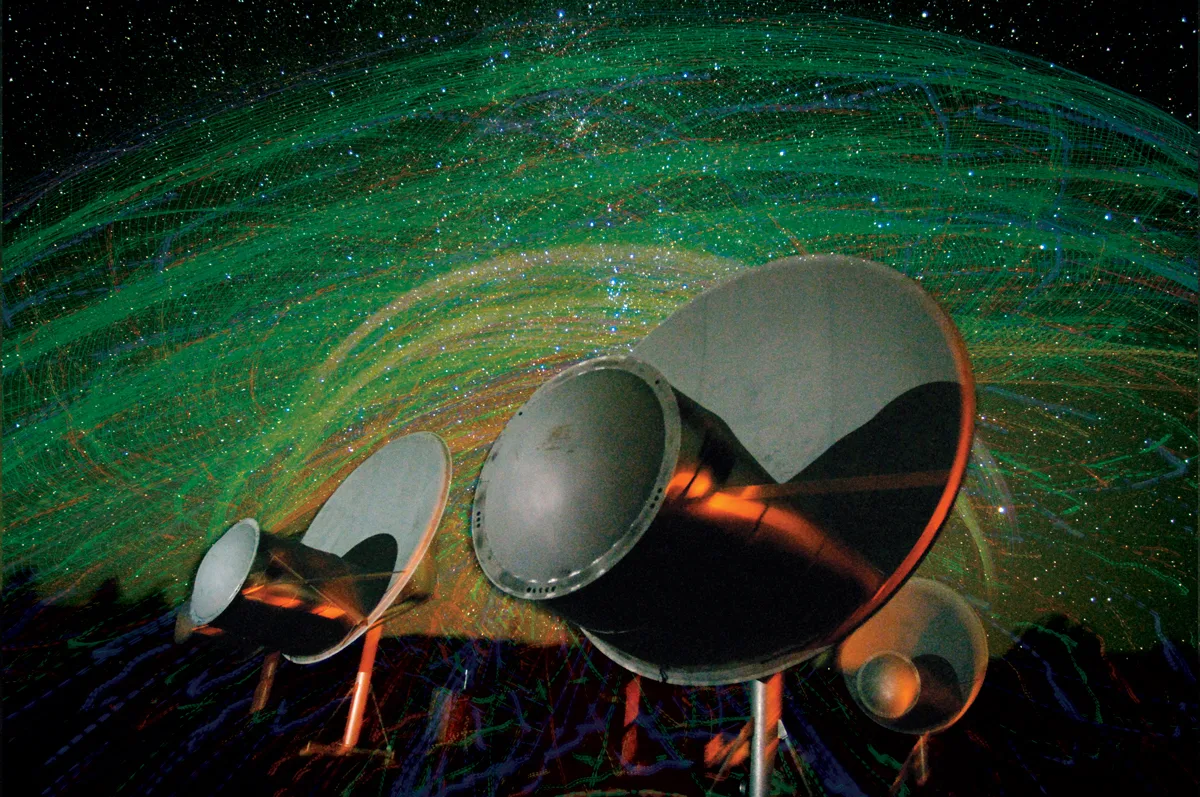 The Allen Telescope Array. Credit: Seth Shostak/SETI Institute
However, as part of this latest study, the science team point out that, while their observations confirm 3I/ATLAS is a natural object, interstellar objects like this are some of the best targets we have to investigate possible technosignatures – signs of technology built by alien civilisations.
“Eventually, our own Voyager spacecraft will be extraterrestrial artefacts in other stellar systems,” says Dr. Sofia Sheikh, lead author on the science paper.
“Given that, it is important that we understand the natural distribution of interstellar objects so that we will be able to identify any anomalies that could one day be signs of an artificial interstellar object.”
The team spent seven hours observing 3I/ATLAS, covering 1 to 9 gigahertz.
They say this range allowed them to search for narrowband radio signals that would indicate evidence of technology.
The team identified about 74 million narrowband signals. They say that, after removing human interference and filtering signals that the comet’s movement, 200 remained for review.
These could all be traced back to technology on Earth or our Earth-orbiting satellites.
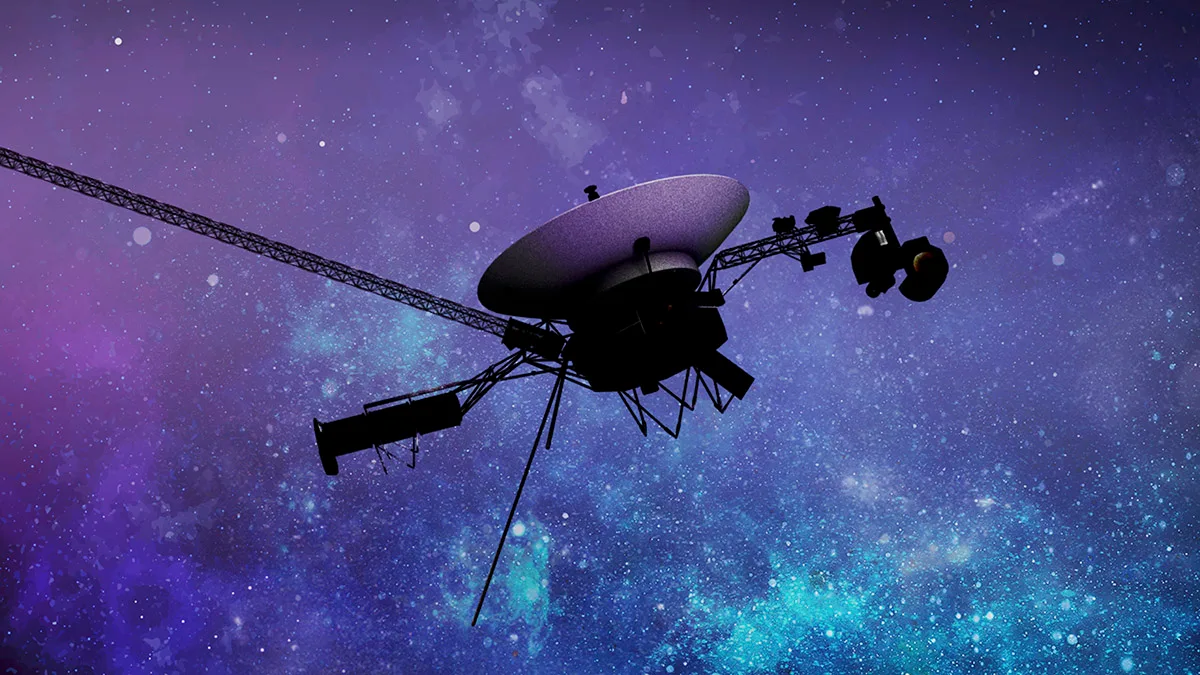 Artist’s impression of a Voyager probe, the farthest human-made object. Could the Voyagers one day be detected by an alien civilisation within their own system? Credit: NASA
What the science says
The team say that, while no technosignatures were found at 3I/ATLAS, their study sets new constraints strongly suggesting 3I/ATLAS is a natural object.
And they say their observations place upper limits on the power of any radio transmitter that would be on or near 3I/ATLAS.
That rules out signals stronger than 10–110 watts, which is the power of a household appliance, over the detected frequencies.
In future, scientists expect to find many more interstellar objects, especially as the next generation of telescopes and space missions come online.
“The results from 3I/ATLAS show how realistic it is to detect a signal with the technology we have today,” says Valeria Garcia Lopez, co-author of the study.
“That is why it is important to keep searching for technosignatures, even from objects we might not expect to have signals.”