
Your support helps us to tell the story
From reproductive rights to climate change to Big Tech, The Independent is on the ground when the story is developing. Whether it’s investigating the financials of Elon Musk’s pro-Trump PAC or producing our latest documentary, ‘The A Word’, which shines a light on the American women fighting for reproductive rights, we know how important it is to parse out the facts from the messaging.
At such a critical moment in US history, we need reporters on the ground. Your donation allows us to keep sending journalists to speak to both sides of the story.
The Independent is trusted by Americans across the entire political spectrum. And unlike many other quality news outlets, we choose not to lock Americans out of our reporting and analysis with paywalls. We believe quality journalism should be available to everyone, paid for by those who can afford it.
Your support makes all the difference.Read more
The search for extraterrestrial intelligence (SETI) has confirmed that an interstellar comet recently observed in our solar system is entirely natural, dismissing speculation of alien technology.
The SETI Institute announced Wednesday that extensive radio scans from its Northern California telescope found no signs of otherworldly technology from the object, 3I/Atlas.
Discovered last summer, it was quickly identified as a comet from another star, despite some unsubstantiated speculation of intelligent life. It marks only the third known object from a faraway star to enter our solar system, all deemed natural.
NASA spacecraft observed the celestial iceball as it swung past Mars last October, venturing within 19 million miles. Its closest approach to Earth in December was 167 million miles.
SETI conducted over seven hours of observations in July, searching a wide range of radio signals. Of nearly 74 million narrow-band signals, only just over 200 remained after filtering human interference.
All were “traced back to technology on the surface of the Earth or our own Earth-orbiting satellites,” according to SETI.
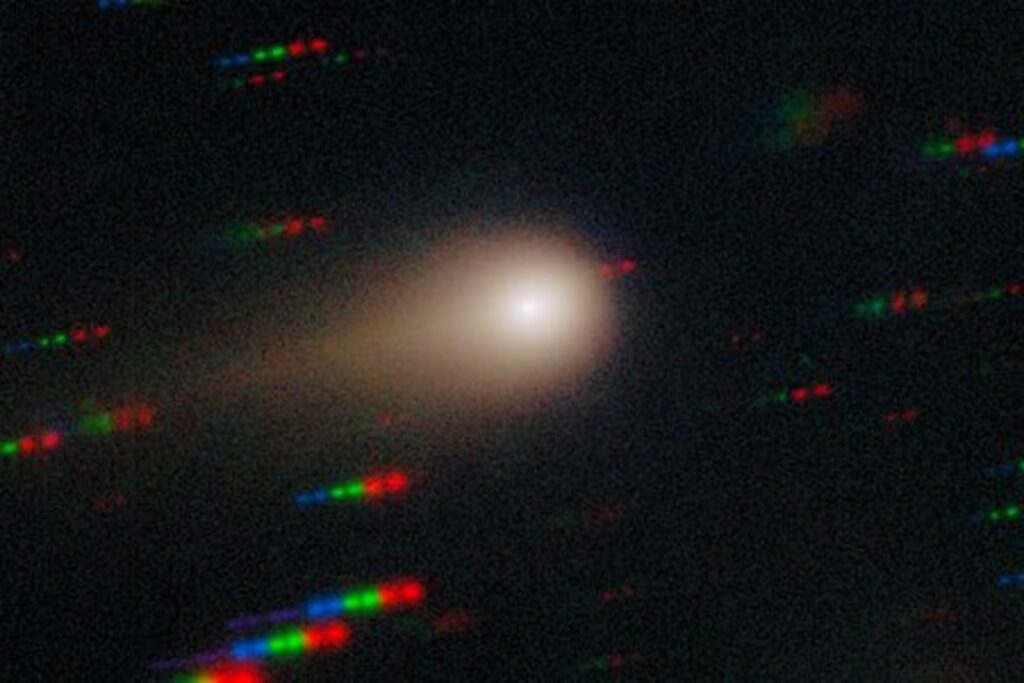
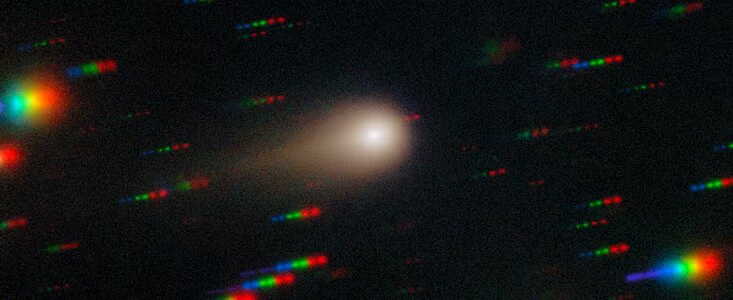 New image of interstellar Comet 3I/ATLAS (NOIRLab)
Published in the Astronomical Journal, these results “show how realistic it is to detect a signal with the technology we have today,” said co-author Valeria Garcia Lopez of Furman University.
“That is why it is important to keep searching for technosignatures, even from objects we might not expect to have signals.”
Lead author Sofia Sheikh and her team noted that NASA’s Voyager spacecraft will one day become interstellar objects.
They wrote, “Voyager and similar probes will eventually become interstellar objects in other stellar systems. We thus know that no extrapolation is needed for the idea of interstellar technological objects, as we have a proof by existence.”
Almost 1 billion miles away now, making its way back to interstellar space — never to return — the comet is estimated to be between 1,444 feet and 3.5 miles in size. Scientists suspect it could be as old as 11 billion years, twice as old as the sun.