
Dark energy has remained one of the most enigmatic elements of modern cosmology since it first entered scientific discourse three decades ago. However, new research shows that it is entirely possible to construct a mathematical model of the expanding universe without using this theoretical concept at all.
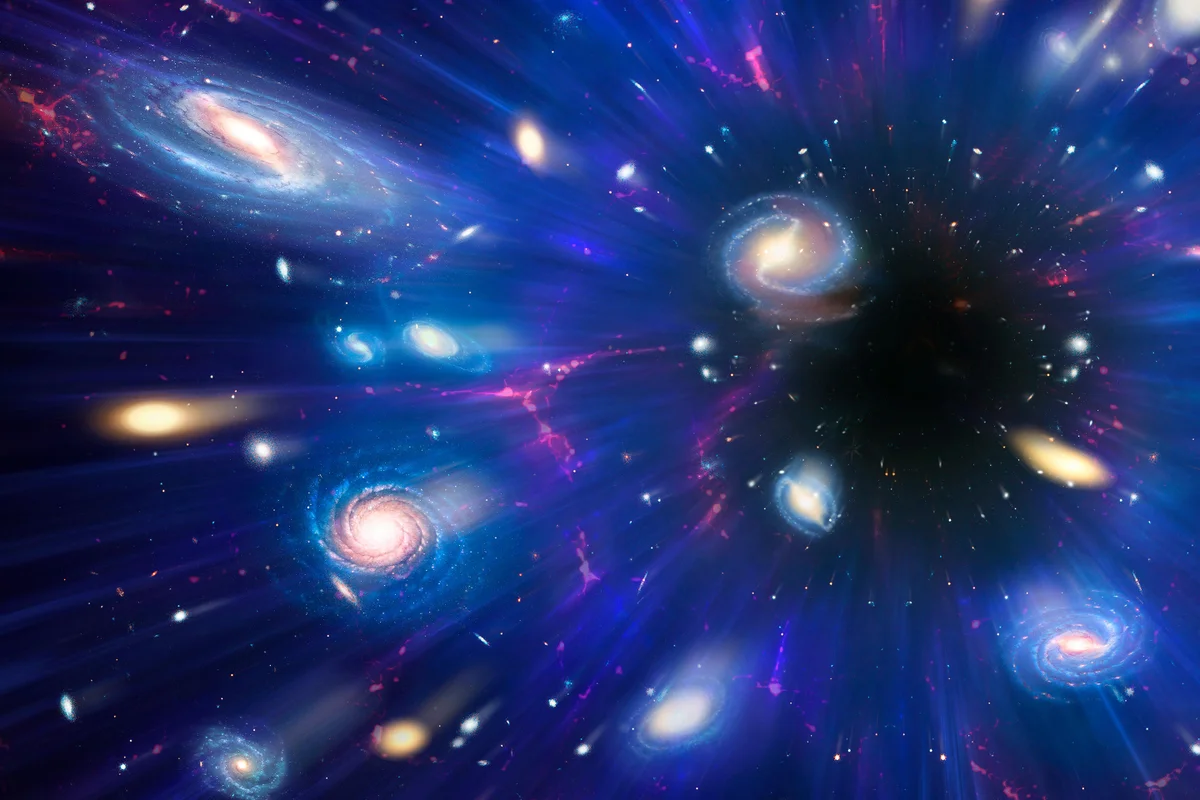 Illustration of the accelerated expansion of the universe caused by dark energy. Source: scientificamerican.com
The current standard cosmological model (Lambda-CDM) has a significant logical gap. It is well established that the universe is expanding, but instead of gradually slowing down under the influence of gravity, this process is, on the contrary, accelerating. To explain this acceleration, scientists have proposed the existence of a hypothetical invisible dark energy, which is supposedly its primary cosmic driving force.
However, in a new research paper published in Proceedings of the Royal Society A, a group of researchers argues that the problem of accelerated expansion may have a different cause. They contend that current models rely heavily on instabilities that do not accurately reflect observed reality.
“Unstable solutions in physics and science in general are considered non-physical,” explains Blake Temple, a co-author of the study and a mathematician at the University of California, Davis (UC Davis). “They simply cannot be observed in nature.”
As an alternative, Temple and his team propose a simpler mathematical model of expansion that fits entirely within the framework of Einstein’s original general theory of relativity.
Cosmological constant
When Albert Einstein first included the cosmological constant λ (Lambda) in his calculations, he assumed that the universe was static. He later abandoned this idea when astronomer Edwin Hubble provided irrefutable evidence of the actual expansion of the universe. However, in 1998, scientists made a discovery that was recognized with a Nobel Prize: they proved that the expansion of the universe is accelerating.
At that time, cosmologists revived lambda as a special metric to describe this acceleration, after which the standard cosmological model came to be known as the “lambda-cold dark matter model.” The force responsible for the expansion of galaxies was named dark energy and was firmly linked to the cosmological constant.
Why doesn’t the math add up?
A key component of the standard model is what are known as Friedmann spacetimes. According to a published paper, they describe a homogeneous three-dimensional universe whose expansion rate is clearly determined by Einstein’s field equations. However, for a team of mathematicians at UC Davis, these calculations “did not add up.”
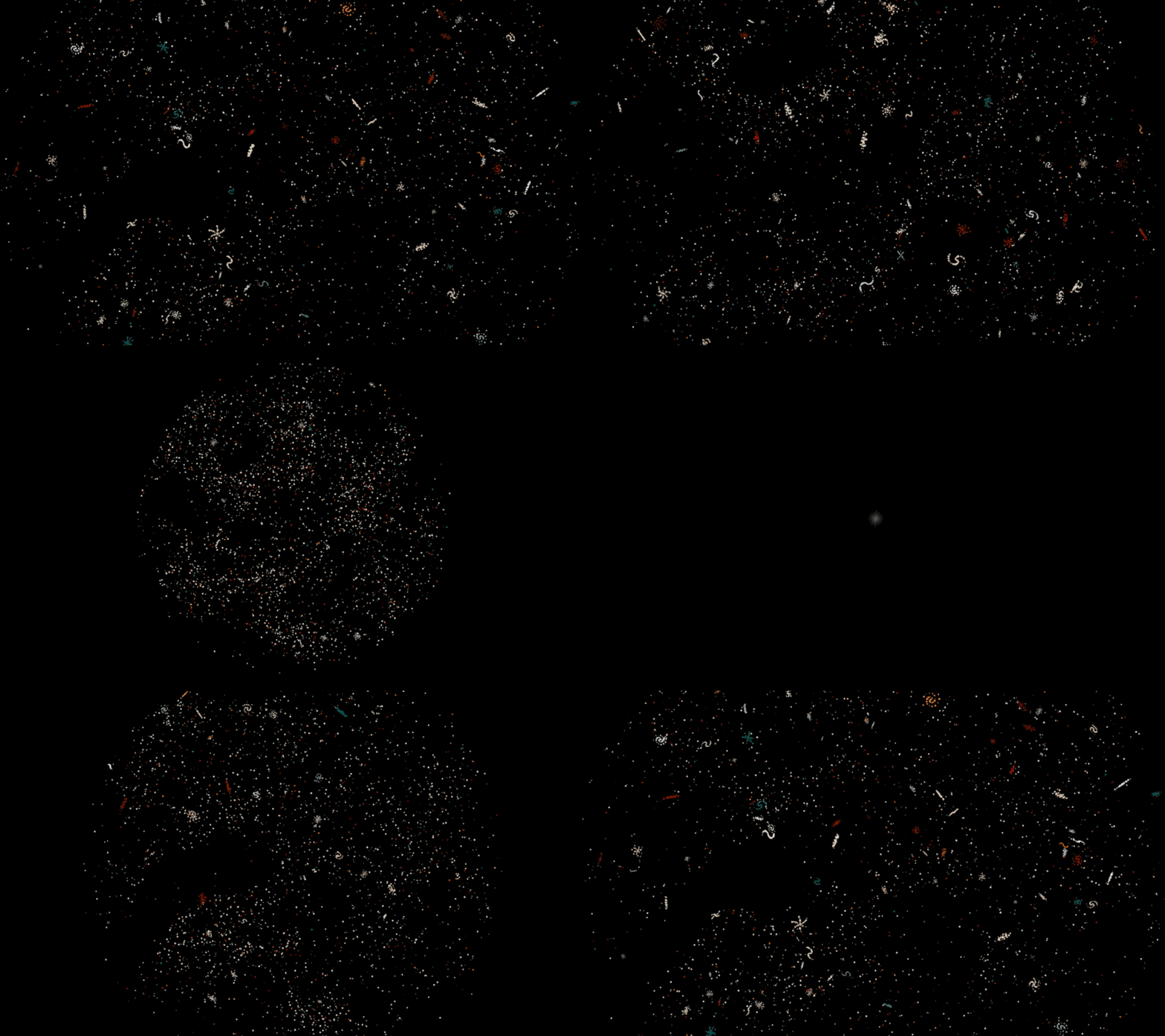
According to Blake Temple, the initial hypothesis was that the observed accelerated expansion of the universe could be due to a large-scale self-similar shock wave that arose early in its evolution. In that case, the effect attributed to dark energy could be a consequence of this wave. The scientists focused on testing whether Friedmann spacetimes, which describe a homogeneous and isotropic universe, could be unstable to such perturbations. To do this, they derived self-similar solutions to Einstein’s equations to estimate the stability of Friedmann spacetimes during the radiation epoch of the early Universe.
Role of instability
The model developed by the team demonstrated that Friedmann spacetimes were unstable on both small and large spatial scales near the Big Bang. This means that even before hypothetical dark energy appears in the equations, the instability creates such a rich set of possible accelerations that it is capable of fully simulating the effects of dark energy at all levels, even when accounting for variable acceleration.
The presented mathematical path to calculate cosmic acceleration directly from the original initial models developed by Einstein and Leonhard Euler argues the accelerated expansion of the Universe may be a consequence of the instability of the standard Friedmann solutions of Einstein’s equations, rather than a manifestation of dark energy. It is still too early to draw conclusions about whether the scientific cosmological community will accept this alternative hypothesis, but it is undoubtedly a bold and extremely interesting idea.
Previously, scientists said that the expansion of the universe was actually an illusion.
According to ucdavis.edu