
Twice in December, the James Webb Space Telescope gathered its first chemical fingerprint of an interstellar visitor. Comet 3I/ATLAS observations were made that focused on how different gases were arranged around the comet when it was moving away from the Sun.
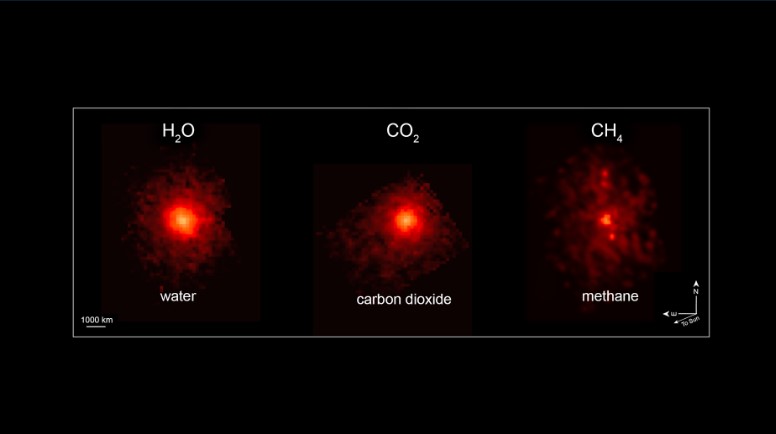
A mid-infrared view from Webb’s MIRI instrument shows the comet in three light wavelengths. Each map highlights where specific gases were located near the nucleus as the comet passed through the outer Solar System. Water vapor spreads widely beyond the nucleus because icy grains in the surrounding coma release it. In contrast, carbon dioxide and methane concentrate more near the nucleus itself.
The two observation sets captured the comet as it travelled away from the Sun. The first snapshot occurred on 15–16 December when the object was about 330 million kilometers from the Sun. The second snapshot followed on 27 December, at roughly 380 million kilometers from the Sun.
In a first for an interstellar visitor, Webb directly detected methane gas in Comet 3I/ATLAS. The methane appears to be buried below the surface, shielded from evaporation until heat from the comet’s solar passage warmed deeper layers of its icy outer shell. The measured methane-to-water ratio is unexpectedly high, a level not commonly seen in comets formed in our Solar System.
Webb’s data also show that Comet 3I/ATLAS remains unusually rich in carbon dioxide, releasing far more carbon dioxide relative to water than typical Solar System comets do. These results point to a formation environment and chemical history that differ markedly from most comets that formed near the Sun.
The team used MIRI’s Medium Resolution Spectrometer, an instrument that splits infrared light into its component wavelengths. This capability yields a spectrum at each point within a small patch of sky, enabling scientists to identify gases and map their distribution around the comet’s nucleus.
The findings appeared in The Astrophysical Journal Letters and in NASA’s 3I/ATLAS blog.
 Published by James Hydzik
James Hydzik is a technology geek focused on the junction of engineering, writing, and coffee. He joined Orbital Today in 2020 to help make sense of the Johnson government’s decision to buy OneWeb. Since then, he has taken on interviewing and editor-in-chief roles. James learned the ropes of editing and writing with Financial Times magazines, The World Bank, PwC, and Ericsson. Thus far, interviewing New Space movers has put the biggest smile on his workaday face. The son of an Electrical Engineer, James understands the value of putting complex topics into clear language for those with a lay person’s understanding of the subject. James is a European transplant from the United States, and as ex-KA3LLL, he now holds European amateur radio licenses. His next radio project is a portable 10GHz EME (moonbounce) station, as it combines his childhood interests in antennas and space.