
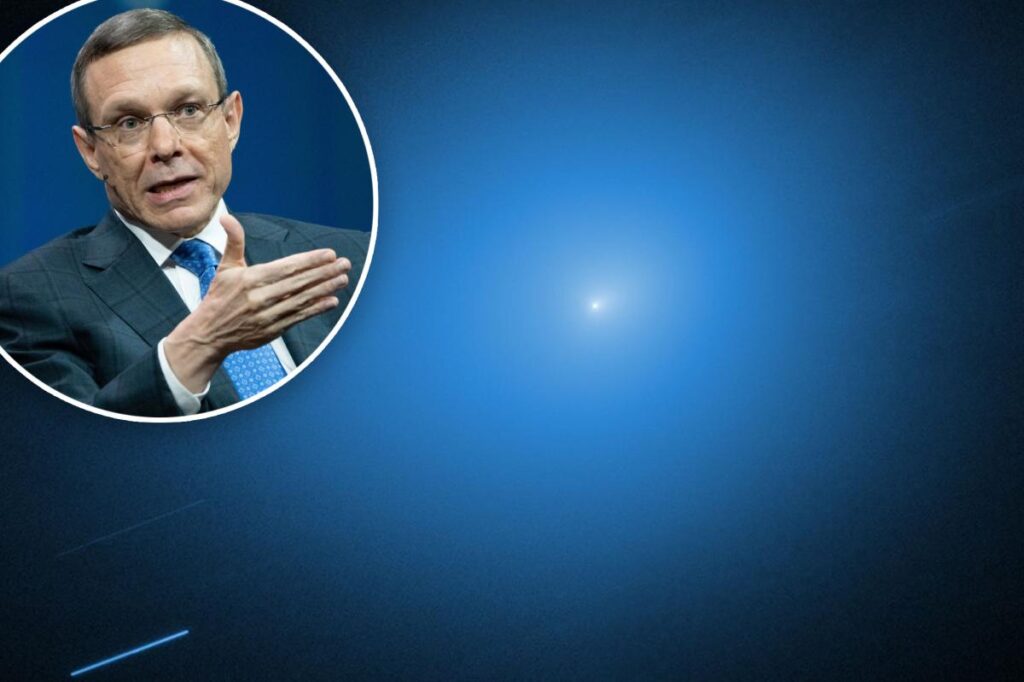
3I/ATLAS may be departing our solar system, but it’s still very much on Avi Loeb’s mind.
In a recent blog post, the Harvard astrophysicist noted that the comet emitted an unusual quantity of methane during its tour of our galaxy, suggesting that our interstellar visitor was potentially pollinating the cosmos with life.
“Was the methane outgassing of 3I/ATLAS near the sun produced by life?” posited the scientist, who has long floated theories regarding the iceball’s possible provenance.
3I/ATLAS as observed by NASA’s Hubble Space Telescope in November. NASA
Loeb said that this quantity of the volatile was picked up by the James Webb Space Telescope in December.
He found the phenomenon unusual as this only occurred during its fly-by of our solar system’s star, wherein sublimation caused ATLAS to let ‘er rip.
He deemed this significant as methane is an important “biosignature” that, according to a recent study in the Proceedings of the National Academy of Sciences (PNAS), could be the “first detectable indication of life beyond Earth.”
Loeb theorized that the material shed by ATLAS’ sunward jet (anti-tail) — another sign of its possible extraterrestrial origins, per Loeb — could have “carried extrasolar life on dust or ice fragments towards habitable planets within the solar system.”
He compared this form of cosmic conception, dubbed panspermia, to a dandelion scattering its seeds to the wind.
“Was the methane outgassing of 3I/ATLAS near the Sun produced by life?” posited Loeb. REUTERS
Loeb speculated that said lifeforms could’ve lain dormant in the intergalactic iceberg, much like microbes hibernating in the permafrost for thousands of years.
When the sun thawed their delivery vehicle, this unleashed them into the cosmos like an interstellar Johnny Appleseed.
Unlike with your garden variety seed pod, however, this might not have been a random dispersal, but rather a targeted insemination.
Observations by NASA’s SPHEREx in December show the infrared light emitted by the dust, water, organic molecules, and carbon dioxide contained within comet 3I/ATLAS’s coma. NASA/JPL-Caltech
“There is the possibility of directed panspermia, whereby an interstellar gardener seeded 3I/ATLAS on a fertilization mission targeting the habitable planets in the solar system,” Loeb theorized.
According to the scientists, this would explain other ATLAS anomalies discussed by Loeb, including the unique alignment between the solar system’s habitable planets and the comet’s trajectory.
“Whether the seeds of extrasolar life reach a fertile ground in the solar system remains to be seen,” said the scientist, who hopes we can discover more of these cosmic cryogenic pods in the future.
He said that should these interstellar icebergs be oriented similarly to ATLAS, then his hypothesis “will gain a higher likelihood.” Loeb said that our space agencies could confirm the existence of these space hitchhikers by intercepting and diagnosing their composition with a probe.
Doing so could perhaps shed light on the origins of life on our own planet, he claimed.
“In case it does [harbor life], the most pressing question is whether extrasolar life resembles life-as-we-know-it,” he said. “If so, perhaps life on Earth was seeded by an interstellar gardener.”