
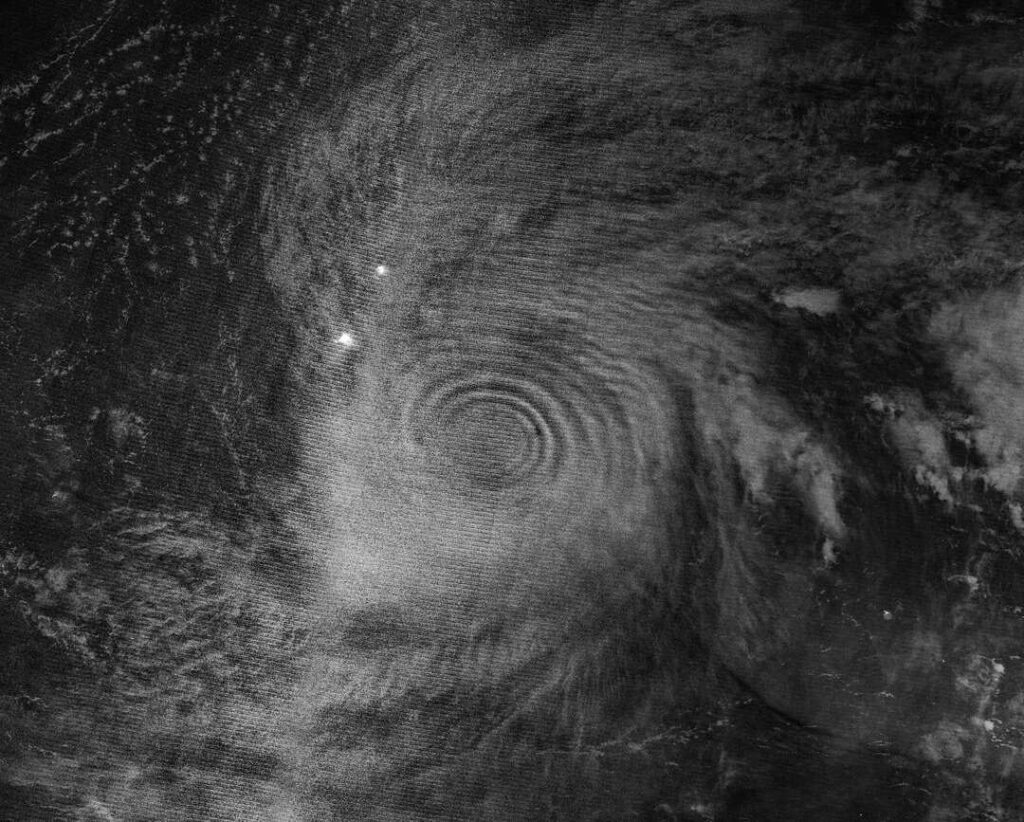
A super typhoon in the Pacific Ocean produced an unusual phenomenon that was captured from orbit. Atmospheric gravity waves from the storm rose through all layers of the atmosphere and reached the mesosphere, where they were detected by satellites. In the images, they appear as concentric rings radiating outward from the center of the cyclone.
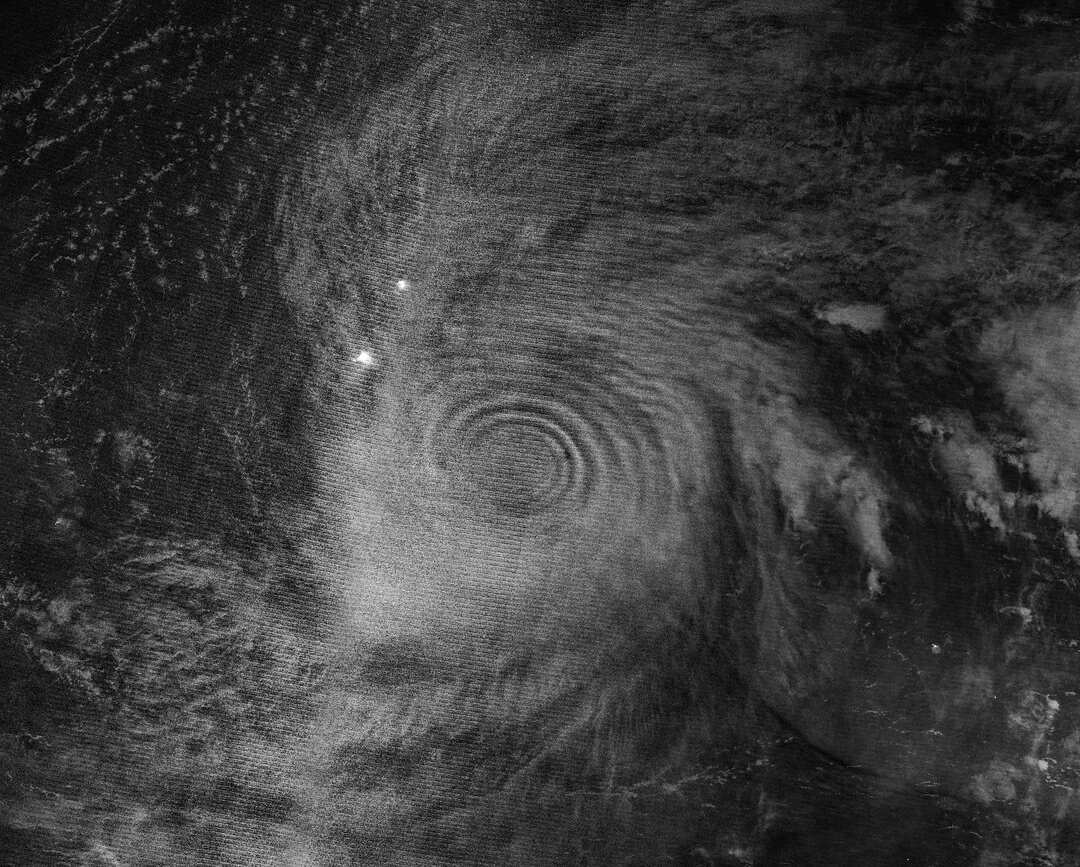 Atmospheric gravity waves from Super Typhoon Sinlaku are visible through mesospheric glow in a nighttime image captured by the VIIRS instrument aboard the NOAA-20 satellite on April 12, 2026. Photo: NASA Earth Observatory / Michala Garrison. Source: earthobservatory.nasa.gov
Abnormal storm intensity
In April 2026, Super Typhoon Sinlaku crossed the northern Pacific Ocean and brought heavy rains and flooding to the Mariana Islands. The Japan Meteorological Agency classified it as a “severe typhoon,” the highest category on the Japanese intensity scale, which roughly corresponds to a Category 5 on the Saffir–Simpson scale.
Meteorologists noted that tropical cyclones of this intensity are extremely rare in this region so early in the spring. The storm rapidly intensified over the open ocean, and it was at this point that its effects began to extend upward into the upper layers of the atmosphere.
Waves from “hot towers”
The mechanism behind the formation of atmospheric gravity waves is linked to the structure of the typhoon itself. The release of latent heat near the eye of the cyclone causes powerful convection and the formation of clouds, so-called “hot towers,” which rise above the troposphere and disturb the stratosphere and mesosphere above it. An analysis of previous tropical cyclones has shown that atmospheric gravity waves most often occur precisely when a storm intensifies. The case of Sinlaku confirmed this; within 24 hours of the images being captured, it had intensified from a Category 2 to a Category 5 storm.
Gravitational waves in the atmosphere are not related to gravitational waves in spacetime. These are oscillations of air masses that occur when the atmosphere returns to equilibrium after a disturbance and propagate like ripples on water.
What did the satellites see?
A nighttime image captured by the VIIRS instrument—which operates in the visible and infrared spectrums—aboard the NOAA-20 satellite has detected gravity waves caused by mesospheric atmospheric glow. It occurs when atoms and molecules, excited by sunlight during the day, return to a lower energy state at night and emit light. In the image, the waves form nearly perfect rings above the center of the typhoon, which surprised the researchers.
“We see waves spreading radially and upward in a cone-shaped pattern,” said Joan Alexander, a senior research scientist at NorthWest Research Associates, a private American research company. According to her, winds in the upper atmosphere usually dissipate such waves as they move upward, but relatively weak stratospheric winds at the storm’s latitude in the spring of 2026 appear to have allowed them to persist.
An additional instrument is the Atmospheric Infrared Sounder (AIRS) aboard NASA’s Aqua satellite, which detected thermal signatures of the same waves in the stratosphere on April 13–14, indicating the storm’s prolonged impact on the atmosphere.
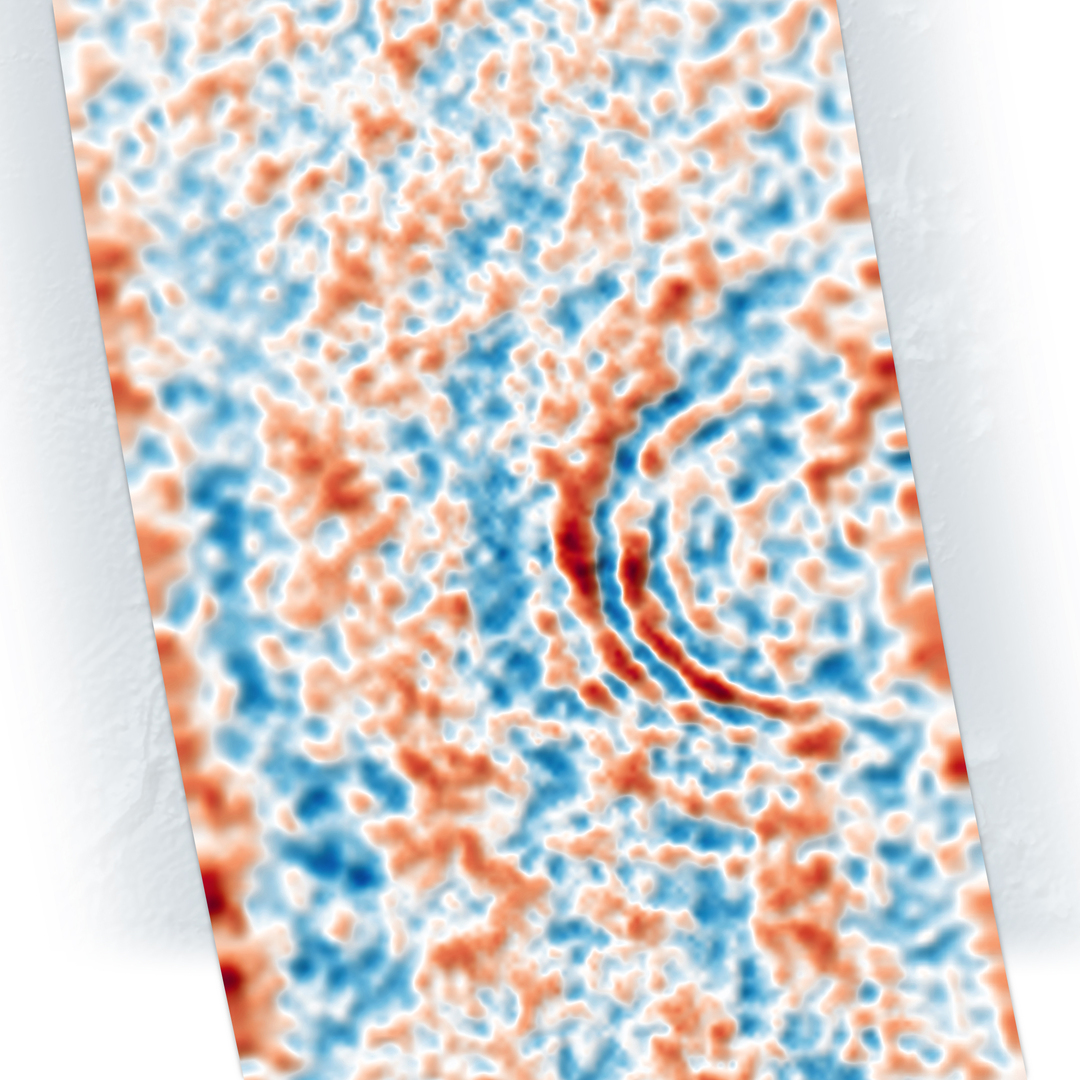 Thermal energy from atmospheric gravity waves generated by Super Typhoon Sinlaku, detected in the stratosphere by the Atmospheric Infrared Sounder (AIRS) aboard NASA’s Aqua satellite on April 13, 2026. Photo: NASA Earth Observatory / Michala Garrison. Source: earthobservatory.nasa.gov
Why study this?
The practical significance of these observations extends beyond mere scientific interest. “We would like to use atmospheric gravity waves to determine whether a storm is intensifying, since this is particularly difficult to track over the open ocean,” Alexander explained.
Laura Holt, a senior research associate at NorthWest Research, also emphasized that processes in the stratosphere influence long-term weather forecasts, particularly winter conditions in the Northern Hemisphere. Such waves from tropical cyclones can reach the ionosphere and cause large-scale fluctuations in plasma density, which disrupt satellite communications and radio communications.
According to science.nasa.gov