
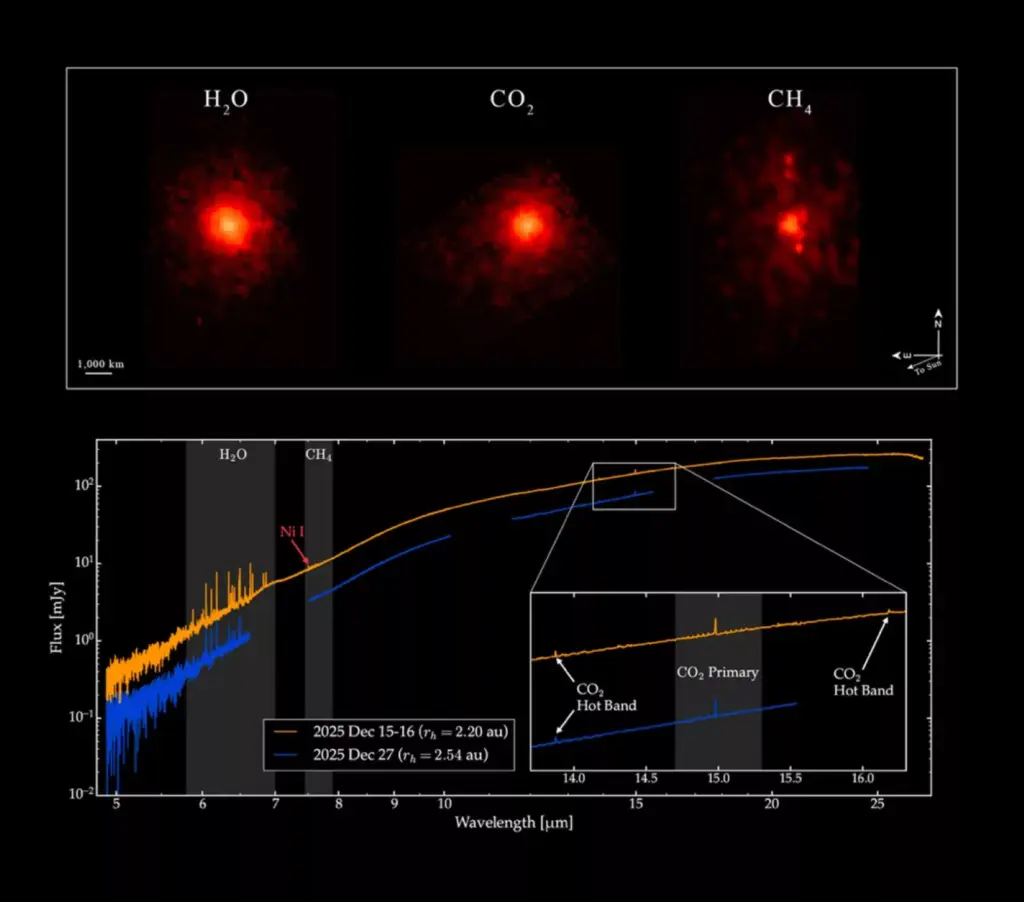
NASA’s James Webb Space Telescope has made a breakthrough in the field of interstellar objects by directly observing the first mid-infrared chemical signature of comet 3I/ATLAS. Writing in The Astrophysical Journal Letters, the researchers reveal a chemical composition that is not typical of comets in the solar system and provides clues to the comet’s exotic origins.
These data were collected using Webb’s Mid-Infrared Instrument (MIRI) in December 2023 while 3I/ATLAS was moving away from the Sun after its approach. Webb observed the comet right after its peak, on December 15 and 16, when it was 205 million miles (329 million kilometers) from the Sun. It was observed again on December 27 when it was 236 million miles (379 million kilometers) away.
Scientists have detected methane gas from an interstellar comet for the first time. Methane is a notoriously variable compound that readily sublimates from ice to gas. This is also consistent with the fact that its detection took longer at 3I/ATLAS, which implies that methane had originally been buried below the surface, where it was shielded from solar heating, until it penetrated deeper layers. Importantly, the proportion of methane to water vapor in this comet is much higher than that found in most comets from within the solar system.
Webb also confirmed that 3I/ATLAS produces an extremely high CO₂-to-H₂O ratio, with much more CO₂ emitted than H₂O, compared with typical solar system comets. The high concentrations of nitrogen, methane, and carbon dioxide indicate that the early environment is distinct from that when most local comets formed.
Growing Tail of Interstellar Comet 3I/ATLAS Captured
On its journey away from the Sun, Webb’s instruments noticed a steady drop in the gas released by the comet. Water vapor declined the most, which makes sense since it is more volatile than methane and carbon dioxide. As the solar radiation reaching the comet began to diminish, the surface cooled quickly, halting water sublimation.
MIRI–Medium Resolution Spectrometer disperses light into different wavelengths, allowing precise measurements across these ranges. An integral field unit of the spectrometer produced a spectrum at each point in a small portion of the sky to identify specific gases and map their location (in 3D space) around Comet 67P’s nucleus.
These findings demonstrate Webb’s unmatched ability to probe the chemistry of interstellar roamers. There have only been two comets like this so far, 2I/Borisov in 2019 and now 3I/ATLAS- but the observations of them both teach us about other planetary systems. 3I/ATLAS’ unique mix of chemicals gives astronomers an unusual snapshot of the range of planetary settings found across the cosmos.
Journal Reference:
Matthew Belyakov, Ian Wong, Bryce T. Bolin, M. Ryleigh Davis, Steven J. Bromley, Carey M. Lisse, and Michael E. Brown. The Volatile Inventory of 3I/ATLAS as Seen with JWST/MIRI. The Astrophysical Journal Letters. DOI 10.3847/2041-8213/ae5700