
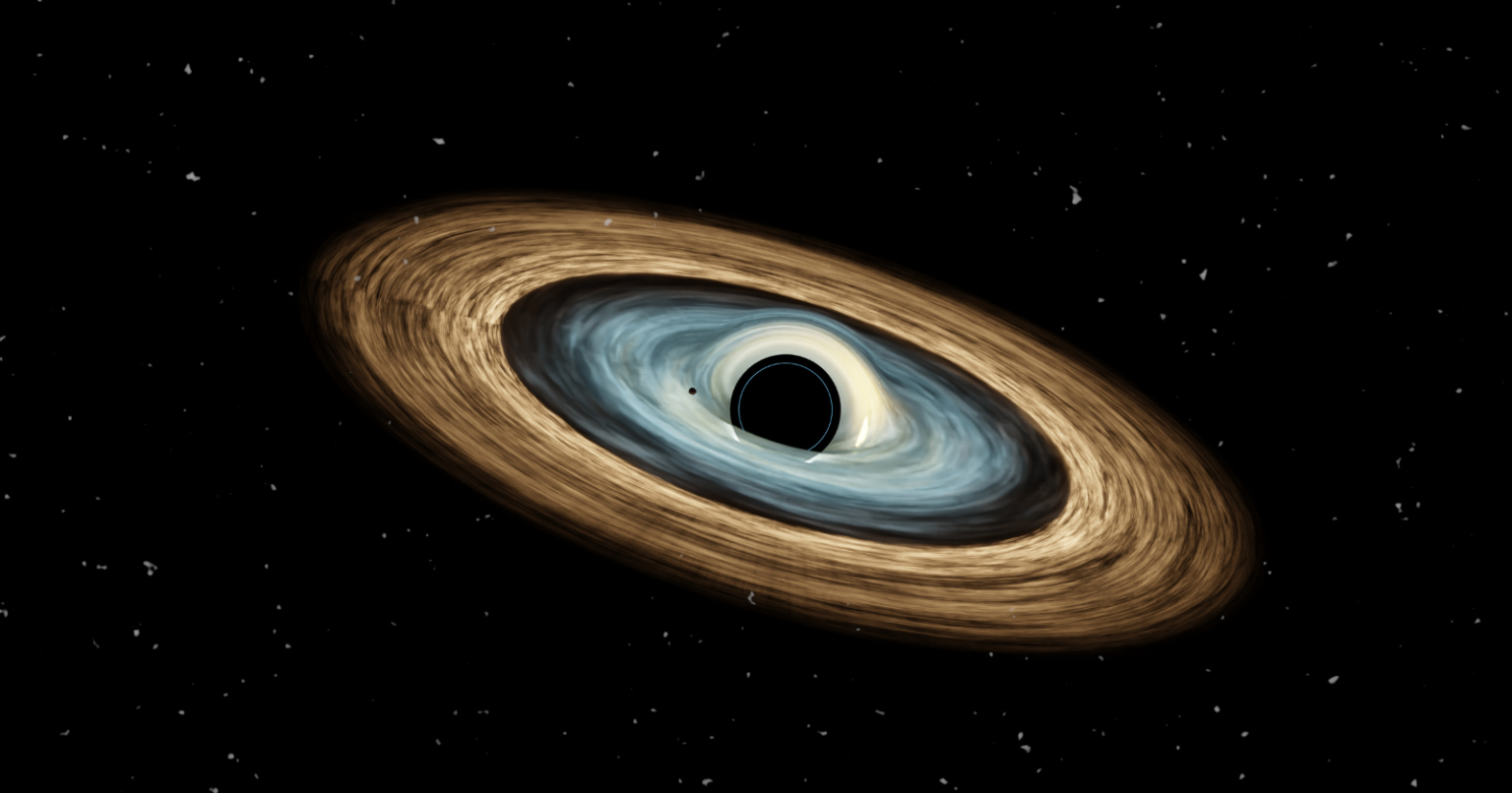
At the centre of most large galaxies sits a supermassive black hole. When that black hole is actively consuming surrounding material, it becomes what astronomers call an active galactic nucleus. The infalling matter forms a disc, heats to extreme temperatures, and generates powerful jets of plasma that fire outward from the poles at close to the speed of light. When those jets happen to point toward Earth, the object is classified as a blazar. The orientation changes nothing about the physics; it changes what we see. A jet aimed at us delivers an intensity of radiation and particle flux that a sideways-on jet does not, making blazars among the most energetically extreme objects observable in the sky.
This matters for the story of KM3-230213A, the neutrino detected at 01:16 UTC on 13 February 2023 by the KM3NeT/ARCA detector at the bottom of the Mediterranean, roughly 3,450 metres below the surface off the coast of Sicily. With an estimated energy of approximately 220 petaelectronvolts, it remains the most energetic neutrino ever recorded. The previous record, from IceCube’s dataset, sat near 10 PeV. The gap between them is roughly a factor of twenty.
Where that neutrino came from has not been settled. Several candidate explanations have been put forward over the past year. A paper published in the Physical Review Letters in February 2026 argues that a population of blazars is a plausible origin. It is, as the authors are explicit in stating, one hypothesis among several. It has not been confirmed.
How neutrinos are produced in blazars
Inside a blazar jet, protons can be accelerated to extreme energies. When those protons interact with photons or other matter inside the jet, they produce pions, and those pions decay into neutrinos and gamma rays. This mechanism, broadly called hadronic production, is why high-energy neutrino detections and high-energy gamma-ray observations are connected: both are products of the same underlying process.
The connection also gives the hypothesis a testable constraint. Any model that invokes blazars as neutrino sources must not produce more gamma rays than have actually been observed. The extragalactic gamma-ray background has been measured carefully by the Fermi Gamma-ray Space Telescope, and a proposed blazar population cannot exceed it. This is one of the key tests the Bendahman paper applies.
The team used an open-source modelling tool called AM3 to simulate a realistic population of blazars, fixing parameters like magnetic field strength and emission region size to values established by independent observations. They then varied two quantities: the baryonic loading, which governs how much energy is carried by protons relative to electrons and therefore how many neutrinos can be produced; and the proton spectral index, which determines how the energy is distributed across the proton population. For each combination of these parameters, they calculated the expected diffuse neutrino flux and the corresponding gamma-ray output, then compared both against actual measurements from KM3NeT, IceCube, and Fermi.
They found a region of parameter space in which the blazar population could account for an event like KM3-230213A while remaining consistent with the gamma-ray constraints. The result positions blazars as physically viable. It does not identify a specific blazar source for this specific neutrino. The paper’s conclusion is that the scenario is plausible and merits further investigation, not that the question has been answered.
Why the absence of a counterpart complicates things
When a high-energy neutrino is detected, the standard follow-up procedure involves searching for an electromagnetic counterpart, a signal in radio, optical, X-ray, or gamma-ray light arriving from the same direction at approximately the same time. For KM3-230213A, no such counterpart was found. The KM3NeT collaboration conducted searches for correlations with known Galactic and extragalactic sources in the direction of the event (right ascension 94.3 degrees, declination minus 7.8 degrees) and found nothing significant.
The absence of a counterpart rules out some source scenarios more cleanly than others. A single dramatic event, a flare or an outburst from one identified object, would generally be expected to produce an accompanying electromagnetic signal. Its absence is one reason Bendahman and colleagues lean toward a diffuse origin: if the neutrino comes not from one spectacular burst but from the accumulated flux of many blazars integrated across large distances, there may be no single object to point to and no associated flare to find.
As Bendahman noted in the EurekAlert press release accompanying the paper, this reasoning does not completely exclude a point-like source. It does shift the prior toward a diffuse population explanation, which the blazar model provides.
The IceCube constraint and what it requires of any model
The IceCube Neutrino Observatory at the South Pole has been collecting data since 2010 with a larger effective detection volume than KM3NeT had at the time of the event. It has not observed any neutrino comparable to KM3-230213A. This non-detection is not a minor footnote: it imposes a real constraint on the expected rate of ultra-high-energy neutrino events, and any proposed source population must be consistent with it.
The tension between KM3NeT’s detection and IceCube’s non-detection has been estimated at between two and three-and-a-half sigma across several analyses, depending on assumptions about the source spectrum and angular region. That sits below the conventional threshold for claiming a significant discrepancy, but it is not easily waved away either.
The Bendahman paper addresses this directly. Their blazar population model is tested not just against the KM3NeT observation but against IceCube’s upper limits as well. They find a scenario in which blazars can produce a neutrino flux consistent with the KM3NeT detection while the IceCube non-detection remains statistically unremarkable. The model threads the needle, but only within a specific parameter range, and only as a statistical argument about expected rates, not as a demonstrated resolution of the IceCube tension.
What other explanations are on the table
The blazar population hypothesis is the most recent well-developed proposal from the KM3NeT collaboration itself, but it is not the only one circulating in the literature.
The cosmogenic neutrino scenario holds that KM3-230213A was produced not at an astrophysical source but in transit, when an ultra-high-energy cosmic ray collided with a photon from the cosmic microwave background. This process, expected to produce neutrinos in a broadly similar energy range, was analysed in a companion paper to the original Nature publication. The cosmogenic explanation has the advantage of not requiring a specific identified source, but the IceCube non-detection makes any steady, isotropic source harder to sustain without careful tuning.
Separate analyses have examined whether specific known objects could be the source. One paper by researchers at Peking University and Chongqing University investigated associations with gamma-ray bursts, searching a broader region around the event’s coordinates while allowing for possible Lorentz invariance violations that might have delayed the neutrino relative to any accompanying photons. No definitive association was found. Another paper pointed to a specific blazar, PKS 0605-085, as a candidate point source, based on its proximity to the reconstructed direction. The angular uncertainty of KM3-230213A is currently around 1.5 degrees, which leaves a sizeable search cone, and PKS 0605-085 has not been confirmed as the source.
A paper published in Physical Review Letters in March 2026, by Vedran Brdar and Dibya S. Chattopadhyay, takes a different approach entirely, focusing not on where the neutrino came from but on what may have happened during its journey. Their proposal involves sterile neutrinos, hypothetical particles that do not interact via the standard weak force, oscillating into active neutrinos over the 147-kilometre path through rock and seawater to the KM3NeT detector. The same transformation would be far less likely over the 14-kilometre path to IceCube from the same sky position, potentially explaining the discrepancy between detectors. This scenario requires physics beyond the Standard Model and remains speculative. The authors describe it as a possible resolution, not a demonstrated one.
A more exotic proposal, published separately in Physical Review Letters, suggested the event could have originated in the final evaporation of a primordial black hole. This hypothesis is not supported by independent evidence and has not been taken up broadly in the follow-up literature.
What the next data should resolve
KM3NeT/ARCA was operating with 21 detection strings at the time of the event, roughly ten per cent of its planned final configuration. Construction has continued since. The completed detector will cover approximately one cubic kilometre of deep water with around 200,000 photomultiplier tubes, and an online alert system is being developed to notify other observatories within seconds of a candidate high-energy event, enabling the kind of rapid multi-wavelength follow-up that might finally attach a counterpart to the next event of this kind.
The collaboration also expects a positioning system upgrade to tighten the directional reconstruction from the current 1.5 degrees to a target of around 0.1 degrees. That improvement, applied retroactively to KM3-230213A as well as to future detections, would substantially shrink the search cone and either implicate or exclude several of the current candidate sources.