
Here’s what you’ll learn when you read this story:
175 years ago, the Foucault pendulum experiment caused a nationwide public science fad.
Most people understood what scientists knew about the universe, but Foucault made it feel real.
Science was racing ahead during this era, leading to massive public interest in both real-life science and science fiction.
Many, many years ago, French physicist Leon Foucault devised a way to prove to everyone in the world that their Earth rotates every day. His experiment was so simple that you could install one in your own home (if you had enough room), and his finding kicked off a fervor for public science known as “pendulum mania” that researchers have studied ever since.
It’s hard to understand now, but Earth’s rotation had been the subject of intense controversy for centuries prior. Earth was long understood to be the center of the visible universe, with the heavens (or firmament) spinning around it. Ancient people figured out that the constellations changed positions, but believed that motion occurred because everything in the sky was affixed to a flat cosmic shell that spun around us.
By the time Foucault came around, people had known for many centuries that Earth is round (it’s close to a sphere, but is more accurately described as an ellipsoid). But as scientists learned more about outer space, regular people still continued to ask a reasonable question: If the Earth is rotating, why don’t we feel it? The speeds required to spin such a massive object would be high enough to turn you into paste. It was easier to believe that the less-well-understood cosmos spun around us at breakneck speeds instead.
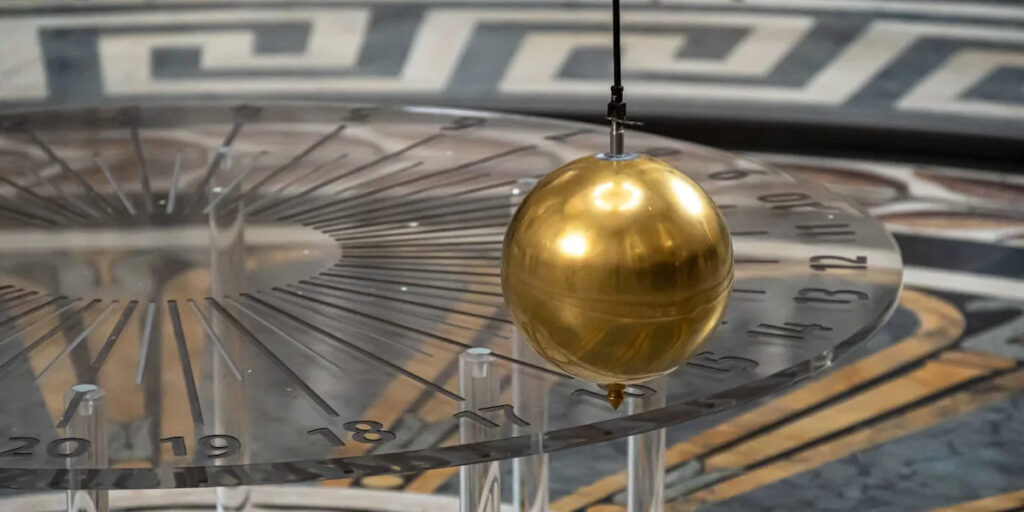
So, to prove that our planet was, in fact, the party twirling through space like an ice dancer, Foucault set up an experiment. The Foucault pendulum, as it has since been named, is “a 28-kg (62-pound) iron ball suspended from inside the dome of the Panthéon by a steel wire 67 [meters] (220 feet) long and set in motion by drawing the ball to one side and carefully releasing it to start it swinging in a plane,” according to Encyclopedia Britannica. The long wire ensures “that its perpendicular plane of swing is not confined to a particular direction and, in fact, rotates in relation to the Earth’s surface.” In other words, the pendulum’s neutral attachment and long, slow swing time mean that it holds a specific path back and forth while the world spins beneath it.
This wasn’t even Foucault’s first time debunking the public’s doubts. He also devised a way to use mirrors to measure the speed of light, and his evidence helped to reinforce that the previous understanding of light had been incorrect. But no one was ready for how much the people of the world loved the Foucault pendulum. In 1999, historian Michael F. Conlin studied contemporary sources in the science history journal Isis:
From April to September 1851 [… a] range of Americans—from distinguished scientists to unschooled enthusiasts—repeated the experiment in private and before crowds in at least twenty-five cities and towns. Private repetitions were conducted in houses, laboratories, and places of business; public demonstrations were conducted in government buildings, hotels, universities, and churches. Many Americans wrote to newspapers demanding demonstrations, requesting explanations, and advancing theories of the Foucault pendulum.
The scale of this response may be surprising—Conlin wrote that the sheer volume of published stories and news make this fad a great case study for historians like him—but the public was not new to obsessing about science. Rather, Foucault’s experiment became a proto-meme, in a sense, because it was easy to reproduce and dramatic in its visible results. Though the specific angles of the pendulum’s swing vary by latitude (and if you’re directly on the equator, a Foucault pendulum will not work as intended at all), people all over the world experienced some version of the same phenomenon, and were able to talk about it on a massive scale.
About 10 years ago, the Smithsonian National Museum of American History opened the exhibit “Fantastic Worlds: Science and Fiction, 1780-1910.” There, the Foucault pendulum lives on as a common museum exhibit around the world. It has also taken on a life in fiction, like in Umberto Eco’s 1988 novel Foucault’s Pendulum, where the titular experiment hides a secret society and conspiracy.
Eco introduced the iconic experiment in dialogue. “The [E]arth turns, but the point doesn’t. That’s how it is. Just take my word for it,” a man says. “I guess it’s the Pendulum’s business,” his companion answers.
But really, the Pendulum was everyone’s business, and its effect on the public has rippled for 175 years in science, pop culture, children’s museums, and much more.
You Might Also Like