
A meteor that created a sonic boom heard by thousands in Massachusetts and parts of the Northeast Saturday afternoon was larger than previously believed, NASA said Monday. Scientists now say the meteor was 5 feet in diameter, up from the initial thought of 3 feet, NASA said. “The meteor was about 5 feet (1.6 meters) in diameter with a mass of 5.6 metric tons and entered Earth’s atmosphere at roughly 42,000 mph,” NASA said Monday. Scientists believe it traveled through the atmosphere from northwest to southeast for 26 miles before breaking up at an altitude of 31 miles and producing a meteorite fall into Cape Cod Bay. “Based on the latest data, the energy released at breakup is estimated to be equivalent to about 230 tons of TNT, which accounts for the sonic boom,” NASA said. The water depth in the part of the bay where the meteorite landed is only about 100 feet deep, so if the meteorite did land there, it is magnetic, and someone with a powerful magnet could find it.”Conceivably, somebody with a really long rope and a really long magnet could fish up some pieces of this, because it’s likely magnetic,” StormTeam 5 meteorologist A.J. Burnett said. Meteor vs. MeteoriteAccording to NASA, the loud boom that sent many flocking to social media to report what they heard may have been a meteorite, with the difference between a meteor and a meteorite depending on where it lands.When a meteor enters Earth’s atmosphere at a “high speed and burns up,” it is referred to as a meteor. However, if the meteor survives the atmosphere and hits the ground, it is a meteorite, NASA said.”A meteor breaks up in the atmosphere, we never see it on Earth,” Burnett said. “A meteorite makes it to Earth’s surface.” Robert Lunsford, the Fireball Program Monitor with the society, told the Associated Press that the group received dozens of reports from Delaware to Montreal with people either hearing the double boom, feeling the ground shake, or seeing the fireball, which he said looks like a shooting star in the daytime sky. “It was definitely bigger than a normal fireball, about a yard wide,” he said.If the skies were clear on Saturday, Lunsford said the meteorite may have been visible to those on the ground. “It may have been a bright streak, just above the horizon, most likely from your vantage point,” Lunsford said. “It would have only lasted a second or two. If you weren’t looking in the right direction, you would have missed it.” Multiple witnesses shared video of the sudden boom. All were recorded at approximately 2:11 p.m.At approximately that same time, NOAA’s GOES-19 weather satellite Geostationary Lightning Mapper shows a burst over the Massachusetts coast.Watch: Cameras across Massachusetts record loud boom at 2:11 p.m. on May 30
A meteor that created a sonic boom heard by thousands in Massachusetts and parts of the Northeast Saturday afternoon was larger than previously believed, NASA said Monday.
Scientists now say the meteor was 5 feet in diameter, up from the initial thought of 3 feet, NASA said.
“The meteor was about 5 feet (1.6 meters) in diameter with a mass of 5.6 metric tons and entered Earth’s atmosphere at roughly 42,000 mph,” NASA said Monday.
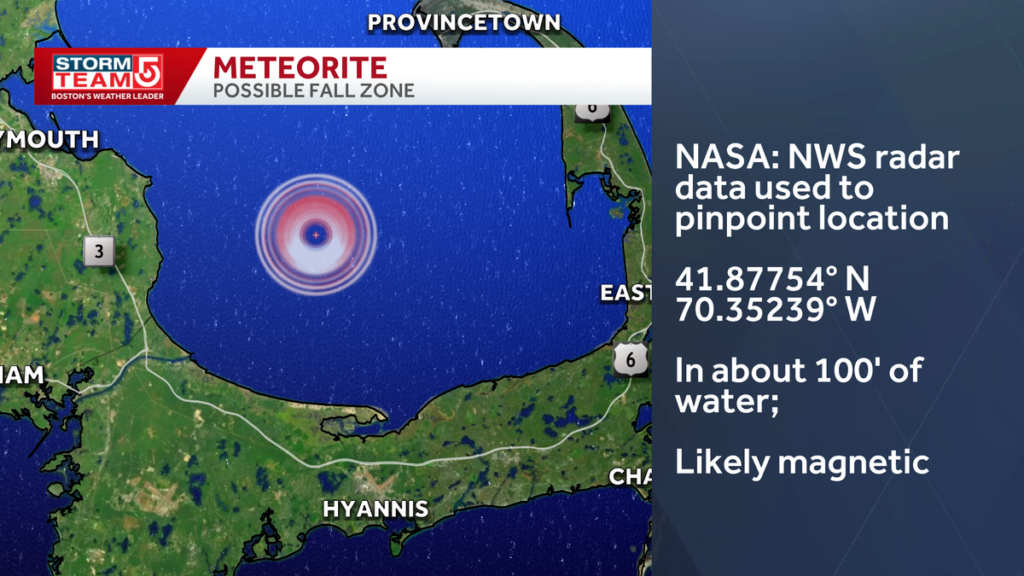
Scientists believe it traveled through the atmosphere from northwest to southeast for 26 miles before breaking up at an altitude of 31 miles and producing a meteorite fall into Cape Cod Bay.
“Based on the latest data, the energy released at breakup is estimated to be equivalent to about 230 tons of TNT, which accounts for the sonic boom,” NASA said.
The water depth in the part of the bay where the meteorite landed is only about 100 feet deep, so if the meteorite did land there, it is magnetic, and someone with a powerful magnet could find it.
“Conceivably, somebody with a really long rope and a really long magnet could fish up some pieces of this, because it’s likely magnetic,” StormTeam 5 meteorologist A.J. Burnett said.
Meteor vs. Meteorite
According to NASA, the loud boom that sent many flocking to social media to report what they heard may have been a meteorite, with the difference between a meteor and a meteorite depending on where it lands.
When a meteor enters Earth’s atmosphere at a “high speed and burns up,” it is referred to as a meteor. However, if the meteor survives the atmosphere and hits the ground, it is a meteorite, NASA said.
“A meteor breaks up in the atmosphere, we never see it on Earth,” Burnett said. “A meteorite makes it to Earth’s surface.”
Robert Lunsford, the Fireball Program Monitor with the society, told the Associated Press that the group received dozens of reports from Delaware to Montreal with people either hearing the double boom, feeling the ground shake, or seeing the fireball, which he said looks like a shooting star in the daytime sky.
“It was definitely bigger than a normal fireball, about a yard wide,” he said.
If the skies were clear on Saturday, Lunsford said the meteorite may have been visible to those on the ground.
“It may have been a bright streak, just above the horizon, most likely from your vantage point,” Lunsford said. “It would have only lasted a second or two. If you weren’t looking in the right direction, you would have missed it.”
Multiple witnesses shared video of the sudden boom. All were recorded at approximately 2:11 p.m.
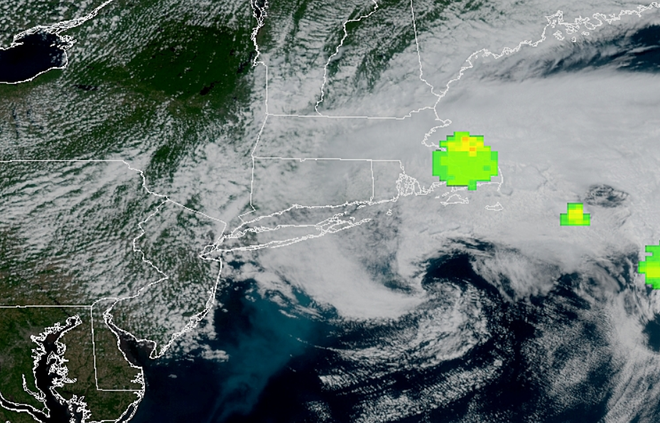
At approximately that same time, NOAA’s GOES-19 weather satellite Geostationary Lightning Mapper shows a burst over the Massachusetts coast.
Watch: Cameras across Massachusetts record loud boom at 2:11 p.m. on May 30